Australia’s $100 million astronaut question: what would it actually buy?by Richard de Grijs
|
| The real issue is not simply whether Australia should pay to put an astronaut in orbit, but what national capability it would gain in return. |
Put that way, the quick answer can sound obvious. A hundred million dollars is a substantial sum for a country with a relatively small civil space budget. An astronaut flight can easily be dismissed as an expensive national prestige project.
But that may be the wrong question. The real issue is not simply whether Australia should pay to put an astronaut in orbit, but what national capability it would gain in return.
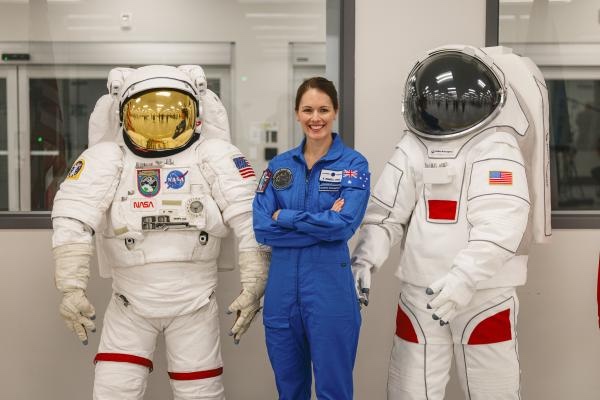
Katherine Bennell-Pegg is not a prospective space tourist. She is an Australian Space Agency employee who completed 13 months of basic astronaut training with the European Space Agency (ESA), graduating in April 2024 as the first qualified astronaut under the Australian flag. She is now eligible for assignment to future human-spaceflight missions, including to the ISS.
Australia now has an opportunity to turn that qualification into an operational mission through enhanced cooperation with ESA. With the ISS approaching retirement around 2030 and mission opportunities allocated well in advance, the window for turning that qualification into a flight is narrowing.
The campaign gained new momentum in September when mining giant BHP committed A$1 million, conditional on federal government support. The funding would support education and outreach connecting the mission with schools and regional communities. Australian aerospace and defense company Nova Systems has separately committed A$1 million in cash and in-kind support, including access to aircraft for microgravity experiment development and expertise in systems engineering, mission integration and launch safety.
Those commitments materially change the proposition. They also sharpen the question Canberra needs to answer: if Australia spends close to A$100 million, what exactly would it be buying?
Not simply a ticket
The first complication is that the widely reported A$100 million figure is an estimate rather than an agreed mission price.
| An astronaut mission could therefore be treated as an isolated national event, or used to deepen a relationship that already exists. |
The parameters of any mission and the associated Australian contribution would have to be negotiated. Supporters of the mission argue that describing the expenditure as purchasing an astronaut “ticket” misunderstands the premise of the model under consideration.
The proposal is instead for a government-to-government cooperation framework with ESA that could embed Australian research, industry, and technology in the mission itself. Contributions could potentially include funding, technology, infrastructure, or services rather than simply a payment for a seat.
That distinction is crucial. Australia could spend a large sum to put its flag on an astronaut’s spacesuit and receive little enduring benefit once the mission is over. Or it could use the flight as the centerpiece of a broader agreement that gives Australian researchers, companies, and engineers access to international programs and experience they would struggle to acquire independently. The flight itself is therefore the least interesting part of the proposition.
Australia has already made the first investment
Australia has already spent public money creating the capability. The Australian Space Agency paid about A$466,000 (US$330,000) for Bennell-Pegg’s basic ESA astronaut training. That investment provided training in areas such as spacecraft systems, robotics, life support, spacewalking, survival, and medical operations.
At the time, the obvious question was what Australia would do with a trained astronaut if there were no flight opportunity. Two years later, that question has become more concrete.
Australia has also been steadily deepening its relationship with ESA. In 2025, the Australian government announced negotiations towards a formal Cooperative Agreement. ESA operates major deep-space communications infrastructure at New Norcia in Western Australia, while Australian researchers and companies already interact with European space programs.
An astronaut mission could therefore be treated as an isolated national event, or used to deepen a relationship that already exists. That second model is the one that deserves serious consideration.
What could Australia put on the mission?
Scientific return provides one obvious test. Australia already has researchers developing experiments for microgravity. Medical and biotechnology research is particularly promising because cells, tissues, and biological systems can behave differently in microgravity, providing experimental conditions that cannot be reproduced straightforwardly on Earth.
Australian researchers are already working on microgravity projects involving cancer biology, regenerative medicine and plant science. Professor Fiona Wood, known internationally for her work on burns treatment, has been associated with proposals to use a Bennell-Pegg mission to investigate regenerative processes with potential relevance to wound healing.
There are similarly natural connections with areas in which Australian industry has unusual strengths.
Mining has made Australia a world leader in operating complex machinery remotely across enormous distances. Autonomous haulage, field robotics, communications, remote asset management and the operation of equipment in hazardous environments all have obvious analogues in lunar and planetary exploration. The involvement of BHP is therefore more interesting than a corporate sponsorship announcement might suggest.
Australia does not build human-rated launch vehicles or operate its own space station. But it does possess expertise in technologies that increasingly matter as space exploration moves from short visits towards sustained operations: robotics, autonomous systems, resource processing, remote medicine, and communications.
A well-designed agreement could use an astronaut mission to connect some of those capabilities with ESA’s much larger exploration ecosystem.
The economic case requires more care
This is also where advocates need to be cautious. Space investment is often accompanied by impressive claims about economic multipliers. Some are well supported; others become detached from the conditions that produced them.
| But inspiration alone cannot justify an investment on this scale. The mission needs to leave infrastructure, skills, relationships and opportunities behind. |
A major UK government evaluation published in 2025 estimated that every £1 of British public investment in ESA generated £7.49 in direct benefits to the UK economy. Firms receiving ESA contracts experienced gains in turnover, employment, productivity, and private research and development. The study also identified spillovers into non-space sectors.
That is meaningful evidence that participation in a large international space organization can generate economic benefits well beyond the initial government contribution. However, it is not evidence that Australia could spend A$100 million on one astronaut mission and automatically receive A$749 million back.
Britain is a longstanding ESA member with a well-established industrial base, extensive participation in ESA programs and mechanisms through which national contributions are returned as contracts and research activity. Australia does not yet have an equivalent relationship.
That difference should sit at the center of Canberra’s decision. The relevant question is not whether ESA participation has produced economic returns elsewhere. It clearly has. Instead, the question is how much of the Australian contribution would create comparable pathways for Australian organizations. And that depends on the agreement.
Set the conditions before signing the check
A decision to support the mission should therefore come with measurable expectations:
- How much Australian research would fly?
- How many Australian companies would receive contracts or become integrated into ESA supply chains?
- Would Australian engineers participate in mission preparation and operations?
- Would the partnership create continuing access to ESA facilities, programs or research opportunities after Bennell-Pegg returned to Earth?
- Would technologies developed for the mission remain useful to Australian companies in mining, medicine, robotics, advanced manufacturing or other sectors?
- And, perhaps most importantly, would this be the beginning of a sustained Australian relationship with human spaceflight and exploration, or an exceptional mission that may not be repeated?
These questions are more useful than trying to attach an abstract monetary value to national inspiration.
Inspiration certainly matters. Bennell-Pegg has already become a highly visible advocate for science and technology education, and BHP’s contribution is explicitly intended to extend the mission into schools and regional communities. Australia faces persistent concerns about its STEM workforce, and astronauts command a public visibility few other scientists or engineers can match.
But inspiration alone cannot justify an investment on this scale. The mission needs to leave infrastructure, skills, relationships and opportunities behind.
A small country does not need a small ambition
Australia faces a familiar space policy dilemma. It has neither the resources nor a compelling reason to reproduce the complete human spaceflight infrastructure of the US, China, or Europe. Building an independent astronaut corps, launch system, and orbital facilities would make little economic sense.
| The opportunity is real, but so is the cost. The government’s task should therefore be to negotiate backwards from the legacy it wants. |
International partnership offers another route. Countries can acquire capabilities by contributing areas in which they have genuine expertise to much larger cooperative programs. Canada’s robotics contribution to human spaceflight is the classic example. Japan converted major infrastructure and technology contributions into a sustained role aboard the ISS.
Australia is not Canada or Japan. Its space sector is smaller and its relationship with ESA much less mature. But that makes the structure of this prospective mission more important, not less.
The strongest argument for flying Bennell-Pegg is not that Australia deserves an astronaut in orbit. Nor is A$100 million a trivial price for national prestige. It is not.
It is that Australia already possesses a qualified astronaut, nurtures an increasingly important relationship with ESA, and has domestic scientific and industrial capabilities that could benefit from deeper participation in international human spaceflight.
The opportunity is real, but so is the cost. The government’s task should therefore be to negotiate backwards from the legacy it wants.
If Australia can turn the mission into research access, industrial contracts, operational experience, international partnerships and capabilities that remain useful long after Bennell-Pegg lands, then the expenditure should be judged as investment in a wider space ecosystem.
If it cannot, A$100 million starts looking much more like the price of a very expensive seat.
Note: we are now moderating comments. There will be a delay in posting comments and no guarantee that all submitted comments will be posted.