Nuke the site from orbit: American orbiting nuclear weapons during the Cold Warby Dwayne A. Day and Hans Dolfing
|
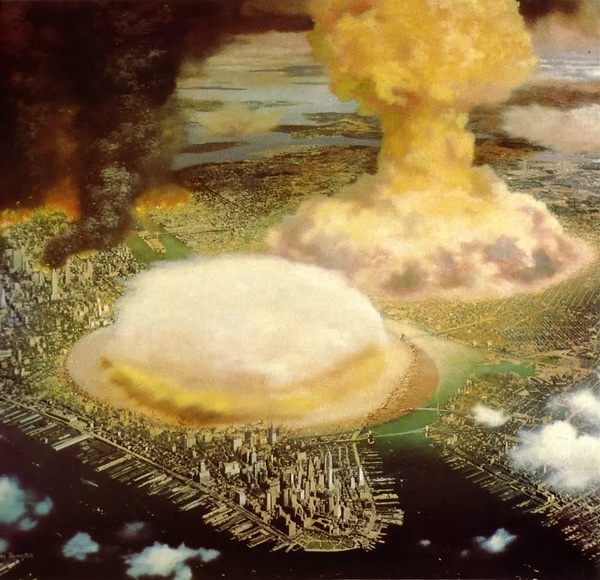
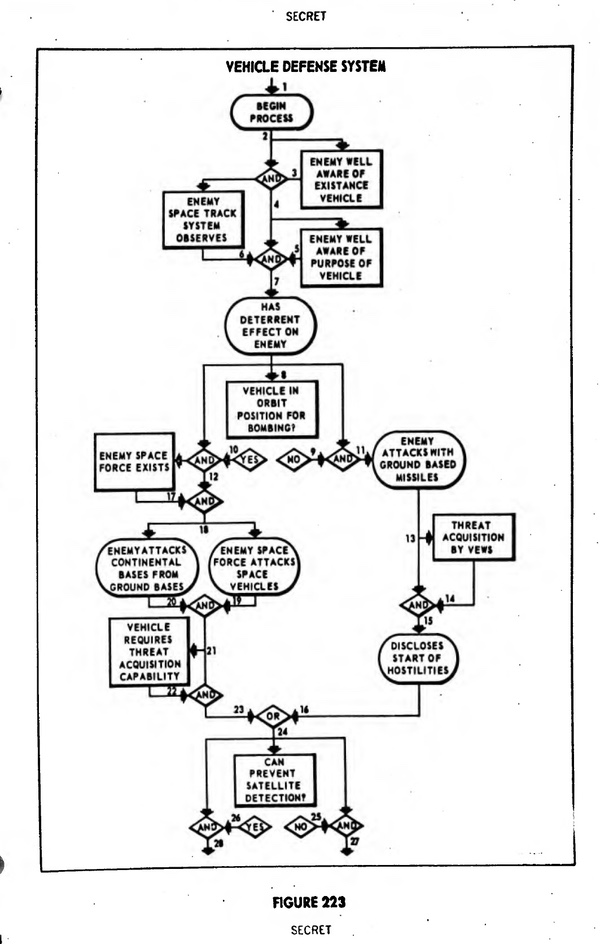 Putting offensive weapons in orbit made them vulnerable to enemy attack or interference. The study analyzed how to make them less vulnerable. (credit: Douglas Aircraft Company) |
Nukes in space
Starting in the late 1950s, the United States Air Force began studying the prospect of putting nuclear weapons in space to extend America’s strategic forces to the ultimate high ground. Several of these efforts have been known for decades, such as studies for placing nuclear missiles on the Moon aimed at Earth, and insane proposals for the Orion space weapons system, propelled into and through space by detonating nuclear bombs behind it while carrying additional nuclear explosives for attacking targets on Earth. But until now, the most likely concept for space weapons—placing nuclear bombs in low Earth orbit for attacking the Soviet Union—has remained secret.
There were senior government advisors who did not believe that weapons in space made much sense, although the subject was being evaluated during the late 1950s and early 1960s. James Killian, who was the president of MIT and a senior advisor to President Eisenhower, later wrote in his 1977 autobiography that he believed that space weapons were “clumsy and ineffective ways of doing a job.” In June 1958, the National Security Council considered a range of national security satellites, including bombardment satellites and a manned lunar base. The RAND Corporation studied bombardment satellites from 1958 to 1960, but due to continued classification, much of these deliberations remain secret.
| The report’s authors made clear that establishing and maintaining an orbital weapons system would be a major task with many difficulties. |
In May 1961, Douglas Aircraft produced a multi-volume report titled “Earth Satellite Weapon System Study.” Also given the more generic designation Special Report (SR) 79821, it was apparently one of several contractor studies of this subject, but the only one now available. It was a comprehensive report that addressed all aspects of an orbital nuclear weapons system, from the launch site to launch vehicles to the orbiting vehicles, their command and control, to operations, and finally reentry and recovery of weapons at the end of their operational lifetime. The report referred to “Satellite Bombs” that could be brought down on Soviet cities during wartime. Douglas’ analysts evaluated the population distribution of the 150 largest Soviet cities and selected 36 targets in the Soviet Union. The specific targets remain classified, but they likely were the same highest priority targets for the US Air Force’s Strategic Air Command.
The report’s authors made clear that establishing and maintaining an orbital weapons system would be a major task with many difficulties. The report devoted substantial effort to subjects like the security necessary to make sure that the Soviet Union could not interfere with the weapons, particularly by taking over their electronic systems. Because the weapons would spend much of their orbits not over the United States and in fact over adversary territory, there would be opportunities for Soviet interference that were unavailable to the Soviets with other American strategic forces securely held on military bases, and/or within American borders.
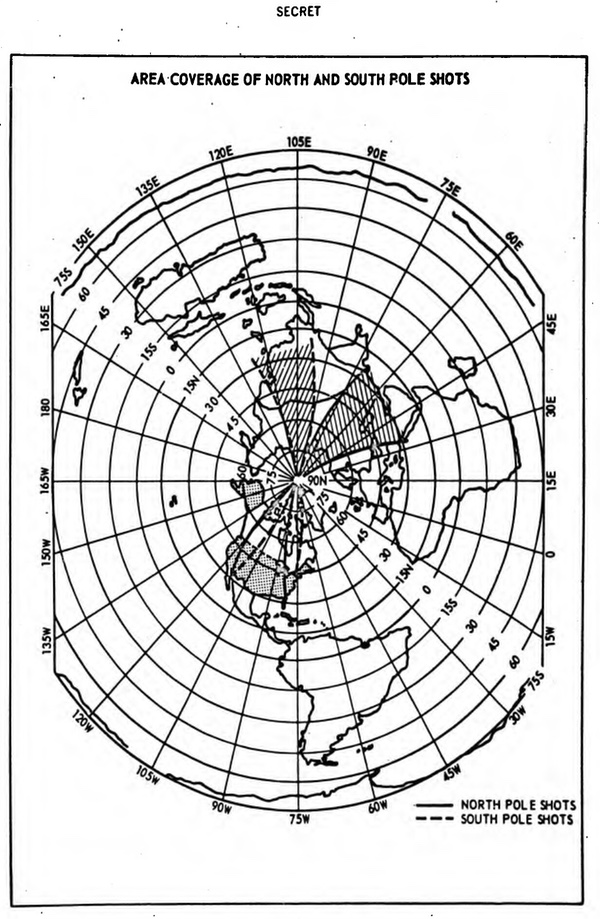 The satellite bombs would operate in polar orbits, which meant that nearly every part of the Earth would be reachable by a weapon. (credit: Douglas Aircraft Company) |
Satellite bombs
The satellite bombs would be placed in circular polar orbits at an altitude of approximately 525 nautical miles (970 kilometers). The 36 weapons would be randomly spaced, although their orbits would be adjusted somewhat to achieve a more even distribution. This spacing would eliminate the need to communicate with more than one weapon at a time.
Each satellite bomb would tumble in orbit, only commanded to stabilize when necessary, such as before reentry. Each weapon would be accompanied in its orbit by 5 to 20 “decoy units” intended to make identification and destruction of the weapons more difficult. Each weapon would be launched unarmed and without targeting information loaded into its electronic systems.
The report devoted significant discussion to survivability, which included protecting its command system from interference as well as protecting the weapons from physical attack. Interference could include sending false signals from the ground to the weapons, interfering with their communications systems on the ground, or physically attacking them. This would require careful selection of communications frequencies, encryption of command links, and other design parameters. Because the weapons would spend most of their orbit out of range of American communications systems and much of their time over Soviet territory, it was vital that they be highly secure.
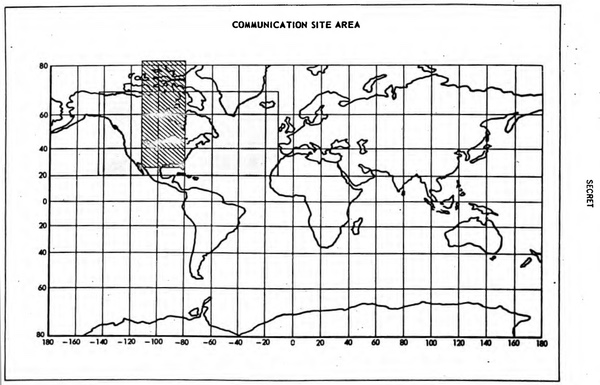 United States for only a small portion of their orbits. This limited communications time, while exposing the weapons to interference over Soviet territory. (credit: Douglas Aircraft Company) |
The “decoy units” would consist of inflatable Mylar balloons of the same size and shape as the actual weapons. They would have to accurately mimic the visual, radar, and infrared appearance of the satellite bombs. They too would tumble like the satellite bombs. Although the report mentioned the effects of “solar pressure,” it is unclear how a lightweight inflatable decoy could maintain the same orbit as a heavy spacecraft that was less susceptible to drag effects.
The vehicle would be conical, with a base diameter of ten feet (3 meters), the same as the launch vehicle, tapering down to 2.75 feet (0.84 meters). It would weigh 8,000 pounds (3,630 kilograms) in orbit with a de-orbit weight of 3,500 pounds (1,590 kilograms). The entry vehicle would be 886 pounds (402 kilograms). The satellite bomb would likely be assembled and handled on the ground in a horizontal orientation, because assembling it vertically would create handling problems.
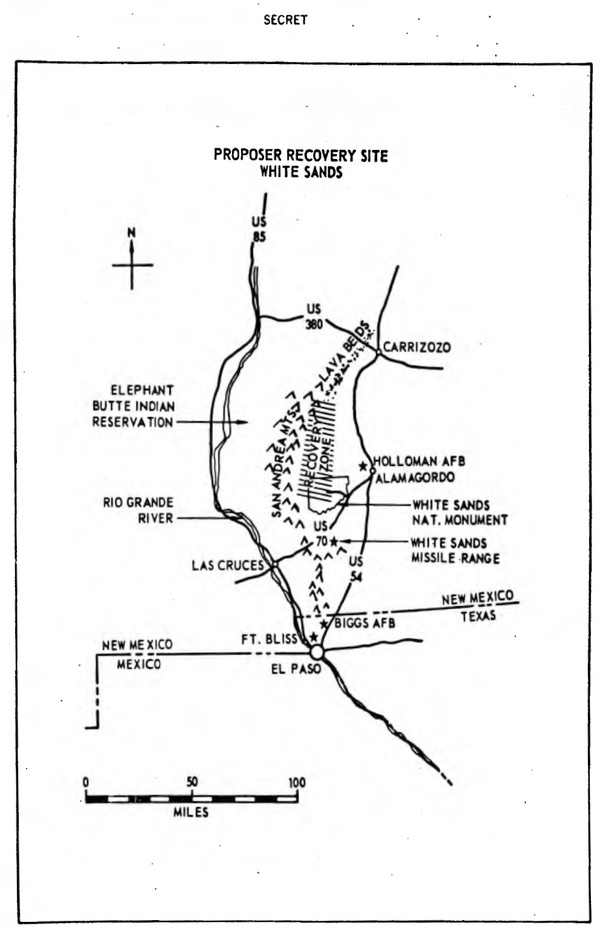 The satellite bombs would have a lifetime in orbit of approximately one year. To prevent them from falling into enemy hands or causing radioactive pollution if destroyed in the atmosphere or in the ocean, the study proposed recovering them over White Sands, New Mexico. With 36 weapons in orbit, this meant that nuclear weapons would be reentering over the United States several times a month. (credit: Douglas Aircraft Company) |
Satellite bomb disposal
Because the satellites would have a mean lifetime of only one year, they would have to be replaced on a regular basis. But even more problematically, they would also have to be recovered. The United States could not leave dead nuclear weapons flying overhead in low Earth orbit. Because they were designed to reenter the atmosphere, a dead nuclear weapon would fall intact, and nobody could predict where.
| Because the satellites would have a mean lifetime of only one year, they would have to be replaced on a regular basis. But even more problematically, they would also have to be recovered. |
The report discussed the various problems associated with leaving the bombs in orbit, destroying them in orbit, and recovering them, determining that recovery was the best option. Dropping them in the ocean was a possible solution but risked enemy recovery. “If the enemy were to recover one of these, our warhead state-of-the-art would be revealed. Detonation of the warhead by high explosives under water would distribute the radioactive debris in the ocean,” the report stated. Even burning them up in the upper atmosphere would result in the distribution of plutonium around the Earth. “Several hundred occurrences of this sort may present a distinct health hazard.”
Before a satellite failed, it would be commanded to reenter over the continental United States. As it descended into the lower atmosphere, it would deploy a parachute and be recovered in midair by a specially equipped aircraft. This technique was already in use for the CORONA reconnaissance satellite and had been proven reliable. However, the CORONA reentry capsules with their reels of exposed film were relatively lightweight, in part because the reentry vehicle ejected its heat shield over the ocean. A nuclear reentry vehicle with its reentry shield attached would weigh significantly more.
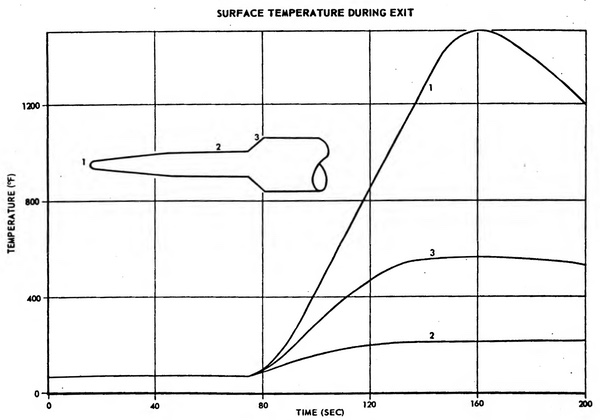 Bringing the weapons back from orbit to hit their targets would subject them to intense heating during reentry. (credit: Douglas Aircraft Company) |
After the satellite bomb was stored in the recovery aircraft, the aircraft would land at a secure facility, the satellite bomb would be removed and then transported to a secure processing facility. This would have to occur on a nearly weekly basis: nuclear weapons reentering over the United States regularly, hopefully without incident.
The designers had to assume that a reentering satellite bomb might not be caught by an aircraft and it therefore had to survive landing on the ground. It would include systems for aiding in this effort, such as a “package of scatter mirrors” made of polished aluminum that would be fired from the vehicle at an altitude of 5,000 feet (1,500 meters) and scatter over the ground near the landing point. The vehicle would also have a smoke generator to create smoke to serve as a post-landing aid. The parachute would be attached in such a way as to land the vehicle nose up, so that the back, with the used retrorocket, and not the nuclear weapon, would take the impact with the ground.
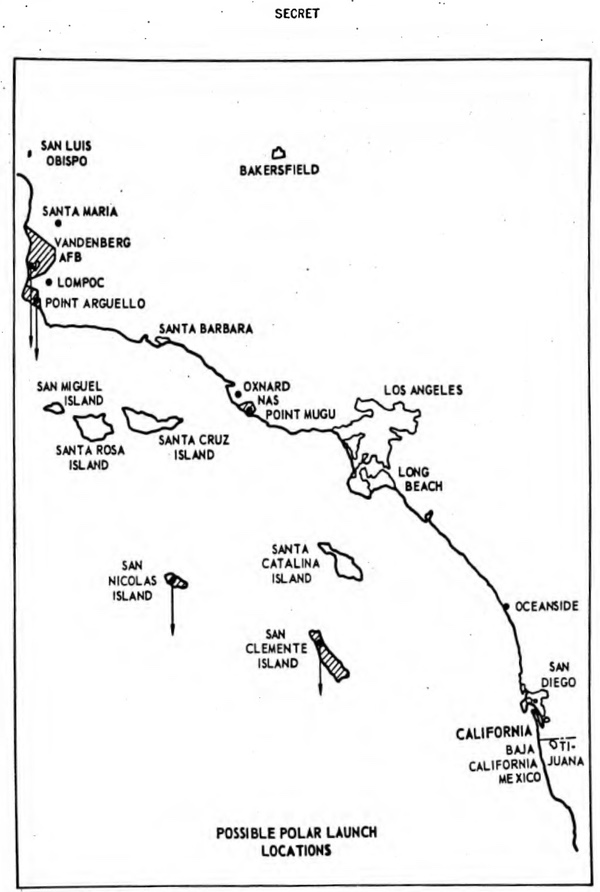 Although several California launch sites were possible for the satellite bombs, the study determined that an operational system should not be launched from the same complex as R&D flights, such as Vandenberg Air Force Base. An additional problem was that Vandenberg included a commercial railway that ran through much of the base and interrupted flights. (credit: Douglas Aircraft Company) |
Launch site
The authors of the report selected a new, dedicated launch site for the weapons. San Clemente Island is located 60 miles (100 kilometers) west of San Diego. As they noted, the Atlantic Missile Range was not suited to polar launches. Point Arguello and Vandenberg Air Force Base, which were then adjacent but administratively separate, already had Atlas launch facilities operating or planned. But those locations were less than ideal. As the authors explained, further expansion of research and development facilities at those locations would be prevented by an operational satellite weapons system, and R&D and operations would be occurring at the same base “thereby presenting complex security and safety problems.” But a third reason was a mundane one that had already plagued launch operations on the West Coast: “A federal contract with the Southern Pacific Railroad restricts launching schedules when trains are in the vicinity of the base.”
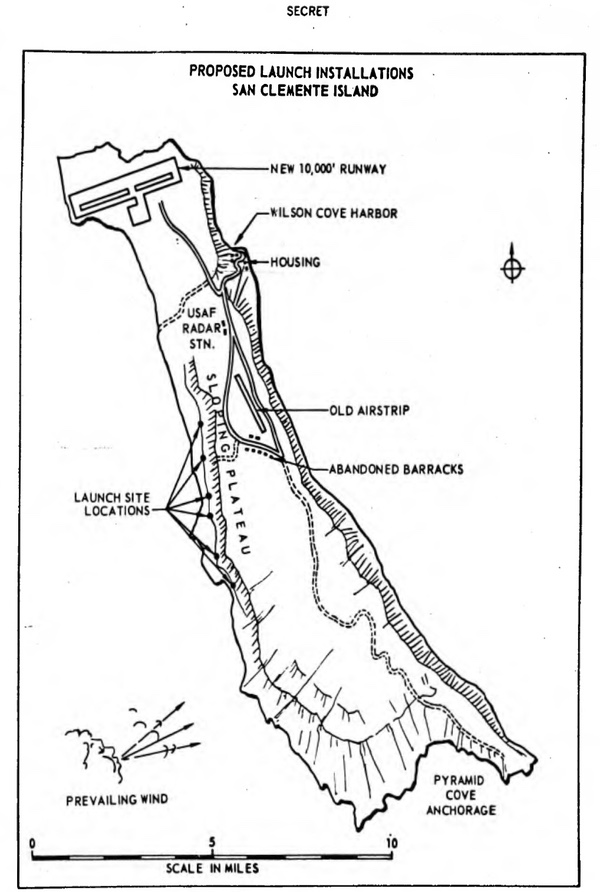 The study looked at several possible launch sites for the satellite bombs and determined that San Clemente Island, off the California Coast, was the best location. (credit: Douglas Aircraft Company) |
San Clemente was the site of an abandoned military facility, but all new facilities would be required, including a new 10,000-foot (3,000-meter) runway, housing and other facilities, and up to five or more launch pads along the west side of the narrow island.
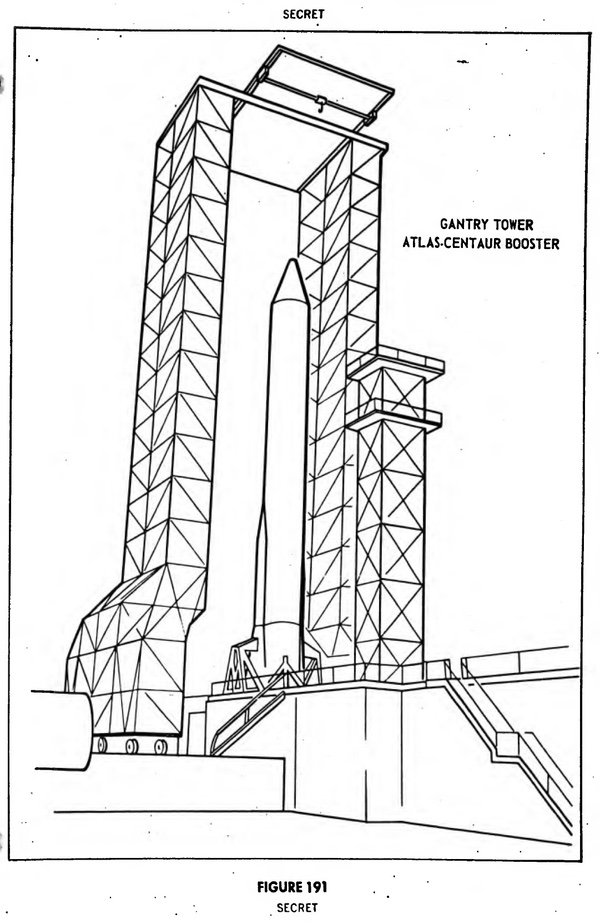 Artist impression of the Atlas-Centaur rocket at its A-frame gantry. (credit: Douglas Aircraft Company) |
Atlas-Centaur
The Douglas study assumed that the satellite bombs would be placed in orbit atop Atlas-Centaur rockets. At the time, the Atlas-Centaur was expected to be operational by 1964. To attain high reliability for launch, the authors recommended having two vehicles undergoing simultaneous countdown.
Atlas was derived from an existing ICBM, but Centaur was a new and unprecedented project, unlike any rocket in development by the military. It was a high-energy upper stage using liquid hydrogen as fuel. Liquid hydrogen was difficult to handle and its physical properties and behavior, particularly in a space environment, were not well understood. Centaur development had been assigned to NASA in 1959.
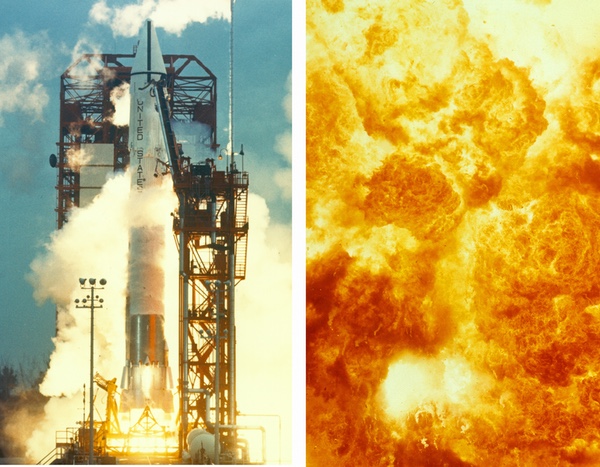 The Atlas-Centaur suffered some problems during its development. (credit: Peter Hunter Collection) |
The requirements and the difficulty of using liquid hydrogen meant that Centaur development was experiencing problems from the start. It was becoming clear to military leadership by January 1961 that the Atlas-Centaur would be a major pacing issue for planned military projects, like the Advent communications satellite. Pratt and Whitney was then working on development of the Centaur’s LR-119 engines. By summer 1961, the problems with Centaur were increasingly apparent even outside of NASA. By summer 1962, Centaur had fallen two years behind schedule. Had the Earth Satellite Weapon System entered into development, Centaur would have presented problems within a year.
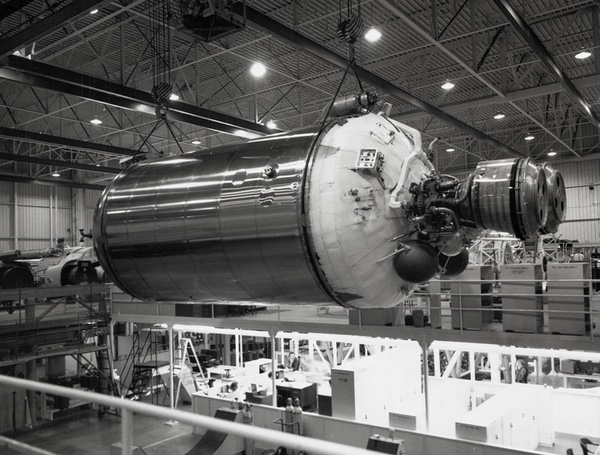 The Centaur upper stage was under development in the early 1960s. It used liquid hydrogen, a remarkably persnickety fuel. Centaur began running into substantial problems around the time the Douglas study that recommended its use was delivered. (credit: Douglas Aircraft Company) |
In spring 1961, when the study was completed, the United States had only been launching rockets into space for three and a half years. Launch vehicles were still a new and immature technology. The study assumed a 20% launch failure rate. But considering that even decades later launch vehicles had failure rates of approximately 5–10%, the safety aspects of launching nuclear weapons into orbit were substantial. Simply establishing a constellation of 36 orbiting Satellite Bombs would result in multiple accidents that would destroy nuclear weapons in the atmosphere, dropping their radioactive wreckage into the ocean, possibly right off the California coast.
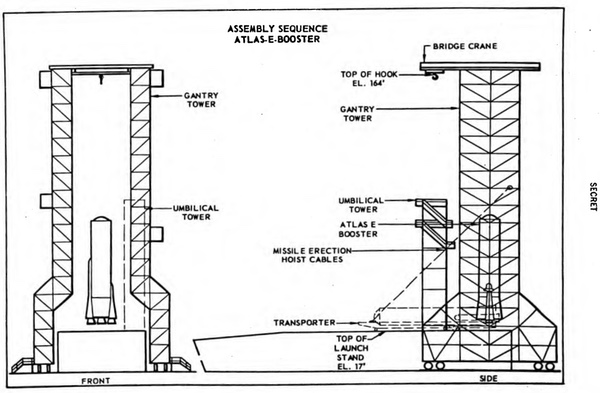 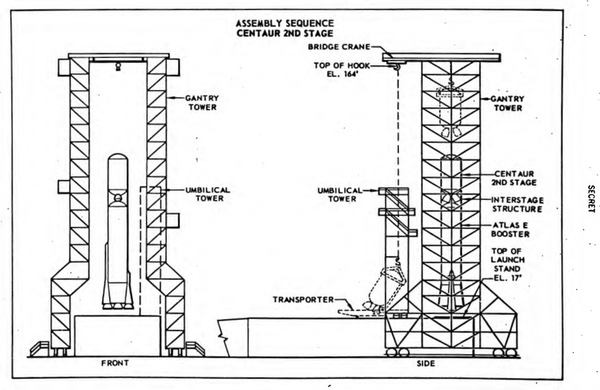 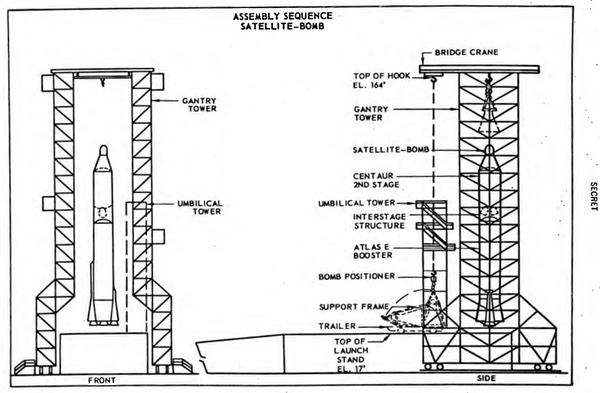 The launch vehicle would be vertically assembled at the launch pad. (credit: Douglas Aircraft Company) |
Cost and schedule
Douglas also estimated the costs and schedules for the Earth Satellite Weapons System. The company assumed that the launch complex would be similar to pad 36 at Cape Canaveral, with six “soft” launch pads—meaning not capable of withstanding attack. These six pads would conduct four launches per month. The Atlas-Centaurs would be vertically assembled at the pad. The mean lifetime to failure of the satellites would be one year, with 36 satellites maintained in orbit. Approximately two thousand personnel would be required to support the launch operation.
The satellite bomb recovery site would be based in the American southwest, and although the company calculated the cost of the recovery operations, it noted that facilities would probably be provided by the government, not the contractor, and would most likely consist of existing facilities in someplace like the Nellis Air Force Base in Nevada. Recovery operations would require approximately one thousand personnel.
| The Earth Satellite Weapon System never progressed beyond the study phase. The details of whether it was seriously evaluated at senior Pentagon levels are unavailable. |
Assuming that authority to proceed was granted by the last quarter of 1961, the first test vehicle launch using an interim booster could take place by the end of 1963, with the first test vehicle launch using an Atlas-Centaur occurring by the middle of 1964. Launch site construction would start at the beginning of 1963, with the site becoming operational by spring of 1965.
The first launch of an operational vehicle would take place by summer 1967, with the system becoming operational by summer of 1968.
Based upon these assumptions, Douglas estimated that the research and development would cost $424.2 million by the end of fiscal year 1964, with an operational cost of $2.569 billion by the end of fiscal year 1973.
A year later, the RAND Corporation produced an estimate that an orbital nuclear bombardment system would cost five times a terrestrial-based system.
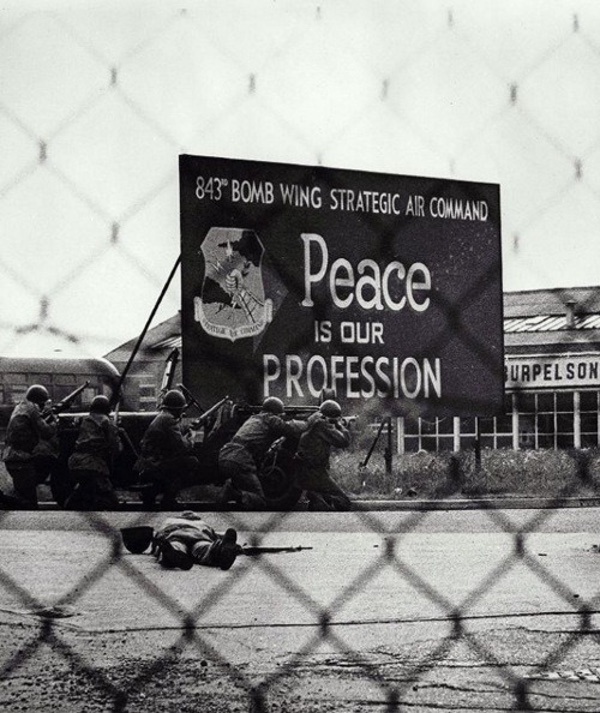 The Earth Satellite Weapon System would likely have been under control of the US Air Force’s Strategic Air Command. (credit: Columbia Pictures) |
No nukes in space
During the time that the Earth Space Weapons System was being studied, the Air Force was also developing the X-20 Dyna-Soar, a winged spacecraft to be launched atop a Titan rocket and piloted by a single military astronaut. The X-20 was an ambitious and complicated program. But it lacked a clear justification. The Air Force and contractors proposed various missions that the X-20 could accomplish, one of which was “orbital bombardment.” But this mission made little sense when closely evaluated. There was no need to put an astronaut in a vehicle to drop a single nuclear weapon from orbit when that same weapon could simply be placed atop an ICBM. Dyna-Soar added tremendous complexity and cost to the mission, not any versatility. There were other proposed missions for Dyna-Soar, but none of them made much sense or justified the cost. By late 1963, Dyna-Soar was canceled.
The Earth Satellite Weapon System never progressed beyond the study phase. The details of whether it was seriously evaluated at senior Pentagon levels are unavailable, although the Douglas study was prepared at a time when the new Secretary of Defense Robert McNamara was canceling many of the Air Force’s more complicated and expensive weapons systems such as the XB-70 Valkyrie bomber, the Skybolt air-launched ballistic missile, and later the X-20 Dyna-Soar. It was thus an expensive and complicated solution in search of a problem.
During the next several years, a series of negotiations on the placement of nuclear weapons in space took place in the United Nations. On October 17, 1963, the United Nations General Assembly Resolution 1884 (XVIII) called on states “to refrain from placing in orbit around the earth any objects carrying nuclear weapons or any other kinds of weapons of mass destruction or from installing such weapons on celestial bodies.” The resolution was formalized in the 1967 Treaty on Principles Governing the Activities of States in the Exploration and Use of Outer Space, including the Moon and Other Celestial Bodies, aka the Outer Space Treaty. However, even while early negotiations were ongoing, the United States continued studying orbital nuclear weapons programs. They will be discussed in a future article.
Note: we are now moderating comments. There will be a delay in posting comments and no guarantee that all submitted comments will be posted.