After the ISS: What happens when humanity loses its shared home in space?by Alex Kennedy
|
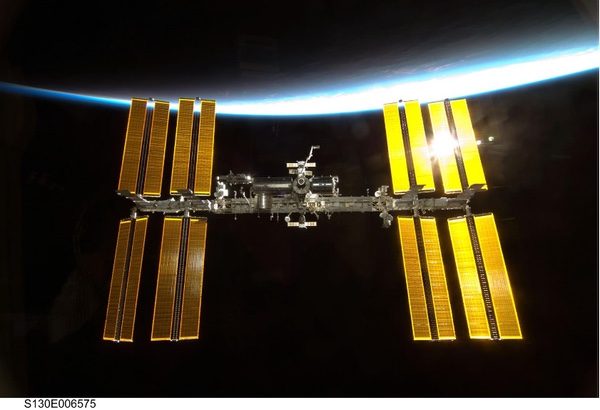
| The more difficult question is what kind of human presence we are replacing it with—and whether, in gaining something new, we may quietly lose something we did not realize the ISS had given us. |
Not intact, of course. After decades in orbit, most of the largest object humanity has ever assembled in space will burn apart during a controlled reentry. Some pieces may survive long enough to reach an uninhabited part of the ocean. NASA and its partners have been planning that ending for years, including a dedicated vehicle intended to guide the station through its final descent.
From an engineering perspective, it will be a disposal operation. I suspect it will feel more like a funeral.
Not because the ISS is beautiful in any conventional sense. It is a collection of cylinders, radiators, solar arrays, cables, storage bags, laptops, and machines assembled over decades by countries that have often disagreed about almost everything else. But for more than a quarter of a century it has been a place where humanity lived away from Earth.
That distinction matters. The question after the ISS is therefore larger than which spacecraft will replace it. We already have names for some of the possible successors, along with renderings, schedules, contracts, and business plans. The more difficult question is what kind of human presence we are replacing it with—and whether, in gaining something new, we may quietly lose something we did not realize the ISS had given us.
The extraordinary thing that became ordinary
On November 2, 2000, three people entered the International Space Station: William Shepherd, Yuri Gidzenko, and Sergei Krikalev. Human beings have lived in space continuously ever since. NASA marked 25 years of uninterrupted occupation in November 2025.
It is worth thinking about how strange that sentence actually is. There are adults alive today who were born into a world in which there has always been at least one human being living somewhere beyond Earth. And we barely notice.
A crew launches. Another returns. Cargo arrives. An astronaut posts photographs of an aurora. A valve fails. Someone replaces it. Experiments are installed. A toilet breaks. A spacesuit is inspected. The station passes overhead again.
Spaceflight has not become routine in the sense that it has become easy. It remains expensive, technically difficult, and unforgiving. But the ISS accomplished something subtler: it made living away from Earth feel normal.
| A footprint photographs better than a maintenance schedule, but civilization is built out of maintenance schedules. |
The history of the International Space Station is usually told through milestones: Zarya, Unity, the first expedition, laboratory modules, commercial cargo, Crew Dragon. Yet perhaps its most important milestone is the one without a date. At some point, we stopped being surprised that people lived there.
Apollo showed that humans could reach another world, but the ISS showed that humans could stay away from this one. The difference is easy to miss because permanence is less dramatic than arrival. A footprint photographs better than a maintenance schedule, but civilization is built out of maintenance schedules.
A machine for learning how fragile we are
The ISS is often described as a laboratory. That is correct, but it is also incomplete. It has been a machine for discovering everything that goes wrong when an organism shaped by billions of years on Earth is removed from Earth.
Our bones assume gravity exists. Our muscles assume they must work against it. Our cardiovascular system assumes there is a direction called down. Our balance system expects the inner ear to make sense. Our immune system, vision and cellular machinery evolved under conditions that spaceflight casually removes.
Without countermeasures, long stays in microgravity can produce bone loss, muscle atrophy, fluid shifts, and changes across multiple physiological systems. Those problems become much more serious when the destination is not a station a few hours from Earth but the Moon or Mars. The question of how the human body may change during life on Mars begins with knowledge accumulated in places like the ISS.
The encouraging part is that the station did not merely catalogue our vulnerabilities, but also became a place to work on them. Astronauts exercise for hours. Doctors collect data. Engineers change hardware. Researchers test how cells, tissues, and organisms respond when gravity is no longer the background condition of life.
The same is true of the machinery that keeps those bodies alive. For a Mars mission, carrying every kilogram of water required by a crew from Earth would be absurdly expensive. Life-support systems have to behave increasingly like ecosystems: recovering what would otherwise be waste and turning it back into something useful. In 2023, NASA reported that the US segment of the station had demonstrated approximately 98% water recovery, a threshold relevant to future long-duration missions.
That sounds like an engineering statistic because it is one. It is also a preview of the philosophy of settlement beyond Earth. On this planet we live inside a life-support system so large that most of us can pretend it does not exist. In orbit, nothing disappears. Air, water, heat, waste, and energy become visible parts of survival.
A space station forces people to confront a truth Earth is good at hiding: survival depends on finite flows of matter and energy, whether we notice them or not.
| The ISS emerged from one historical moment and survived into another. The political world around it changed more radically than the basic logic of the station. |
Scientific output from the station is also easy to underestimate. The ISS National Laboratory reported a record 76 peer-reviewed publications in fiscal year 2025, bringing its cumulative publication count to nearly 630. A 2025 study in npj Microgravity examined research linked to the US National Laboratory and identified roughly 400 scholarly papers and 41 patents in its dataset. The authors found that the resulting intellectual products had unusually strong citation impact compared with matched terrestrial research.
Not every experiment in orbit changed science. The deeper achievement was that humanity maintained a laboratory where some questions could be asked in a way they simply cannot be asked on Earth, and kept it alive long enough for researchers to build careers around those questions.
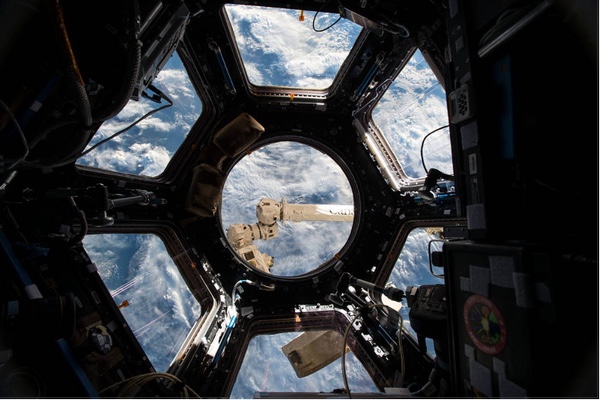 Earth fills the windows of the International Space Station's Cupola, a reminder that the orbital laboratory has also been a human home. (credit: NASA) |
The experiment of the ISS itself
There is another experiment aboard the ISS that receives less attention because it does not fit inside a laboratory rack. It is the station itself.
NASA, Roscosmos, ESA, JAXA, and the Canadian Space Agency did not merely contribute pieces to the same machine. They created systems that had to function together for decades. Different engineering cultures had to agree on interfaces. Different organizations had to share schedules, risk, electricity, communications, and responsibility for keeping people alive.
An astronaut could not simply decide that geopolitics had become inconvenient and disconnect a module. The atmosphere still had to be controlled. Spacecraft still had to dock safely. The station still had to avoid debris. Crews still had to come home.
That created a form of interdependence that is difficult to reproduce in speeches or treaties. It would be naive to romanticize it. Cooperation in orbit never erased competition on Earth, and the ISS did not abolish national interests. But it did create a place where cooperation was not a sentiment. It was an engineering requirement.
A study published in the Journal of Peace Research examined international space cooperation from 1958 through 2023 and found that it has increasingly organized itself into distinct “space blocs” whose composition reflects geopolitical relationships on Earth. Those blocs, importantly, were not completely isolated from one another.
That makes the ISS more interesting at the end of its life than it was at the beginning. It emerged from one historical moment and survived into another. The political world around it changed more radically than the basic logic of the station.
This raises an uncomfortable possibility: what if the International Space Station was not the first example of how humanity will permanently organize itself in space, but instead the exception?
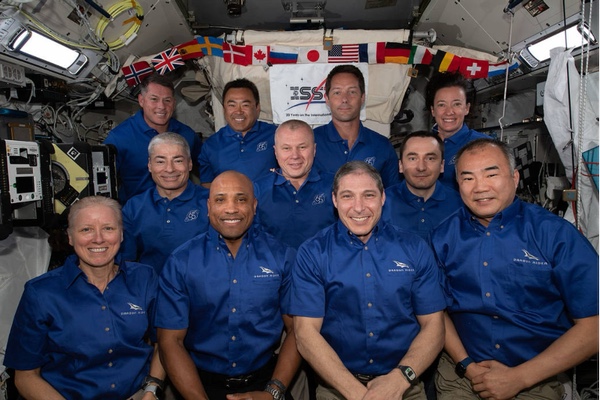 Eleven crew members aboard the International Space Station in April 2021, representing three overlapping crews and several national space agencies. (credit: NASA) |
After one station, many stations
The future NASA is preparing for does not look like another ISS.
The agency wants to become one customer among many purchasing services from commercially operated stations in low Earth orbit, rather than owning and operating the primary US orbital laboratory itself. This is not merely a rhetorical shift. NASA has been advancing the Commercial Low Earth Orbit Destinations effort as the bridge between the ISS era and a market in which government research, private science, manufacturing, national astronaut programs, and perhaps tourism share orbital infrastructure.
Europe is preparing for that world as well. In September 2026, ESA signed a letter of intent with Starlab exploring potential future European use of the station and a post-ISS memorandum with Axiom Space. Last week, it signed a memorandum of understanding with Vast, updating an agreement from 2024.
There is a compelling logic behind this. Governments do not need to own every laboratory, ship, aircraft, or communications network they use. If companies can provide safe orbital infrastructure and find additional customers, NASA can purchase what it needs in low Earth orbit while spending more attention and money on destinations farther away.
Commercialization could also produce something the ISS never could: diversity. Instead of one enormous multipurpose outpost, low Earth orbit might eventually contain several stations optimized for different roles. One could emphasize biomedical research, while another is devoted to manufacturing. Another could serve national astronaut programs or private missions. Some may combine all of those things.
The ISS is effectively a single house. The next phase of human spaceflight may look more like a neighborhood. That could be progress. But neighborhoods work differently from houses.
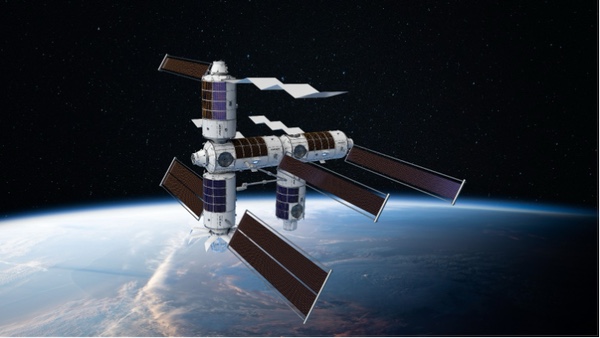 A rendering of the completed Axiom Station, one of the commercial destinations being developed for the post-ISS era. (credit: Axiom Space) |
Who owns the room where humanity learns to live in space?
This is the question I keep returning to. Not who legally owns a particular module, as lawyers can answer that. I mean something less precise: who owns the idea of human presence in space?
| The ISS was born when permanent life in space was uncertain. Its successors are being designed in a world where permanent orbital activity is increasingly treated as an assumption. |
The ISS was expensive, bureaucratic, and sometimes maddening precisely because it was built to satisfy many governments and institutions at once. Those weaknesses were real. Yet they were connected to one of its strengths: the station did not need to justify every cubic meter through the logic of a single commercial business case.
Some research could be conducted because governments had decided that knowledge itself was worth funding. Some activities mattered because they trained astronauts. Others existed because they reduced risk for future missions. And some mattered because the partner nations considered continuous human presence in orbit to be strategically, scientifically or symbolically valuable.
Commercial stations will not automatically abandon any of those things. NASA, ESA, and other agencies can pay for them. Nor is “commercial” a synonym for shallow or short-sighted. Private launch providers have already changed the economics of reaching orbit, and competition could make orbital research accessible to institutions that would never have found room aboard the ISS.
Still, incentives matter. A laboratory treated as public infrastructure and a laboratory operated as a business may host many of the same experiments while answering different institutional questions. The ISS asked: What can we learn if nations collectively maintain a permanent laboratory in space? The coming era may ask: What happens when human presence in orbit becomes a service?
Neither question is inherently better. But they are not the same question, and pretending they are would make it harder to notice what is actually changing.
The day after the ISS
There is a tendency to think of space exploration as a sequence of machines. Mercury led to Gemini. Gemini led to Apollo. The Space Shuttle helped build the ISS. The ISS will give way to commercial stations, Gateway, Artemis, and whatever follows.
History rarely moves that neatly. Machines carry institutions with them. They create habits. They create professions. They teach people what is normal.
The ISS taught mission controllers how to manage permanent operations in orbit. It taught astronauts how to repair a home while living inside it. It taught engineers which systems fail after years rather than weeks. It taught physicians what long-duration microgravity does to the body. It taught scientists how to design experiments for an environment unlike anything available on Earth.
And, for a quarter century, it taught several nations how to share responsibility for keeping human beings alive in space. Perhaps that is the hardest experiment to reproduce.
We will almost certainly build technically better stations. They may be cheaper, quieter, easier to maintain, and more comfortable. Their computers will be newer. Their life-support systems may recycle more. Their launch costs may be lower. Researchers may gain access to orbit without navigating the institutional machinery required by the ISS.
In almost every technical sense, the descendants should eventually surpass their ancestor. Progress, however, does not guarantee continuity.
The final crew will someday close the hatch. The station will be emptied. Its orbit will begin to fall under deliberate control. Then, after decades of carrying people around Earth every ninety minutes, the structure will meet the atmosphere it spent its entire existence avoiding. Most of it will disappear.
That will not mean humanity has abandoned space. Quite the opposite. By then people may already be living aboard another station, flying around the Moon, or testing hardware meant for Mars. Continuous human presence beyond Earth may survive the transition. But something will still have ended.
The ISS was born when permanent life in space was uncertain. Its successors are being designed in a world where permanent orbital activity is increasingly treated as an assumption. Perhaps that is the clearest definition of its legacy.
It succeeded so completely at proving that humans could live beyond Earth that the argument moved on. We now debate customers, contracts, markets, national stations, commercial destinations, and who pays for which services instead of whether people can remain in orbit at all.
That is an extraordinary transition. It is also a dangerous moment to confuse technical succession with cultural inheritance. The hardware cannot be preserved forever. The orbit cannot be occupied by the same structure forever. Even the institutions that created it will change. What can survive is the idea behind the station: that space can be more than territory to visit, exploit, or compete over. It can also be a place where people stay, learn and build things together.
The real successor to the International Space Station may therefore not be another station. It may be the moment when humanity stops asking whether we belong beyond Earth and starts confronting the more difficult question: what kind of civilization do we intend to become once we get there?
Note: we are now moderating comments. There will be a delay in posting comments and no guarantee that all submitted comments will be posted.