Bounders and RAMs: satellites track a unique bomber at the Soviet Ramenskoye flight test center (part 1)by Dwayne A. Day and Harry Stranger
|
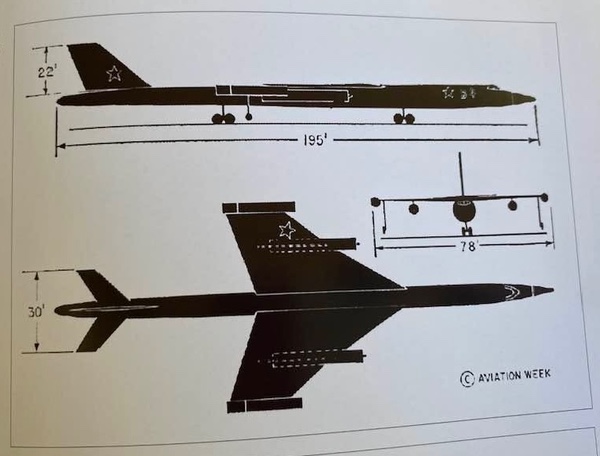 Drawing of the M-50 that appeared in a December 1958 issue of Aviation Week. (credit: Aviation Week & Space Technology) |
Aviation Week (not yet “& Space Technology”) ran both an editorial and an article about the supersecret airplane. (“Soviets Flight Testing Nuclear Bomber,” December 1, 1958, p. 27). The article itself was authoritative sounding: “A nuclear-powered bomber is being flight tested in the Soviet Union. Completed about six months ago, this aircraft has been flying in the Moscow area for at least two months. It has been observed both in flight and on the ground by a wide variety of foreign observers from Communist and non-Communist countries.” The article continued: “The Soviet aircraft is a prototype of a design to perform a military mission as a continuous airborne alert warning system and missile launching platform.”
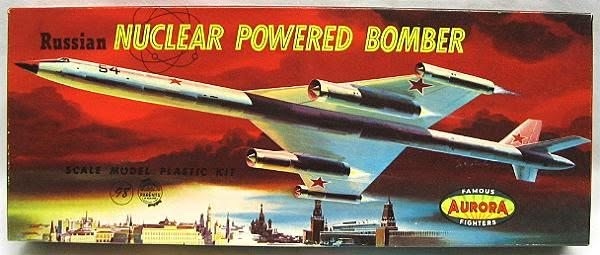 There was even a model kid of the "nuclear-powered bomber." In reality, the M-50 had conventional propulsion, and has many design flaws. (credit: Aurora) |
The magazine was jumping to conclusions about a new Soviet bomber aircraft. It was not nuclear-powered. This was only a few years after the so-called “Bomber Gap,” an early example of Cold War military hysteria where estimates of Soviet military capabilities wildly exceeded the reality. Aviation Week was trying to start a new bandwagon rolling. But it didn’t work. And over the next decade, American reconnaissance satellites kept tabs on the new aircraft, but as they flew overhead and photographed the flight test facility, it became quickly apparent that the Soviets were not even building a handful of them.
Early intelligence from the ground
The CIA was paying attention to Soviet bomber developments in the late 1950s before the dawn of satellite reconnaissance, mainly by monitoring Soviet airfields and the airspace around them using observers in Moscow. Declassified reports indicate that intelligence analysts had detected a new Soviet bomber near Moscow in 1958, but were apparently not all that impressed. A secret December 23, 1958, CIA memo on “Long Range Aviation” stated that a new aircraft that the CIA designated “Bounder” had been observed in flight. It added that “sightings of the new Bounder aircraft indicate it may have a probe for aerial refueling.” The CIA believed that “Bounder is associated with” the Ramenskoye and Fili airfields near Moscow.
| The Soviet Union only built three M-50s, with only one taking flight. On July 9, 1961, the M-50 participated in a Soviet Aviation Day flyby, its only public appearance. |
A little over six months later, a June 2, 1959, CIA report on Soviet aircraft production stated that the Bounder was first observed in Moscow in August of 1958. It was considered “potentially supersonic and may be intended as a carrier of air-to surface missile(s).” In its current configuration, the CIA concluded that “should the USSR decide to produce this prototype in its present configuration, it would probably be a medium-range bomber comparable in range to Badger rather than Bison or Bear.” Thus, contrary to the “wide variety of foreign observers from Communist and non-Communist countries,” by mid-1959 the CIA did not consider the aircraft nuclear-powered, was not even sure if it was supersonic, and it certainly was not the long-range aircraft Aviation Week had breathlessly reported.
The Soviets designated the airplane the Myasishchev M-50. It was a Soviet prototype four-jet engine supersonic strategic bomber that never entered service. The M-50 was constructed by the Myasishchev design bureau. NATO applied names starting with the letter “B” to Soviet bombers: Bear, Badger, Bison, etc., usually spelled out in all-caps.
The Soviet Union only built three M-50s, with only one taking flight. The four engines were mounted in pods, with two under the wing and two more mounted to the wingtips. The second aircraft was designated the M-52 and had a different engine installation. It also had a wider cockpit with the pilots sitting side-by-side rather than one in front of the other. The M-52 appeared at the Fili airfield outside of Moscow, but never flew. The Soviets also built an unmanned M-51 cruise missile variant.
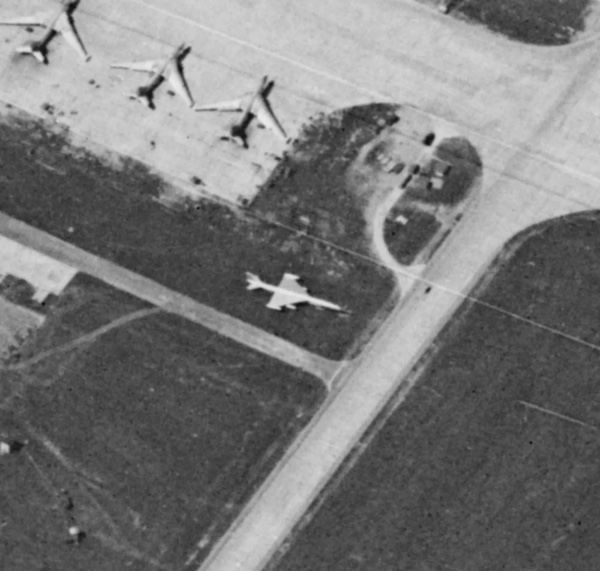
There were no U-2 reconnaissance aircraft flights over Moscow during this time, although the CIA may have obtained photos of the planes from the ground. By August 1960, the United States began flying reconnaissance satellites, and over the subsequent years as they flew over Soviet airfields and aircraft production facilities, they did not photograph any more than the three airframes. On July 9, 1961, the M-50 participated in a Soviet Aviation Day flyby, its only public appearance.
Although the M-50 was not nuclear-powered, the Soviet Union did test a nuclear-powered technology demonstrator, just like the United States had with the Convair NB-36H project. The Soviet aircraft was based upon the Tu-95 Bear and was designated the Tupolev Tu-95LAL. This was a test bed with the goal of testing the nuclear reactor shielding efficiency. The Tupolev Design Bureau was a competitor to Myasishchev.
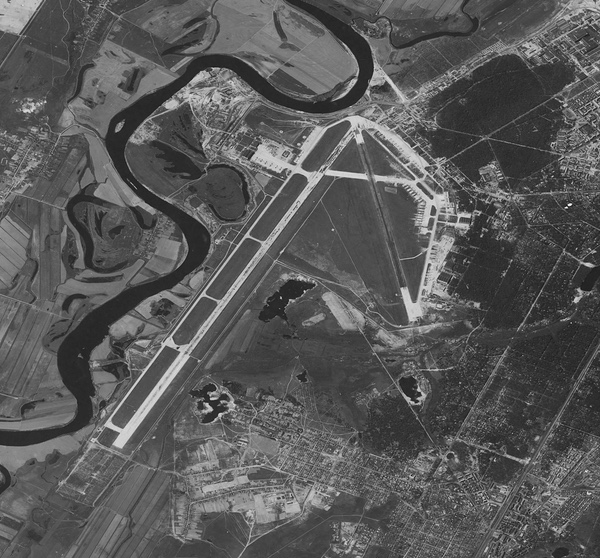 The sprawling airfield outside of Moscow that the CIA referred to as Ramenskoye, but Russians referred to as Zhukovsky, was where Soviet aircraft were flight-tested. It was the equivalent to Edwards Air Force Base in California. New aircraft were often spotted here first by American reconnaissance satellites. (credit: Harry Stranger) |
Monitoring Ramenskoye
United States intelligence services kept track of the M-50 and its derivatives. Multiple reconnaissance satellites photographed an airbase outside of Moscow referred to as Zhukovsky by the Russians, after a nearby suburb. But during the Cold War the CIA referred to it by the name of another Moscow suburb, Ramenskoye. Officially known as the Flight Research Institute (or LII), the base was the Soviet equivalent to the famed Edwards Air Force Base in California. US intelligence reports were clear: “Ramenskoye is the most important flight test center in the USSR. All of the latest aircraft under development are usually tested at this base.” As of October 1965, Ramenskoye had two runways, one 17,000 by 350 feet (5,180 by 107 meters), and another that was 8,200 by 280 feet (2,500 by 85 meters). During many satellite overflights in the mid-1960s, only one Bounder aircraft was visible during a satellite pass, with multiple other aircraft spread around the airfield.
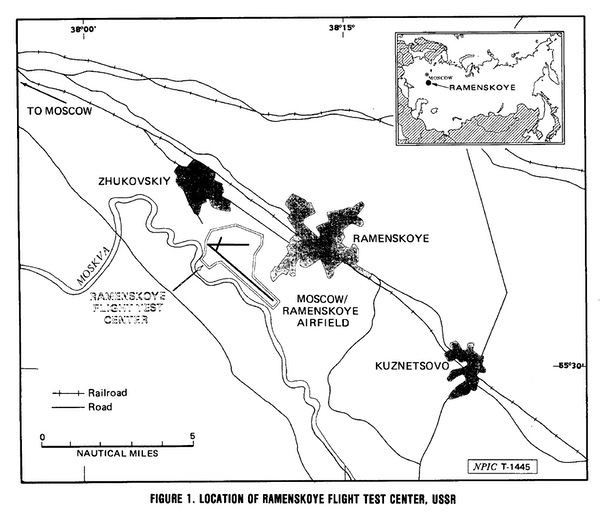 This CIA map shows the two Moscow suburbs near the airfield. Although the CIA referred to the airfield as Ramenskoye, the Russians referred to it as Zhukovsky. (credit: CIA) |
Numerous large and small Soviet aircraft were visible at Ramenskoye during every reconnaissance satellite overflight as long as the skies were cloud-free, and photo-interpreters were always on the lookout for new aircraft. The M-50, with its distinctive four jet engines, was unique at the base, one of a kind. Since 1963, the M-50 was photographed at the Myasishchev area of the base. American photo-interpreters could discern the manufacturers of new Soviet aircraft by several means. One was what area of Ramenskoye they first appeared at. Another was their overall design style: different designers built planes that had a similar look, which was true of American aircraft companies as well. By 1963, the M-50 stayed in the same place each time it was photographed, an indication that it was no longer flying. The M-52 was photographed at Fili.
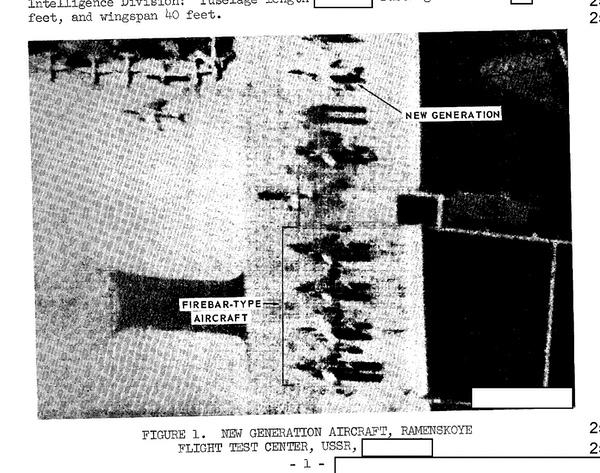 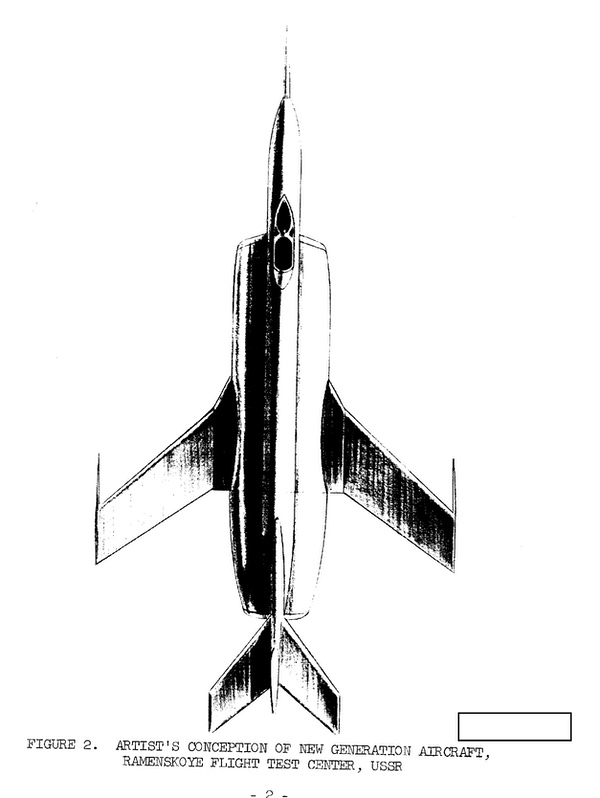 New aircraft often were photographed by American satellites at Ramenskoye before they appeared anywhere else, such as the Yak-28-64 interceptor that was first spotted there in the mid-1960s. This drawing was made from a satellite photo. (credit: CIA) |
Ramenskoye was a target-rich environment for American photo-interpreters during the 1960s. In May 1966, a “probable new generation aircraft” was identified at the airfield. It was the fourth type of new generation aircraft observed on satellite photography at either Ramenskoye or Novosibirsky airfield since October 1965.
In July 1966, a US satellite spotted a “new generation delta-wing aircraft” at Ramenskoye. Another “new generation aircraft” was also spotted at Ramenskoye at the same time. This was a swept-wing aircraft rather than a delta-wing. It also appeared to have two engines as well as wing pods.
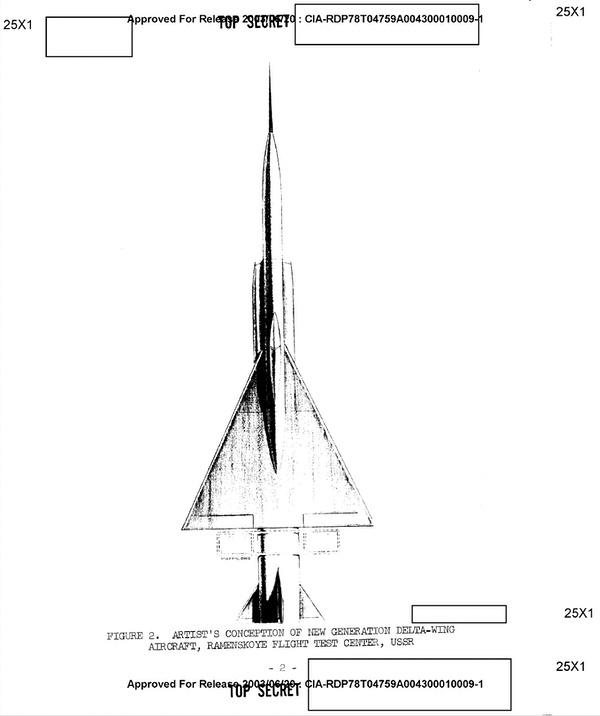 The Sukhoi Su-15 was an interceptor that was first spotted by an American satellite at Ramenskoye in the mid-1960s. This drawing was made from a satellite photo. The Su-15 was placed into production and served into the 1990s. (credit: CIA) |
By early June 1967, a total of six new generation fighter-type aircraft were observed at Ramenskoye, two of which were identified for the first time. By late July 1968, four new aircraft that were apparently not displayed at the Moscow airshow had been identified at Ramenskoye on satellite photography. These were:
- RAM A first spotted in May 1966
- RAM B first spotted in May 1966
- RAM D first spotted in May 1967
- NOVO A first spotted in April 1966
RAM A was assessed to be the possible engine testbed for the Soviet Tu-144 supersonic transport. The British-French Concorde started production in early 1965 and first flew in 1969, and later the Tu-144 earned the nickname “Konkordski.”
| With only a small number of M-50s built, the CIA obviously did not consider the Bounder to be a threat. |
RAM B and presumably RAM C were apparently the aircraft spotted in summer 1966. The swept-wing aircraft was probably the Yak-28-64, which was developed to compete with Sukhoi Su-15, the delta-wing aircraft that appeared at Ramenskoye/Zhukovsky around the same time but had been flying in prototype form for a few years. The Su-15 proved more successful and was approved for production as a twinjet supersonic interceptor that served until the 1990s. It is possible that one of the aircraft was photographed by satellite earlier, but not identified until better imagery became available.
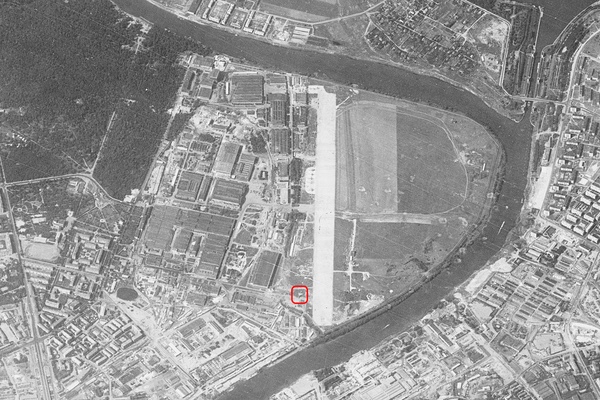 Fili was another airfield outside of Moscow. The M-52 aircraft was photographed there by an American satellite. (credit: Harry Stranger) |
The M-50 quickly fades away
With only a small number of M-50s built, the CIA obviously did not consider the Bounder to be a threat. In November 1969, the CIA produced a short report on the three M-50 aircraft, noting that all three had been moved since late 1967. “The Bounder which had been in the Myasishchev area of the Ramenskoye flight test center since September 1963 was missing from that area in March 1968, and is now on display at the air museum at Moscow/Monino airfield.”
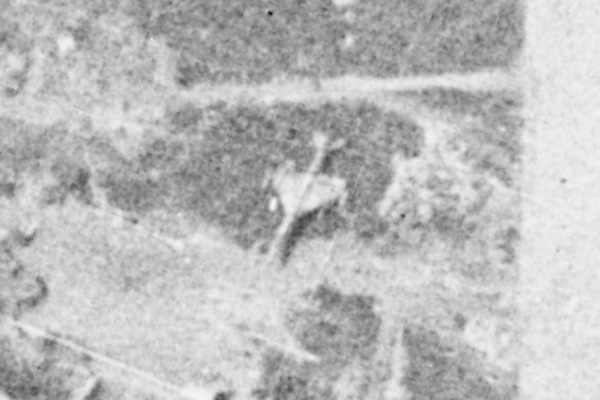 The M-52 aircraft was a modified version of the M-50. It appeared at Fili airfield outside of Moscow around 1963, but never took flight. Years later it was partially disassembled and moved by land to Ramenskoye. (credit: Harry Stranger) |
“The second Bounder aircraft, which had been at Moscow/Fili airfield since March 1963 is now in the Myasishchev area of Ramenskoye. It was observed being disassembled at Fili on ground photography of September 1967 and was not present there on satellite photography of November 1967. It appeared at Ramenskoye in June 1968 and was still there in October 1969.”
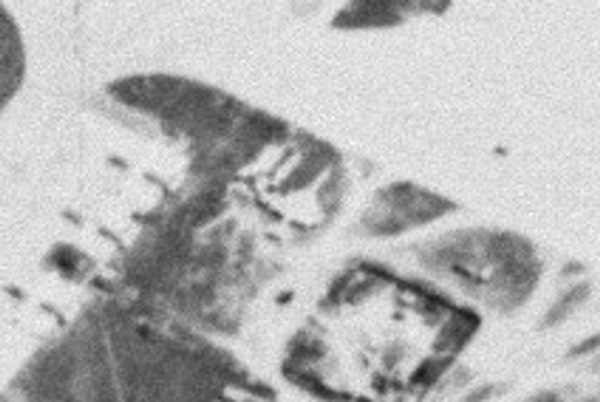 The M-52 was moved to Ramenskoye in the later 1960s. Here it was photographed in 1971. (credit: Harry Stranger) |
“In March 1968, the remnants of the third Bounder (most of the wing and aft fuselage section) were moved, probably from a hangar in the Myasishchev area of Ramenskoye, to the structure test/derelict area where they are presently located. Movement of this third Bounder was probably necessitated by the arrival of the second one from Fili.”
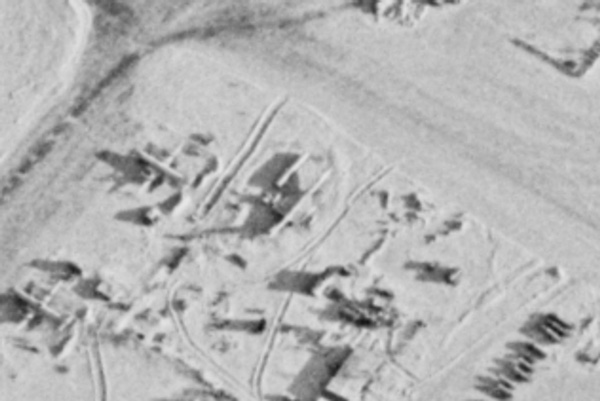 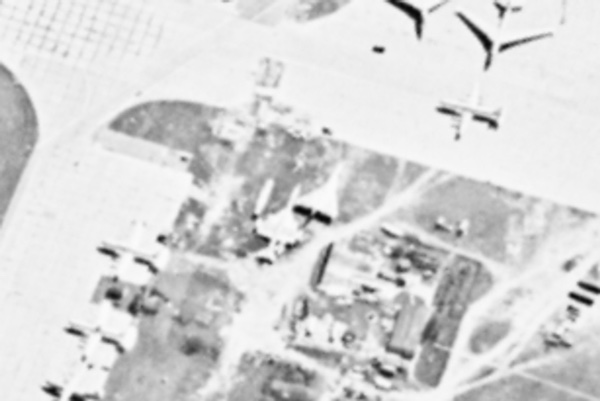 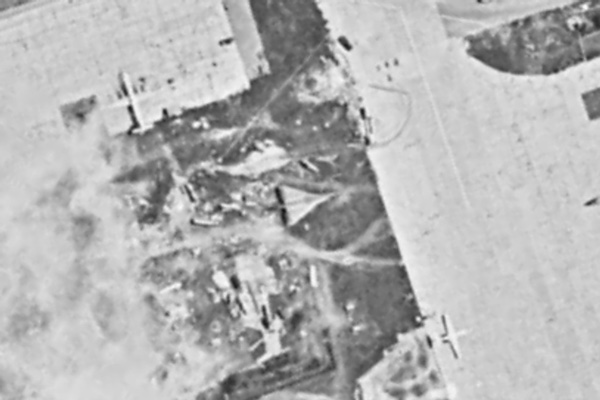 The M-52 photographed at Ramenskoye in 1974 and 1979. In the last photo, taken in 1980, the aircraft has been scrapped. (credit: Harry Stranger) |
“Because the Bounder now in the Myasishchev area at Ramenskoye had undergone several design modifications while it was at Fili, it is easily distinguishable from the Bounder moved from Ramenskoye to Moscow/Monino. The modifications consist of: A) shorter engine nacelles, B) removal of a section of the trailing edge of each wing tip at which point pods are attached, C) tapered trailing edge of wing, D) swept trailing edge of vertical stabilizer.”
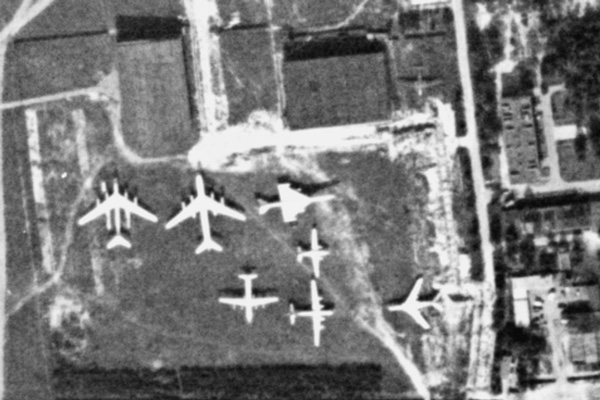 The M-50 Bounder bomber eventually ended up at the Monino museum outside Moscow. Here it was photographed in 1973. (credit: Harry Stranger) |
The M-50 is currently displayed at the Monino Museum outside Moscow. It has been photographed there by tourists, and satellites, countless times.
Next: RAMS and shuttles.
Further reading: Yefim Gordon and Dmitriy Komissarov, Myasishchev M-50 and M-52 – The First Soviet Supersonic Strategic Bomber, Schiffer, 2023.
Note: we are now moderating comments. There will be a delay in posting comments and no guarantee that all submitted comments will be posted.