The ghost beneath the shuttle ColumbiaKosmos 398, STS-73, and the last echo of the US/Soviet Moon raceby Robert M. Kelso
|
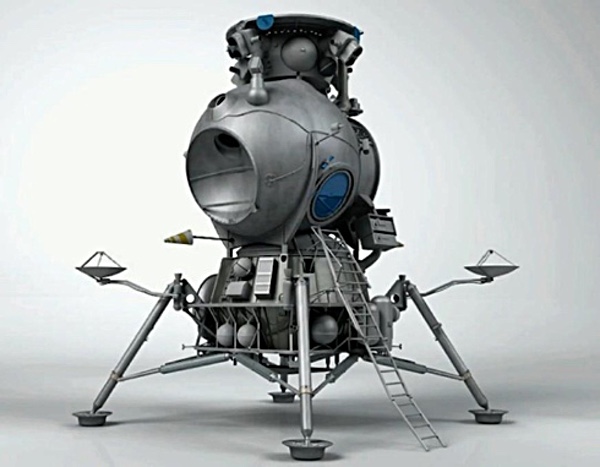
| The object was Kosmos 398. And suddenly, a piece of the first Moon Race was passing through the flight environment of Columbia. |
It was November 1995. The Space Shuttle Columbia was in orbit on STS-73, the second United States Microgravity Laboratory mission. Seven astronauts were aboard, working around the clock on a remarkably successful scientific mission. Columbia was flying at approximately 150 nautical miles in a 39-degree-inclination orbit. The mission would eventually last nearly 16 days before Columbia returned to Earth on November 5.
For most people, STS-73 was a mission about microgravity science. For the science and research communities, STS-73 was a wonderful, cooperative effort of the US government, universities, and industry to push back the frontiers of science and technology in microgravity, the near-weightless environment of space. For the shuttle flight control team, it was mostly “less-exciting”… no rendezvous, no docking, no EVAs, no large spacecraft deployments.
But, for this flight director, and for Flight Dynamics team mebers like Phil Burley, something unexpected had appeared in the orbital picture. It was initially identified simply as Space Item 4966.The description from the Space Defense Operations Center (SPADOC), located at the Cheyenne Mountain Complex in Colorado, was remarkably understated: “Lunar Cabin.”
The object was Kosmos 398. And suddenly, a piece of the first Moon Race was passing through the flight environment of Columbia. What unfolded was one of the most remarkable, memorable, and heart-touching adventures in my time in NASA Mission Control.
A lunar lander from another time
Kosmos 398 was not an ordinary satellite. Launched by the Soviet Union on February 26, 1971, it was the second uncrewed orbital test vehicle in the T2K series of the Soviet LK lunar lander. The LK was the spacecraft the Soviet Union intended to use to land a cosmonaut on the Moon.
The program never reached that goal. But the T2K vehicles were real flight hardware and were among the very few pieces in the Soviet space program to fly in space in readying for the Moon. The uncrewed lunar landers were specifically built to test the systems and operational concepts that would have been required to land and return a Soviet lunar cosmonaut.
Kosmos 398 had been launched more than 24 years earlier when our team was flying STS-73 from the NASA Mission Control Center in Houston. Now it was still up there. And… Space Shuttle Columbia was up there, too.
The two spacecraft represented different generations, different nations, different programs, and very different chapters of spaceflight history. Yet they were both circling the Earth at the same time.
“Lunar cabin”
At approximately Mission Elapsed Time (MET) of 5 days, 4 hours, and 15 minutes after launch of Columbia into space, NORAD/SPACECOM notified the Flight Dynamics Officer of Space Item 4966.
The object was identified by SPACECOM as: “Lunar Cabin.” That description would have immediately gotten the attention of anyone who understood what it meant. This wasn’t simply another cataloged piece of orbital debris. This was a Soviet lunar lander test vehicle… and one of the last remaining spacecraft still in-orbit from that challenging Moon Race of the 1960’s.
And it belonged to a story that NASA flight controllers knew intimately because their own history was built around the same fundamental engineering challenge. Before Apollo could put astronauts on the Moon, NASA had to prove that the Lunar Module could actually work.
| The ephemeris showed the separation between Columbia and Kosmos 398 as 50.8 miles. Not thousands. Not some abstract orbital coincidence. Fifty point eight miles. |
The Soviets had followed a remarkably similar philosophy: Test the lunar lander in Earth orbit. Exercise its systems. Understand how it behaves. Build confidence before putting a human being inside it.
That parallel was not lost on us in Mission Control. And now, more than two decades later, one of those Soviet test vehicles was about to cross Columbia's orbital neighborhood.
Flight Dynamics goes to work
Once the notification arrived, Kosmos 398 became much more than a line in an orbital catalog. The Flight Dynamics team wanted to know exactly where it was. A later SPADOC report logged at approximately MET 10/15:47, provided another piece of the puzzle. The report indicated that the tracking data had been solved for drag, yielding an area of 74.22 square feet.
The team continued working to refine the orbit of this forgotten Soviet lunar lander test vehicle. As Flight Director, I issued direction for additional tracking resources to be brought into the effort, including C-band tracking assets.
With updated tracking data in-hand, I had the FDOs add another ground track onto large 10-by-20-foot plot board in the Mission Operations Control Room, Kosmos 398 was put onto the picture.
There it was. A Soviet lunar lander test vehicle. Flying around Earth. And Columbia was flying nearby. For a Flight Dynamics Officer, this was first and foremost a flight dynamics problem. Where was it? Where would it be? What was the geometry? Would it pass close enough to Columbia to be seen? Could the crew possibly observe it?
But for those of us looking at the history behind the numbers, there was something else happening. We knew what we were looking at.
“Lunar vehicle flyby”
The FDO report was eventually titled: LUNAR VEHICLE FLYBY. The report gave the predicted geometry in the precise, wonderfully matter-of-fact language of Mission Control.
At MET 11/03:02, Kosmos 398 would come AOS from behind the Earth. The orbiter would be in its current attitude of the payload bay facing the Aun. The prediction indicated that Kosmos 398 would emerge from behind the Earth behind the tail of Columbia, toward the port side. The geometry was described precisely: 14 degrees of pitch. 40 degrees of yaw.
It was not expected to be visible from the crew cabin at first. But then came the possibility. At approximately MET 11/03:06, the 398 vehicle was predicted to pass beneath the belly of Columbia, traveling from port to starboard. And it might be visible from Window 5 of the crew cockpit. The prediction placed it approximately 25 degrees above the Earth's horizon, moving away from Columbia toward the horizon. It would remain approximately 20 degrees below and 36 degrees to the right of the Orbiter's nose.
The report also noted that constellation Draco would be too obscured by the Earth to help identify and locate 398. And at approximately MET 11/03:13, Kosmos 398 would disappear behind the Earth again. That was the prediction.
But then came the number that made the encounter real. The FDO logbook recorded that at approximately MET 11/03:17, the ephemeris showed the separation between Columbia and Kosmos 398 as: 50.8 miles. Not thousands. Not some abstract orbital coincidence. Fifty point eight miles.
A piece of the Soviet lunar program was passing through the neighborhood of an American Space Shuttle.
We wanted to see it
There is a difference between tracking something and seeing it. Flight Dynamics can tell you where an object is. Orbital mechanics can tell you where it will be. An ephemeris can tell you how far away it should be. But none of those things guarantees that a human being will actually see the spacecraft. Unfortunately, it was not visible to the flight crew.
| But the human eye never found the spacecraft. And somehow, that made the whole thing even more poignant. |
So, we kept looking. Later on November 3, another SPADOC vector was transmitted for Space Item 4966. The Pointing Officer examined the possibilities and identified another opportunity for a visual sighting. The predicted time of closest approach was MET 14/08:39. This looked like the best opportunity. The team tried. But there was no joy.
The observation record was brutally simple: “All dark, low elevation.” No sighting. The numbers had worked. The tracking had worked. The prediction had worked. But the human eye never found the spacecraft. And somehow, that made the whole thing even more poignant.
A ghost from the Moon Race
By then, Kosmos 398 had become something different in our minds. It was still Space Item 4966. Still an orbital object. Still something that had to be tracked and characterized. But it was also a survivor.
It had been built for a mission that never happened. It had been part of a national effort to put a human being on the Moon. It had flown in 1971, when the United States and Soviet Union were still competing fiercely for the technological and political achievement of reaching the lunar surface.
The Soviet N1 rocket had failed. The Soviet lunar landing program was eventually abandoned. Apollo had gone on to the Moon. And then, 24 years later, one of the Soviet program’s lunar landing test vehicles was still circling Earth.
Now it was passing beneath an American Space Shuttle. For a few minutes, the past and present of the Moon Race occupied the same sky.
The Apollo 5 connection
There was another reason the encounter resonated so strongly. The philosophy behind Kosmos 398 was familiar. NASA had faced essentially the same engineering question with Apollo.
Before astronauts could trust the Lunar Module on the Moon, NASA had to test it. Apollo 5 did that. On January 22, 1968, an uncrewed LM-1 flew into Earth orbit. The mission exercised the descent and ascent propulsion systems and demonstrated the ability to abort from a simulated lunar landing back into orbit. NASA considered the flight a complete success.
The Soviet T2K program represented the same fundamental engineering instinct: Before you send a human being to the Moon, fly the machine first.
Different nations. Different spacecraft. Different engineering organizations. Different political systems. But the same fundamental problem. Can we build a machine that can take a human being to another world and bring him home?
That is the part of the Space Race that engineers and flight controllers understood particularly well. Underneath the politics was an extraordinary commonality of purpose.
The end of the journey
STS-73 continued. The experiments continued. The crew continued working. And Columbia eventually came home on November 5, 1995, after 15 days, 21 hours and 52 minutes in orbit.
But Kosmos 398 remained in orbit… if only for a little while longer. For those of us who had watched it move across the plot board, it was no longer anonymous.
| We were not simply tracking Space Item 4966. We were watching history pass beneath Columbia. And it touched our hearts. |
We knew its history. We knew what it had been built to do. We knew what it represented. And we knew that its time in orbit was coming to an end. Kosmos 398 eventually reentered the atmosphere in December 1995. The spacecraft that had once represented a possible Soviet road to the Moon disappeared in fire.
What we really saw
Looking back, the remarkable thing about the Kosmos 398 encounter is that we did not actually need to see it with our eyes. The MCC team had seen it! Not visually. But through the mathematics. Through the tracking data. Through the state vectors and ephemeris. Through the plot board. Through the predicted geometry. Through the terse language of a Flight Dynamics Officer’s report.
We watched a spacecraft that had been built for the first Moon Race cross the orbital neighborhood of Columbia. We calculated where it would be. We predicted when it would appear. We searched for it through the windows. We tried again later. And although the visual sighting never came, something perhaps more important did.
We recognized what was passing by. For a few minutes during STS-73, the future of American human spaceflight was flying alongside a ghost from the first attempt to reach the Moon. Columbia was carrying the science of the future. Kosmos 398 was carrying the memory of the past.
And somewhere between the two, on a large plot board in Mission Control, the history of the Moon Race came alive again. We were not simply tracking Space Item 4966. We were watching history pass beneath Columbia. And it touched our hearts.
And then—we watched it go.
Note: we are now moderating comments. There will be a delay in posting comments and no guarantee that all submitted comments will be posted.