Slaying snakes, claiming freedom: Susan Still Kilrain’s unconventional astronaut careerby Dwayne A. Day
|
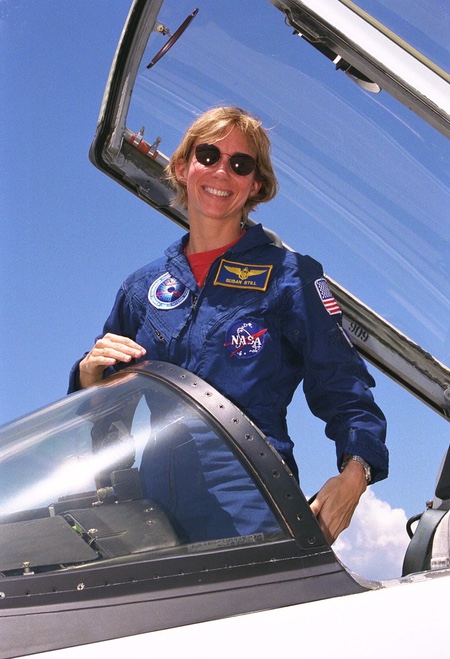 STS-94 Pilot Susan Leigh Still arrives at the Shuttle Landing Facility aboard a T-38 jet in preparation for the reflight of the Microgravity Science Laboratory-1 mission. (credit: NASA) |
But Still’s autobiography also resonates in how it discusses the before-and-after of her space missions. Full disclosure: I am a Navy veteran, and I joined in April 1997, the time STS-83 also launched. While Still joined in 1985, not much had changed between when she joined and when I enlisted, and she discusses some of the struggles she encountered as she broke barrier after barrier before, during, and after United States Naval Test Pilot School. While she excelled as a pilot and in the academics required to complete such a challenging school, she still faced indignities such as unwelcome verbal barbs from male colleagues and even one disturbing instance of physical harassment.
| Still also discusses why she didn’t go on to command a second mission, which has nothing to do with her excellence and fidelity as an astronaut. |
Indeed, the 1990s were a tumultuous time for women in the Navy, but Still’s approach to these unpleasant realities didn’t involve protesting. Instead, she proved her mettle by showing she was more than capable of operating complex, unforgiving high-speed aircraft. When you work with frankly dangerous machines, the machines don’t care about whether you’re a woman or not. They care if you know how to operate them without killing others and yourself.
Still also discusses why she didn’t go on to command a second mission, which has nothing to do with her excellence and fidelity as an astronaut; indeed, her mission commander stated in a pre-flight interview, “While on orbit, Susan is second in command… she was assigned because she’s the best pilot.” (It bears mentioning that Still, ever humble, states in the book, “I’m only just coming to realize that perhaps I really had deserved to fly first.”) Still went on to start a family with her husband, a Navy SEAL, and wrote, “Every astronaut, male or female, has to decide what matters most at any given time… Life has a way of charting a better course than the one we plan.” The “busyness” of astronaut and Navy life, alongside having small children to raise and a husband in a combat zone, no longer appealed to Still as much.
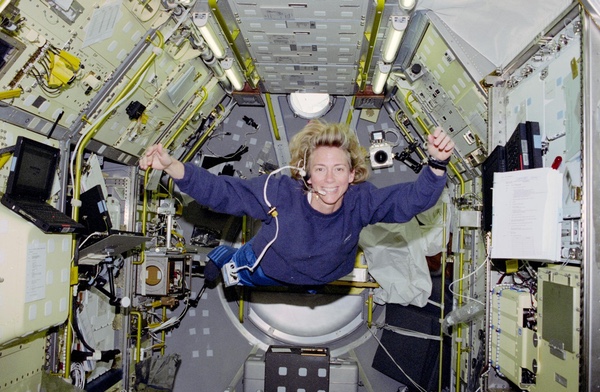 "Astronaut Susan L. Still, pilot, floats into the Spacelab Module in the early phases of its activation. Still, a member of the 1995 astronaut class, joined four other NASA astronauts and two scientist payload specialists for the Microgravity Science Laboratory 1 (MSL-1) mission aboard the Earth-orbiting Space Shuttle Columbia. (credit: NASA) |
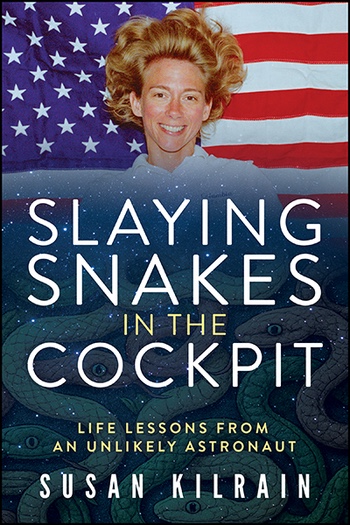
Still relates that some still ask her why she didn’t have a more prolific astronaut career (personally, I think flying two spaceflights is impressive enough, but I suppose the public can be fickle.) Slaying Snakes answers this beautifully and, in a genius way, lays out Still’s own feminist manifesto. Some might be tempted to criticize her for not loudly protesting some of the indignities she encountered in the Navy, and some might want to do the same given that she chose to raise a family rather than continue flying in space. But, to me, her decisions exemplify a powerful type of feminism and feminine freedom.
Still realized that to be respected and “seen” in a highly male-coded environment, she first had to excel on what men viewed as their turf: the flight deck. And this she did. In addition, there’s no “rule book” that says a woman must have a “set” career and life, no matter who came before or after her, and her career is still an incredible template for any young woman pilot to aspire to. You can easily “slay snakes” at home and at work. The feminist Germaine Greer once wrote, “Freedom is fragile and must be protected. To sacrifice it, even as a temporary measure, is to betray it.” At the conclusion of Slaying Snakes, you’re not at all sad for Susan Still Kilrain, or feel like she got “cheated.” You realize she achieved perfect freedom.
Slaying Snakes in the Cockpit is available at all major booksellers and through BookPress’ website.
Note: we are now moderating comments. There will be a delay in posting comments and no guarantee that all submitted comments will be posted.