A long-distance look at SPACEHABby James Behling
|
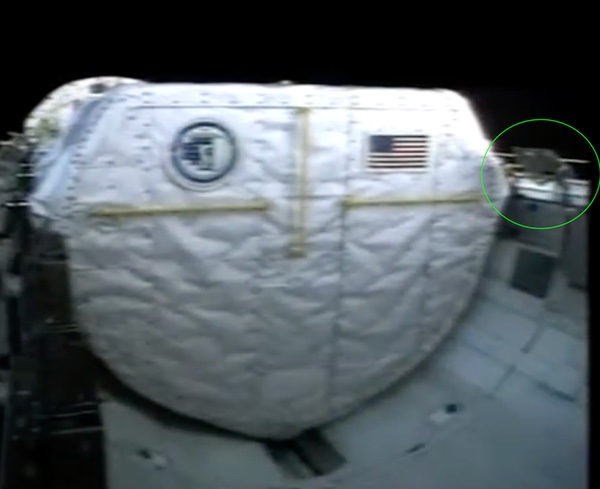
| The entire SPACEHAB module was covered in white multilayer insulation (MLI). As the view panned across the module’s aft bulkhead, I noticed a large gray area near the right-hand edge. |
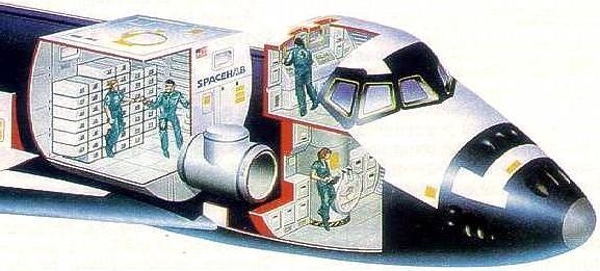
Although originally designed to support small-scale experiments, SPACEHAB ultimately found its primary role as a pressurized logistics carrier for space stations. It supported seven logistics flights to Mir, five logistics flights to the International Space Station (ISS), and six dedicated science missions. Overall, SPACEHAB modules flew on 18 shuttle missions, compared with 16 missions for the NASA/European Space Agency's Spacelab modules.
In 1990, SPACEHAB received a NASA contract to provide 200 lockers over six missions, while reserving the remaining capacity for commercial customers. Its first mission was STS-57 in June 1993. The second mission, STS-60, focused on science and carried Sergei Krikalev, the first Russian cosmonaut to fly aboard a US spacecraft. In 1995, after SPACEHAB’s third mission carried another cosmonaut and rendezvoused with Mir, the company received a contract to support seven Shuttle-Mir missions.
I was hired in 1992 and was responsible for experiment and payload ground operations. I created and managed the plans and schedules for when the experimenter/payload owner was to hand over their hardware and when it would be installed in the module. Additionally, I provided lab space and instruments to the experimenters.
Our busiest times were once the shuttle was at the pad, when we loaded experiments and payloads in the module during the countdown. After launch, we had a lull until landing, as the Florida team had little involvement in on-orbit operations. Those were the responsibility of our Huntsville headquarters, which sent personnel to Houston to support each mission. Consequently, the period between launch and landing was our slowest time, and we often used it to perform facility work.
On Saturday night, March 23, 1996, Atlantis was on Flight Day 2 of STS-76, SPACEHAB’s first Mir logistics mission. We needed to recoat the surface of the floor in the transporter airlock so that it met cleanroom requirements and was compatible with air bearings. We scheduled the work for the weekend after the launch. Since somebody had to be in the facility with the contractors and I was single at the time, I volunteered for the Saturday night shift and the overtime.
It was boring, since it was pre-Internet days and the TV system in the building was set up only to get NASA TV and a few blurry over-the-air broadcast stations. I walked around the building and watched the contractors. I decided to check on the mission and went to turn on NASA TV in the break room. The crew was asleep, so the video downlink was just from the orbiter's payload bay cameras. Typically, the cameras were used for observations of Earth or lightning, or for surveys of the payload bay. In this case, most of the views were of Earth. Mission Control was panning the cameras around. At one point, the view from the aft starboard camera swept across the aft bulkhead of the SPACEHAB module.
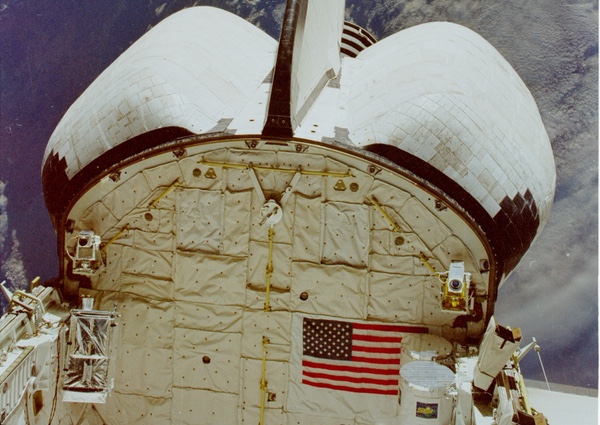 The orbiter’s aft starboard payload-bay camera is visible at left. (credit: NASA) |
I watched with interest because it was our hardware. The entire SPACEHAB module was covered in white multilayer insulation (MLI). As the view panned across the module’s aft bulkhead, I noticed a large gray area near the right-hand edge. “Uh-oh,” I thought. Perhaps one of the MLI blankets had come loose during launch. I wondered whether the exposed area might raise the module’s cabin temperature or create a localized hot spot in the structure.
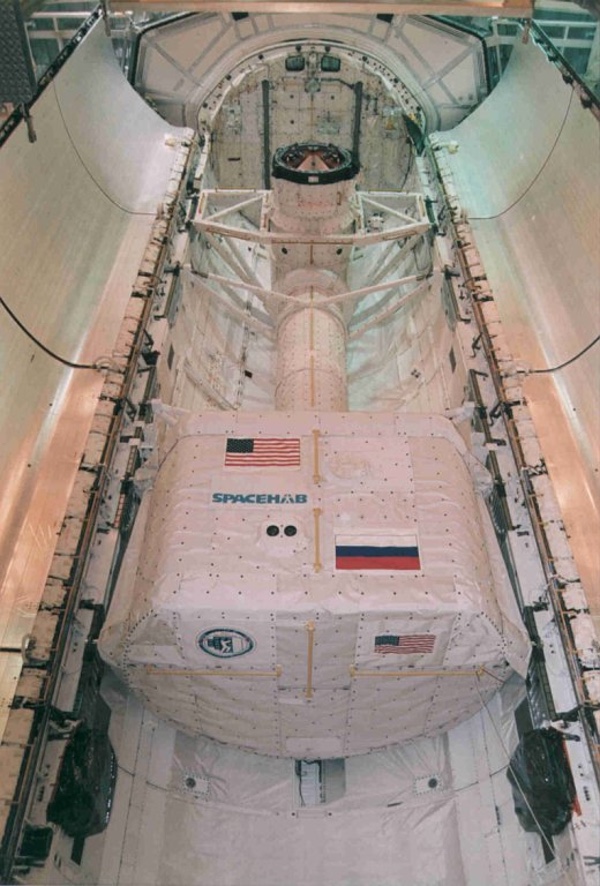 TView of SPACEHAB module aft bulkhead (credit: NASA) |
I pondered what to do. We had a call tree for the mission, so I decided to call a counterpart in experiment operations, who was then supporting the mission from Houston. He answered the phone from his console in mission control (in one of the support rooms). I described what I had seen, but there were two problems: the camera view had changed, and their monitors were not tuned to NASA TV. This made it harder to explain what I had seen. He took the information and thanked me for it.
I went about trying to relieve my boredom and watched the contractor spread the floor sealant. Half an hour later, I was paged by the security guard. I went to see him, and he gave me a Houston phone number to call. The call reached our SPACEHAB Operations Director in mission control. He told me to get in front of a TV and to call back on another number, which I did. To my surprise, I was talking to the Instrumentation and Communications Officer (INCO) in Mission Control. Soon afterward, the television returned to a payload bay view. The INCO then said if I told him which way to point the camera to find the area I saw, he would move the camera. I proceeded to watch the TV as the camera panned and tilted in response to my directions (with a delay, of course). I got the same view of the module that started the whole thing, and we both saw the gray area. The INCO zoomed the camera in on the gray area. As the image came into focus, the mysterious gray area proved to be an EVA foot restraint that was attached to the payload bay sill, just in front of the aft bulkhead.
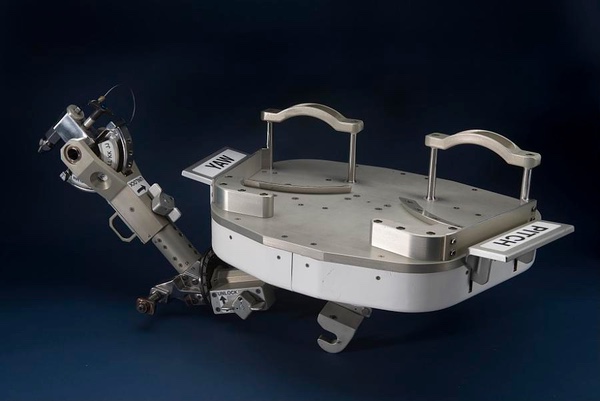 Example of an EVA foot restraint. (credit: Smithsonian National Air and Space Museum) |
Here is a still from the aft port camera from a different point in the mission.
 Still from STS-76 Flight Day 2 at 3:21 (credit: NASA) |
There was a collective sigh, and I was then thanked by the INCO for my sharp eye. I returned to my uneventful night shift smiling, knowing that, from a television in Port Canaveral, I had helped direct a camera aboard Atlantis.
Note: we are now moderating comments. There will be a delay in posting comments and no guarantee that all submitted comments will be posted.