A reusable rocket alone is not a resilient launch systemby Burak Oktenli
|
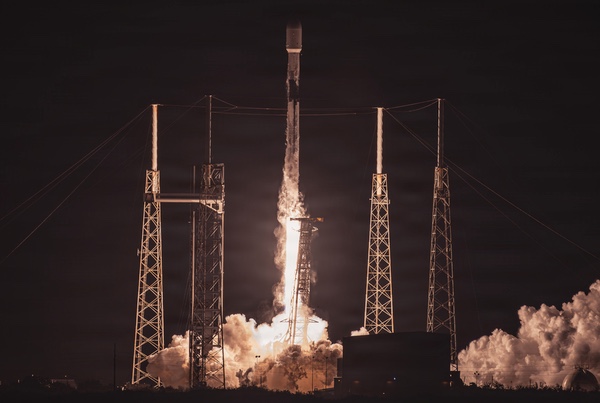
| Reuse reduces the number of replacement vehicles a factory needs to build. That saves hardware, but it can also slow production learning and leave a specialized workforce dependent on a smaller annual build. |
Inna Galinger recently argued in The Space Review that Starship’s impact will depend on the economic activity enabled by its capacity, not simply on the advertised launch price (see “Starship’s real test may begin after launch,” The Space Review, October 12, 2026). That is right. The next layer of analysis concerns going from a promising vehicle to a dependable transportation service: refurbishment, manufacturing, launch pads, mission integration, spare capacity, and the ability to switch when a preferred rocket is unavailable.
Reuse starts between flights
A returning booster and a returning orbital stage face very different engineering burdens. The first stage separates well below orbital speed; an upper stage must endure the much greater thermal and structural demands of reentry from orbit. Recovery hardware and propellant also consume mass that could otherwise contribute to payload. These are familiar tradeoffs, not arguments that upper-stage reuse is impossible.
The business case depends on what happens after landing. How many labor hours are spent inspecting thermal protection? How many components need replacement? How often does an engine or structural finding force an extended standdown? How many launches can the pad and its ground crews support while repairs and vehicle production proceed? A beautiful catch is a milestone in recovery, but alone is not proof of affordable reuse.
Cadence matters for another reason. The development, manufacturing, and fixed costs of a reusable fleet must be spread across its completed missions. High demand can make those fixed costs easier to absorb, while frequent refurbishment can eat away at the advantage. A rocket flown ten times a year belongs to a different economic proposition from one flown many times that often, even with the same hardware.
There is a less obvious manufacturing consequence. Reuse reduces the number of replacement vehicles a factory needs to build. That saves hardware, but it can also slow production learning and leave a specialized workforce dependent on a smaller annual build. There is no universal launch-rate threshold at which reuse becomes economical. The answer changes with the mission, factory economics, recovery approach, maintenance burden and accounting treatment.
Cost itself needs precision. The price paid by a satellite customer is not SpaceX’s internal recurring cost; neither is the full program cost after development and infrastructure, or the customer’s cost of delay if a mission misses a narrow operational window. A provider can cut its own costs without passing the full savings to buyers.
What a launch swap proved
On March 20, the Space Force announced that its GPS 3-8 mission would move from United Launch Alliance’s Vulcan to SpaceX’s Falcon 9 while an anomaly investigation on Vulcan continued. On April 21, the GPS satellite reached orbit. The government reported completing the provider change in under seven weeks. The episode is a more revealing measure of launch resilience than a count of rockets on contract: a mission with a real payload and destination could move between two operational systems in time to preserve its delivery.
That result is encouraging, but it should not be romanticized. A GPS satellite is not a shipping container that can be placed on any available rocket. A switch can require new compatibility work on interfaces, loads, environments, mission software, range arrangements, integration schedules, and assurance. Some missions, especially very large or unusual spacecraft, have no near-term replacement vehicle. An alternative matters only if the payload can actually fly on it, the new provider is qualified for the task, and a launch opportunity exists.
| The episode is a more revealing measure of launch resilience than a count of rockets on contract: a mission with a real payload and destination could move between two operational systems in time to preserve its delivery. |
The Space Force already recognizes the value of multiple providers. Its National Security Space Launch Phase 3 program uses different lanes for missions with different demands. In July it expanded its Lane 1 pool to seven contract holders. This increases competitive possibilities, but contract eligibility is not equivalent to immediately available flight capacity; some providers still must complete qualifying flights and mission-specific work. Resilience must be counted in actual transfers of payloads among vehicles, not just names on an award list.
The practical next step is a recurring launch-substitution exercise. Select a representative satellite and ask how quickly it could shift to a second qualified vehicle if the original vehicle was grounded. Include the engineering effort, available slots, price of the change, approvals that cannot be waived, and the chance of missing the customer’s actual deadline. A 30-day target could be a useful stretch goal for suitable missions, but it should be treated as a goal to test rather than a capability it assumes the industry already possesses.
A constellation does not stop aging during a grounding
The consequence of dependence grows as satellites become more numerous and less individually expensive. A proliferated constellation can withstand the loss of several satellites, but keeping it healthy requires an ongoing replacement stream. Losing that stream may be less dramatic than a launch failure and more consequential than it first appears.
Consider a deliberately simplified 240-satellite constellation whose spacecraft reach the end of their service lives at an even rate over five years. It needs about four replacements per month. If the sole launcher is unavailable for a year, roughly one-fifth of the fleet could age out before replenishment resumes. If a prequalified second provider starts after a one-month delay and can cover three-quarters of normal replacement demand, the remaining fleet would be about 94% of the original size after that year instead of about 80%.
These numbers are an illustrative inventory exercise, not a prediction of Starlink or of any real constellation. Actual satellites have different ages, lifetimes, reserves, and failure rates; on-orbit spares and coverage design matter. The example, though, illustrates one fact: recovery time and replacement capacity can dominate the consequences of a launcher grounding.
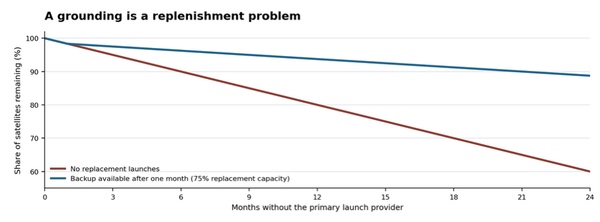 Illustrative calculation only. Assumes 240 satellites, four retirements per month, and a backup replacing three per month starting after month one. This is not flight performance or an actual constellation forecast. Graphic by the author. |
Measure access recovery as carefully as vehicle recovery
The next generation of launch services needs two scorecards, not one. The first belongs to the operator: repeated flights of recovered hardware, inspection labor, replaced parts, pad turnaround, mission success, and fully burdened costs for specified missions. The second belongs to the customer: how many days a grounding would delay a critical launch, how fast another provider could accept the payload, what the switch would cost, and whether the mission could still meet its deadline.
| The more space infrastructure depends on fast, cheap replenishment, the more important a tested recovery path becomes when the system that normally provides it cannot operate. |
Those measurements serve different markets. A broadband operator with a flexible replacement manifest may prize the lowest sustainable price per satellite. A national security customer replacing an aging asset may pay more for a qualified second path. A lunar program may care most about a sequence of tankers and a propellant-transfer operation succeeding in the correct order. No single dollars-per-kilogram figure can answer all three.
SpaceX is right to pursue full reuse aggressively. The effort can increase launch capacity and lower costs that once made entire missions uneconomic. But that success does not remove the need for independent providers, adaptable payload interfaces, and rehearsed alternatives. Indeed, the more space infrastructure depends on fast, cheap replenishment, the more important a tested recovery path becomes when the system that normally provides it cannot operate.
The next Starship catch, if successful, will make headlines for good reason. However, the seven-week GPS launch switch deserved more attention than it received. One shows that a vehicle can be recovered and potentially reused; the other shows that a mission need not be lost with its assigned vehicle. The mature launch economy will need both.
Note: we are now moderating comments. There will be a delay in posting comments and no guarantee that all submitted comments will be posted.