The space code: How China uses culture to build its space soft powerby Krzysztof Karwowski
|
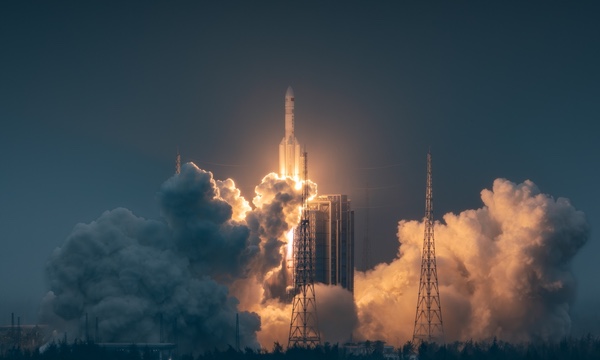
| Space programs are neither purely technological nor military domains. They offer a specific opportunity as vehicles of soft power projection. |
Beijing leverages the nomenclature of its space missions to legitimize the vision of the “great rejuvenation of the nation“ (Fùxīng) and cultivates the image of civilization-state of inventors and astronomers. While Western space exploration relied for decades on Greco-Roman traditions, China’s cultural codification offered an alternative pole in astropolitics, trying to export its original vision across the Global South especially.
Space programs are neither purely technological nor military domains. They offer a specific opportunity as vehicles of soft power projection. Their functions as science diplomacy brands calibrated to generate domestic pride, influence the rising astropolitical order.
Throughout the Cold War space race, both the United States and the Soviet Union drew from a shared Mediterranean heritage despite fundamental ideological division. Both superpowers utilized Greek and Roman mythology (Gemini, Apollo, Helios in the American case, Luna and Venera on the Soviet side). When the People’s Republic of China launched its first satellite in 1970, it was named Dong Fang Hong (“The East Is Red,” the title of the patriotic communist anthem), while its launch vehicles were named the Cháng Zhēng (the Long March, an important event of the history of Chinese communism and foundation of Mao Zedong’s path to power). This was classic, austere revolutionary language of space narrative. The death of Mao was a turning point. The zealous party campaigns were gradually withdrawn, and the fight against the legacy of the past was abandoned.
Over the past decades, Beijing’s public diplomacy and visual statecraft have undergone a structural evolution. An examination of the nomenclature of Chinese space missions reveals an obvious departure from communist symbolism. Across the space endeavors, strictly political motifs comprise only a small fraction, whereas designations rooted in mythology and philosophy of nature predominate. Communism remained only in the matter of launching capabilities, where most of the payloads were still carried out by the Long March rocket family.
In traditional Chinese religious thought, the Heavens (Tiān) served as the primary source of moral order, harmony, and political legitimacy. The sovereign derived the “Mandate of Heaven” (Tiānxia) as the Son of Heavens (Tiānzǐ). The modern Chinese authority undertakes a pragmatic secular transfer of these archetypes: technological milestones are applied to legitimize state competence and one-party rule, transposing traditional attributes of divinity into modern developmental statecraft.
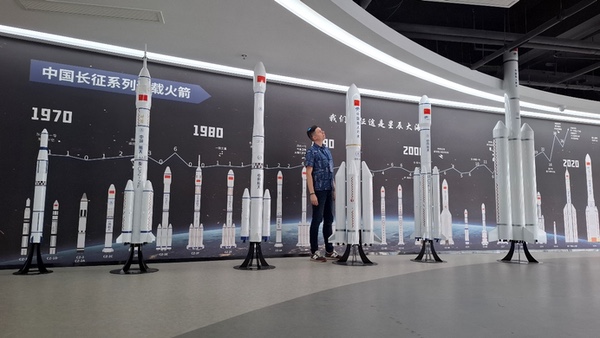 The family of Long March rockets on display at an exhibition at Beihang Beijing University of Aeronautics and Astronautics. (credit: author) |
Mythological pantheon on the Moon
Within the CSP, the selection of names is neither accidental nor a technical shorthand. It constitutes a cohesive framework of cultural narrative. The most prominent example is lunar exploration project known as the Cháng’é Program. This lunar research effort bears the name of the mythical goddess of harvest, friendship, and longing. According to legend, beautiful Cháng’é, after consuming the elixir of immortality, ascended to reside on the Moon. Her name was given to the space probes exploring the Moon, while she herself became a broader patroness of the entire Chinese space program. The surface rovers deployed by the Cháng’é landers, were designated Yùtù (Jade Rabbit), the loyal companion of the goddess.
In turn, the relay satellites enabling communication with the lunar far side were named Quèqiáo (Magpie Bridge), drawing on the folklore tale of separated lovers for whom a flock of magpies forms an annual celestial bridge across the Milky Way.
Gods, poems and stars
The China interplanetary program takes its name from Qu Yuan’s classical poem from the fourth century BCE titled Tiānwèn (“Questions to Heaven”), which contemplates the origins of the universe and the search for truth. Tiānwèn 1 was the flagship mission sent to orbit Mars in 2020 and land on its surface. The accompanying rover was named Zhùróng, after the mythical god of fire and war, mirroring the traditional Chinese designation for Red Planet. It is worth recalling that prior to the Tiānwèn launch, China attempted to send another Martian probe in cooperation with Russia. The failed Fobos-Grunt mission was intended to deliver the Chinese orbiter Yínghuǒ (“Firefly”) as part of the broader scientific project called Huǒxīng (Fire Star or Fire Planet).
| Why the Chinese decided to incorporate its ancient culture into a cutting-edge strategic research and technology effort? The identity and international perception, in line with soft-hard power conceptualization popularized by Joseph Nye, are not fixed. |
Another important example is China’s orbital infrastructure and its crown jewel, the space station. The literal meaning of Tiāngōng is the “Heavenly Palace”. Its science laboratory modules are named Wèntiān (Quest for the Heavens) and Mèngtiān (Dreaming of the Heavens), uniting ancient poetics with technological pragmatism. The core module, Tiānhé (Celestial Harmony), also received its sky-inspired connotation.
Moreover, Chinese crews reach their orbital outpost aboard Shénzhōu (Divine Vessel) spacecrafts. The designation of these crewed vehicles carries a profound, layered cultural resonance readily understood across Chinese society. Beyond its literal meaning, Shénzhōu (神舟) is a homophone word for Shénzhōu (神州), the “Divine Land” or “Celestial Realm”, one of the historic honorifics for imperial China.
Above the Middle Kingdom shines yet another symbol. It is the Běidǒu satellite system. China’s indigenous alternative to GPS takes its name from the Little Bear (Ursa Minor) constellation utilized by Chinese sailors for navigation. The function was the same, the name was completely different but domestically renowned.
Other examples of the culture-rooted names for the space missions (alphabetic). Source: author’s individual research.
| Mission name | Source | Translation | Mission description |
|---|---|---|---|
| Gān Dé | Astronomy | Ancient Chinese official and astronomer born in the State of Qi | Planned Tiānwèn 3 name to the Jupiter and its moon system |
| Fēng Yún | Meteorology | Wind and Clouds | Weather-forcasting satellite series |
| Lóng Jiāng | Geography | Dragon River, Chinese name of Amur (Heilongjiang River), North China | Lunar extreme wavelength satellite |
| Mengzhōu | Space inspiration | Dream Boat, vessel from the dreams | Designed crewed capsule |
| Nüwa | Mythology | Goddess and creator of humankind | Satellite measuring the anthropocentric CO2 emissions |
| Tiānyǎn | Space inspiration | Sky Eye | FAST; China 500-meter radiotelescope |
| Wukōng | Ming era novel “Journey to the West” | Understanding the Void; referring to the elusive nature of dark matter; the name of the novel’s main character – Monkey King | DAMPE – “Dark Matter Particle Explorer” orbital observatory |
| Xī hé | Tang era poem “Suffering from the Shortness of Days” | Goddess of the Sun | Chinese Hα Solar Explorer – sunwind monitoring mission |
Crucially, Beijing has institutionalized public engagement in the naming process. Since 2021, designations for aerospace hardware (landers, rovers, and spacesuits) have frequently been selected through nationwide public polls coordinated by the China National Space Administration. The celestial symbolism in this manner, became actively internalized by society, serving as a pillar of national cohesion and great-power identity.
Mobilizing culture for geopolitics
Why the Chinese decided to incorporate its ancient culture into a cutting-edge strategic research and technology effort? The identity and international perception, in line with soft-hard power conceptualization popularized by Joseph Nye, are not fixed. They are negotiated and constructed through social interactions and narrated symbolism. China has operationalized this dynamic that can be characterized as an achievement-branding loop. First, the technological achievements take place, when the CSP performs the pioneering missions (e.g., soft-landing on the far side of the Moon or the space station assembly). Next, the propaganda services run a carefully deliberated media branding. The discourse frames these breakthroughs within a civilizational narrative that spans millennia, casting China as a distinct technological civilization with its own epistemological paradigm. This is the main goal of leaving the socialist slogans and avoid image of a socialist imitator of the West.
| The Chinese nomenclature, culturally distinct to Western audiences, projects its own aura of technological autonomy and also an independent civilizational agency. |
Even the diplomatic efforts act to transform the space program into a political capital. Space missions elevated to the role of international prestige source, fueled by aerospace experts and vivid graphic messaging, incentivize international partners to join Chinese multilateral astronautic initiatives such as the launching campaign advertised by the China Great Wall Industry Corporation, or the format of the International Lunar Research Station, or ILRS.
This trajectory mirrors the strategic directives set in state documents: “China’s Space Program: A 2021 Perspective“ and the White Paper on Diplomacy: “(2023) Global Community of Shared Future“. Both emphasize that external messaging must anchor itself in “deep cultural heritage interconnected with the unique experience of Chinese modernization.” The connection of ancient and new, cultural and technological, takes place.
Strategic takeaways and implications
For generations, the dominant narrative of space exploration relied almost exclusively on Western legends and historic milestones: the Artemis program named after the twin sister of Apollo is not an exception here. Beijing’s space expansion introduces an alternative symbolic lexicon. The Chinese nomenclature, culturally distinct to Western audiences, projects its own aura of technological autonomy and also an independent civilizational agency. The CSP became a bridge connecting millennial traditions with technological development in the information age. China systematically and globally communicates its concept of a “community with a shared future for mankind,” presenting itself as an inclusive architect of an alternative institutional architecture in counterpoint to American dominance. Promoting critical assets such as the BeiDou navigation network across the Global South, China reinforces long-term technological interoperability and geopolitical alignment.
Western policymakers cannot afford to assess the Chinese space machine only through rocket payloads and number of launches. The competitive trajectory of CSP is driven as much by narrative diplomacy, carefully engineered strategic culture, and identity formation. Neglecting the civilizational dimensions of China’s space strategy risks underestimating both its appeal across emerging markets (Africa, Southeastern and Central Asia, Eastern Europe, and the Balkans) and its mobilizational capacity at home.
Note: we are now moderating comments. There will be a delay in posting comments and no guarantee that all submitted comments will be posted.