Is the south pole the right place for a lunar base?by Jeff Foust
|
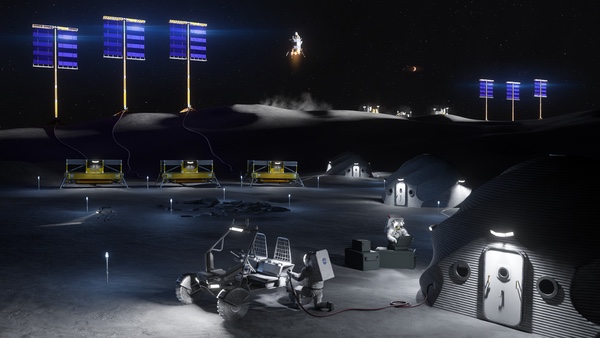
| However, even as NASA intensifies its focus on the Moon’s south pole, there are those who argue that emphasis is unwise. |
NASA will also use the event to provide an update on Moon Base, its plans announced at Ignition to establish a lunar base near the south pole of the Moon. In late May, when NASA announced contracts for lunar rovers and landers, it promised monthly updates. But the agency has not done a major update since a briefing at the end of June when it announced additional lander contracts. Some expect NASA to use the Max Power briefing to make new awards of lander contracts, including the companies selected for the new Commercial Lunar Payload Services (CLPS) 2.0 contract that will cover future robotic landers needed to develop the base.
NASA has yet to announce where it will build the base beyond somewhere in the vicinity of the south pole. The agency has long emphasized the importance of going there, citing the likely presence of water ice and competition with China for the handful of locations that it considers optimal for a base. That interest in the lunar south pole long predates the announcement of Moon Base, when NASA was instead focusing a series of sortie landings in the south polar region that might eventually lead to a lunar base.
However, even as NASA intensifies its focus on the Moon’s south pole, there are those who argue that emphasis is unwise. Those people, ranging from astronauts to scientists, say the risks of going to the south polar region on the first Artemis landings far outweigh the rewards.
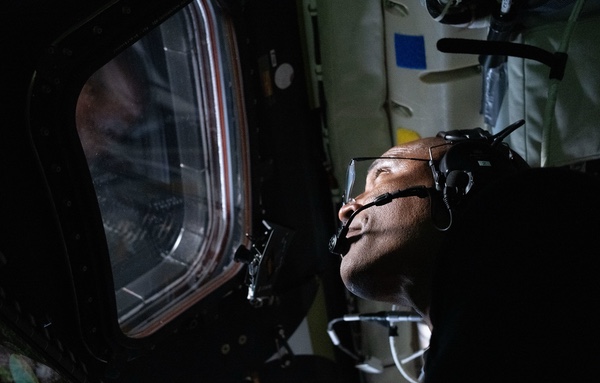 Artemis 2 pilot Victor Glover observes the Moon during the April mission.. (credit: NASA) |
“Go fast, go familiar”
One person who wants NASA to look elsewhere for the first Artemis landing is someone who flew around the Moon earlier this year. Victor Glover, pilot of Artemis 2, was a surprise speaker in July at the NASA Exploration Science Forum at the Ames Research Center in California.
He eschewed a traditional presentation about the mission and instead spent most of the hour in an extended question-and-answer session with the scientists in the room. They asked him questions about the mission and his career and more.
“On behalf of all the geologists here, what is your favorite rock?” one asked. (“Can I just say Earth?” he responded.)
Another attendee asked him where the first Artemis mission should land. That prompted a lengthy response from Glover that pushed against NASA’s longstanding plans to immediately go to the south polar region of the Moon.
“If you’ve ever seen me speak, you’ve probably heard me say, ‘If you want to go fast, go alone. If you want to go far, go together.’ There’s another thing I say all the time too: if you want to go fast, go familiar,” he said. “We want to get to the surface. If we want to land soon: familiar, daylight, equator.”
Part of his concerns revolved around NASA’s plans at the time to stage the lunar landing from a near-rectilinear halo orbit. Once the lander touched down, it would have to stay for about a week before Orion would be in position again for the lander to dock with it.
“If an appendix ruptures, the current plan we have right now, if it ruptures on landing day, you’re stuck for a week. That’s a big deal to me,” he said. “So, the equator gives me opportunity to save that person.”
Another issue he had with a polar landing is that he felt it took too much risk on a single mission. “We’ve got to work our way towards the south pole, of course, but it doesn’t have to be first, right?” he said, calling upon his test pilot experience of gradually building up in speed and altitude. “You have a process for accepting risk more and more, but also retiring it right.”
| “We’ve got to work our way towards the south pole, of course, but it doesn’t have to be first, right?” Glover said. |
There are several reasons why the south polar region is such a challenging place to land, including rugged terrain and low sun elevation angles. “You think driving home into the sunset is challenging? Imagine being on another celestial body and going from this room to low sun angle in a suit,” he said.
One of the scientists in the room for Glover’s talk was Pascal Lee, a planetary scientist at the SETI Institute. He shares those concerns about going immediately to the south pole of the Moon, not just because of the risks of operating there but also uncertainty about water ice thought to be there.
“The south polar regions is really very hard to work in. You are setting yourself up for some unnecessary challenges,” he said at the Space Economy Summit last week in Orlando. “There is water at the south pole, but we don’t know how much exactly or where it is exactly.”
He reiterated concerns about low sun angles. “The vast majority of the terrain doesn’t see much sun,” he said, beyond a few locations that are nearly permanently in sunlight. Similarly, the Earth is out of view for extended periods for many regions. “This is not great for human operations at all.”
One issue that raises is low temperatures. While the lunar surface can get quite warm in equatorial regions during the two-week lunar day, it remains cold in the polar regions. In the day, temperatures range from 40 to 90 kelvins, well below even nighttime temperatures in equatorial regions. “Forty to 50 kelvin, that’s the temperature of the surface of Pluto,” he said. “We do not have robotic systems that operate at those temperatures.”
As for the water ice, he noted that there is an estimated 600 billion kilograms of water at the south pole, which would fill 240,000 Olympic-sized swimming pools. “That sounds like an attractive number, but the area over which this is spread out is huge,” he said.
The best estimate is that regolith with the highest concentrations of water contains only 0.5% of water by mass. That means one metric ton of regolith would contain only five liters of water.
“This is not screaming ‘resource’ to me. This is screaming ‘scientific curiosity,’” he concluded. “It is not clear to me to all at this minute that we should be rushing to the south pole.”
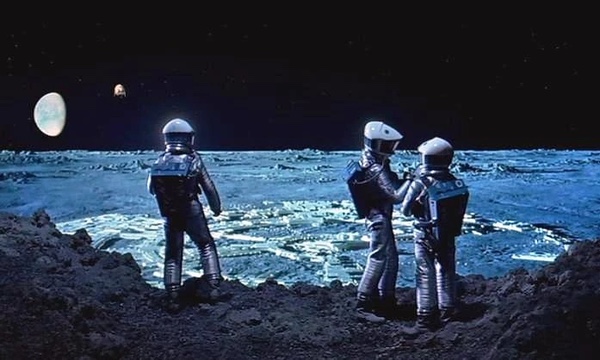 Clavius crater was the site of the lunar base in 2001: A Space Odyssey, and might be an ideal location for an actual lunar base. (credit: MGM) |
Where else to go?
If the south pole isn’t the first place for humans to go when they return to the Moon, what are the alternatives?
Last month, the National Academies released a report commissioned by NASA titled “Human Exploration Across the Moon.” The study examined potential sites beyond the lunar poles that could host individual sortie Artemis missions, complementing landings at the polar regions.
“A broader exploration strategy that includes visiting sites globally distributed across the Moon offers access to enormous diversity of scientific and potential economic opportunities, including access to geology, resources, geographical and site characteristics not found at the poles,” said James Day, a professor at Scripps Institution of Oceanography and the University of California San Diego who co-chaired the study. “It will be highly beneficial to space exploration and complementary to a sustained polar presence on the lunar surface.”
The report identified four specific regions the committee who worked on the study concluded were the most important locations for crewed visits. Topping that list was Bhabha Crater, located on the lunar farside in the middle of the sprawling South Pole-Aitken Basin.
“It’s an amazing location to do all kinds of science,” he said, from lunar geology to determine the age of the basin to setting up radio telescopes shielded from terrestrial emissions.
| Water ice concentrations at the south pole of the Moon are no greater than 0.5%. “This is not screaming ‘resource’ to me. This is screaming ‘scientific curiosity,’” Lee concluded. |
Second on the list was Mons Hadley, which was visited by Apollo 15 in 1971. The report specifically recommended visiting the landing site by touching down two kilometers away from it, close enough for astronauts to walk to the site. (The report did not assume the sortie missions would have access to a rover but added that a simple unpressurized one “enhances and amplifies” what each mission could do.)
A mission to Mons Hadley would not only allow astronauts to continue lunar science started by the Apollo 15 mission but also to study the landing site itself, from the lander’s descent stage to even the bags of human waste left behind by the astronauts before they left.
“This is a fantastic opportunity to be able to go there and have the astronauts review and assess the rover, descent stage, instrumentation packages and energy systems” left behind, said Dan Dumbacher, a professor of engineering practice in the School of Aeronautics and Astronautics at Purdue University who was the other co-chair of the study. “It would be foundational information for how we need to engineer the systems for lunar bases.”
Third on the list was Orientale Basin, a multi-ring impact basin on the limb of the lunar near side. Day called this a “pristine Moon and pristine solar system mission” that would be visited just once by astronauts, studying lunar geology and setting up a gravitational wave observatory. The latter, he said, would be a long-term experiment that needed to avoid disruption by frequent landings.
The fourth and final site was Aristarchus Plateau. It offers a wide diversity of terrain for study, said Dumbacher. “There is much to learn from the diversity of volcanism on this plateau,” he said, and added the site could also be used for a space weather observatory.
The study emphasizes that the four regions recommended for sortie missions were not meant to replace missions at the south pole but complement them by visiting regions of scientific interest beyond what’s accessible at the poles. “It will be highly beneficial to space exploration and complementary to a sustained polar presence on the lunar surface,” said Day.
How these fit into NASA’s current strategy that emphasizes a south pole lunar base is not clear. NASA commissioned the study a year and a half ago, long before new Moon Base program emerged at Ignition.
“We have provided them and the community what we believe is a solid case of science objectives and locations that NASA can factor into their planning,” Dumbacher said. It is up to NASA, he added, to determine “where do they go and when do they do it.” NASA has said little about the report since its October 21 release.
Lee, speaking at the Space Economy Summit, had his own idea. He proposed setting up a lunar base at Clavius crater, at about 60 degrees south latitude on the near side of the Moon. It would allow astronauts to drive to the south pole “relatively easily,” drawing parallels to Antarctic exploration that started with bases on the coast that support expeditions towards the pole.
Clavius itself, he said, is an interesting place for exploration, with features ranging from caves and volcanic mounds to small permanently shadowed regions that could serve as training for visiting larger such regions at the poles. From Clavius, it is about a 900-kilometer traverse to the south pole, something he argued is feasible with future pressurized rovers.
| “We have provided them and the community what we believe is a solid case of science objectives and locations that NASA can factor into their planning,” Dumbacher said. It is up to NASA, he added, to determine “where do they go and when do they do it.” |
If Clavius sounds familiar, it may be because it was the site of the lunar base in 2001: A Space Odyssey. Lee said his selection of the crater was not influenced by the film but is fortuitous nonetheless. “As it turns out, I think if we actually did this, it would drum up a huge amount of public support,” he said. “It would be a case of reality meeting fiction.”
For now, though, NASA appears focused on its Moon Base program for the south pole, something that appeared to frustrate Glover. “I would go where we know. That’s just me, and nobody’s asking me those questions. I’ve tried to force that conversation,” he said in July.
“So, if Jared listens to this recording,” he said later, referring to NASA administrator Jared Isaacman, “I had this conversation with your predecessor, and we should talk.”
Some of Glover’s concerns have been addressed by recent changes to the Artemis architecture. At an October 23 briefing, agency officials said they were no longer planning to use a near-rectilinear halo orbit for Artemis landings. For missions using SpaceX’s Starship lander, Starship will dock with Orion in Earth orbit and push Orion out to a low lunar orbit. For Blue Origin’s Blue Moon, Orion and the lander will dock in an elliptical polar orbit around Moon that would be closer than the halo orbit, although NASA did not reveal specifics about the orbit.
NASA added that with the use of a stretched Centaur upper stage on the Space Launch System along with a kick stage—details of which the agency did not disclose at the briefing—Orion could travel directly to a low lunar orbit, helping resolve some of the landing site accessibility concerns Glover raised.
However, the south pole of the Moon still has the rugged terrain and challenging lighting conditions that make landings difficult. At some point, NASA may need to weigh those technical risks with the political risks of seeing a Chinese crew land first.
Note: we are now moderating comments. There will be a delay in posting comments and no guarantee that all submitted comments will be posted.