Low and clean: very low Earth orbit is space’s self-cleaning frontier for defense, commerce, and scienceby Tim Franta
|
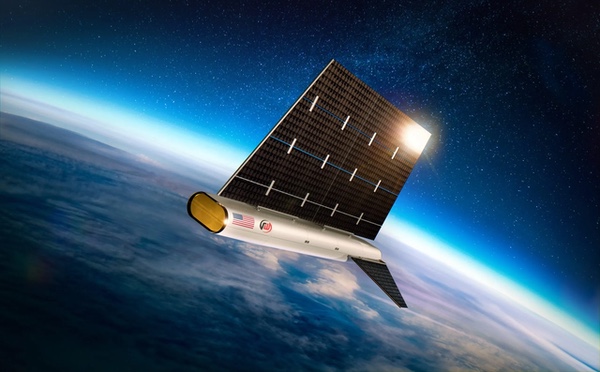
| VLEO is, in effect, a self-cleaning orbital environment. |
We have spent two decades considering ways to legislate, insure, and engineer our way around this problem with capture systems, graveyard orbits, and incentivized deorbit schemes. These all make sense because a dead satellite at 800 kilometers can circle the Earth for more than a century. A fragment from a collision at that altitude will become a hazard our grandchildren will inherit.
But there is an underutilized part of space where the problem largely solves itself. Very Low Earth Orbit (VLEO), roughly 100 to 450 kilometers up, sits inside the thin outer reaches of the atmosphere (specifically, the thermosphere and ionosphere) where residual air creates a variable but relentless drag on spacecraft. Satellites without propulsion typically last from weeks to a few years in this domain, depending on their altitude, size and the solar cycle. VLEO is, in effect, a self-cleaning orbital environment.
For decades, that drag made VLEO an orbit to avoid. Today it is becoming an orbit of choice, especially for small, inexpensive satellites built for short, high-value missions.
The military use cases for VLEO are the most compelling. The Space Force envisions satellites that can be launched within hours’ notice for high-need missions, like VLEO deployments for tactical surveillance, producing sharper imagery, lower latency, and better-defined targets. Pairing responsive launch capabilities with VLEO satellites allows disposable tactical constellations that can enable a high-value campaign, then remove themselves from the battlespace without leaving debris that threatens other orbital assets. Redwire has been awarded more than $64 million from DARPA for VLEO demonstrations.
The commercial uses are also attractive. Flying lower means a smaller camera sees more, a smaller antenna connects faster, and the whole satellite gets cheaper. Juniper Research projects global VLEO satellite investment will nearly double, from $5.2 billion this year to $9.8 billion by 2031. European startup NewOrbit just raised $18.5 million to fly customer payloads between 200 and 300 kilometers. For these operators, built-in disposal is not a compliance burden. It is a feature of the neighborhood.
| To best position VLEO as an orbit of choice, regulators should recognize VLEO as a distinct regime, with streamlined licensing and debris-mitigation reviews. |
For scientific missions, the region below about 300 kilometers is one of the least-measured parts of our atmosphere: too high for balloons and aircraft, yet too low for conventional satellites to survive. Its density swells with solar storms, its atomic oxygen, or ATOX, erodes spacecraft surfaces, and who knows what other phenomena might hide there. In February 2022, a modest geomagnetic storm thickened the atmosphere enough to doom most of a 49-satellite Starlink batch deployed at low altitude. Fleets of short-lived science microsats, along with suborbital and air-launched probes, could close that gap and make every VLEO mission safer.
At this year’s Smallsat Conference in Utah, my company was exploring a conceptual payload to measure the VLEO atmosphere, as our STARLAUNCH air-launch system is being designed for VLEO missions. “ATOX” was a buzzword at the event. Turns out, multiple companies, including Redwire, with Defense Department sponsorship, are developing novel air-breathing propulsion systems that will exploit the atomic oxygen to keep VLEO microsatellites in orbit longer.
To best position VLEO as an orbit of choice, regulators should recognize VLEO as a distinct regime, with streamlined licensing and debris-mitigation reviews for satellites whose orbits guarantee rapid natural decay. The military should view VLEO as a deliberate tactical destination, not a perpetual experiment. And NASA, NOAA, and the Space Force should jointly invest in characterizing VLEO so every operator flies with better data.
We cannot easily clean up the orbits we have already cluttered. But we can choose to build the next era of tactical, scientific and commercial space activity where nature doesn’t allow unused satellites to loiter.
Note: we are now moderating comments. There will be a delay in posting comments and no guarantee that all submitted comments will be posted.