Indian flattop photographed from spaceby Dwayne A. Day and Harry Stranger
|
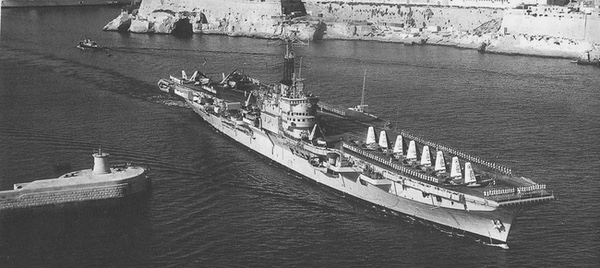 The HMS Hercules was placed in mothballs by the Royal Navy in 1946 before she was complete. A decade later she was purchased by India and completed, entering service in 1961. (credit: Wikimedia Commons) |
Hand-me-down carriers
By the end of the Second World War, both the United States and Great Britain possessed impressive navies, equipped with the most modern naval weapon, the aircraft carrier. Both countries had additional ships under construction and canceled many of them as unnecessary. Britain had begun construction of its fifth Majestic-class aircraft carrier, to be named HMS Hercules. Ordered in August 1942, laid down in October 1943 by Vickers-Armstrongs at High Walker on the River Tyne, the ship was unfinished when the war ended. She was launched in September 1945 and construction was suspended in May 1946, when she was 75% complete.
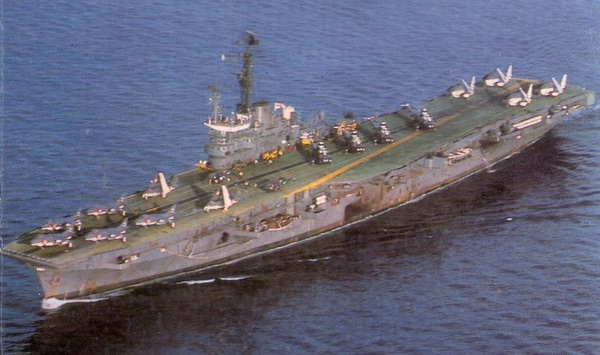 INS Vikrant operated various aircraft during her four decades of service. Built as a light carrier, her deck space was limited. (credit: Wikimedia Commons) |
The Royal Navy already had more ships than it could afford, and HMS Hercules was laid up in Gareloch off the Clyde. There she sat, for ten years.
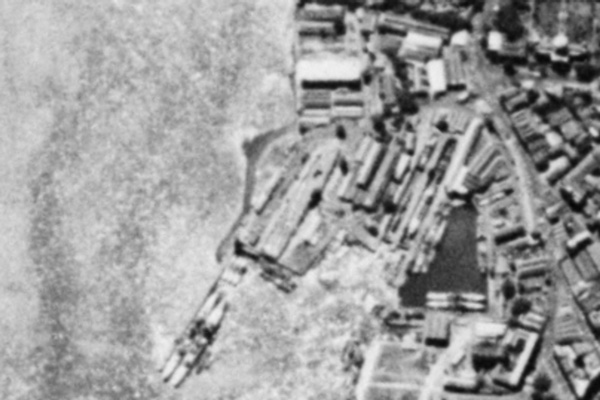 In 1967, an American CORONA reconnaissance satellite photographed the Vikrant in drydock. Although the photograph is low-resolution, the stern elevator is clearly in the lowered position. (credit: Harry Stranger) |
In January 1957, she was purchased by India. The ship was towed to Belfast to complete construction and modification. The famed shipbuilder Harland & Wolff performed the work, adding a modified island, steam catapults, and an important British invention, the angled deck. In March 1961, the ship was commissioned as INS Vikrant. The name was derived from the Sanskrit word vikrānta meaning “stepping beyond,” “courageous,” or “bold.”
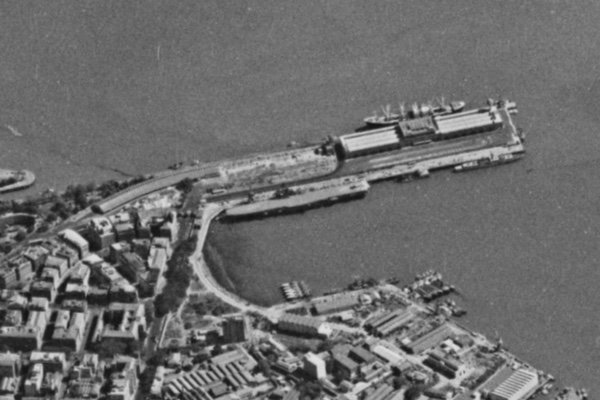 INS Vikrant in January 1975. This photo was taken from an oblique angle. An aircraft appears to be on the flight deck. (credit: Harry Stranger) |
During the 1971 Indo-Pakistan War Vikrant was involved in combat operations, and at one point the Pakistani Navy sent the submarine Ghazi to sink her. But Ghazi sank under mysterious circumstances, possibly running into the bottom during a crash dive, or being damaged by Indian depth charges.
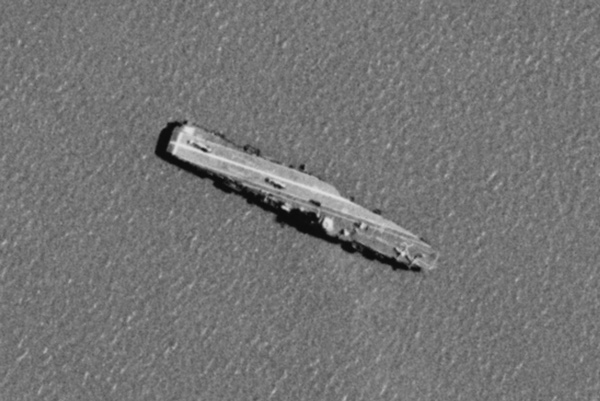
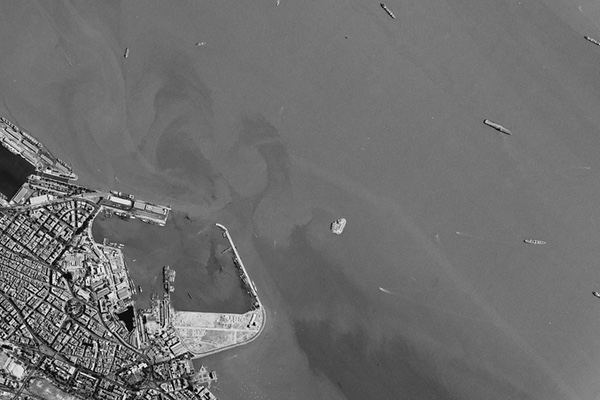 IINS Vikrant photographed by a HEXAGON reconnaissance satellite in 1977. This is a small section of a much larger photograph which was used by American intelligence analysts to track any changes to the dispersal of military forces. Among other things, regular photography like this enabled American intelligence analysts to assess the state of India's fleet and whether it was about to be deployed. (credit: Harry Stranger) |
In the 1970s and later the ship saw less service. From 1979 to 1981 she was modernized to extend her lifetime and to operate the new Sea Harrier vertical takeoff and landing jet. The Harrier demonstrated its value to the Royal Navy during the 1982 Falklands War. During a second refit in 1987–1989, Vikrant was further modernized, and in 1991 she began operating Sea King anti-submarine helicopters. She was retired in 1997.
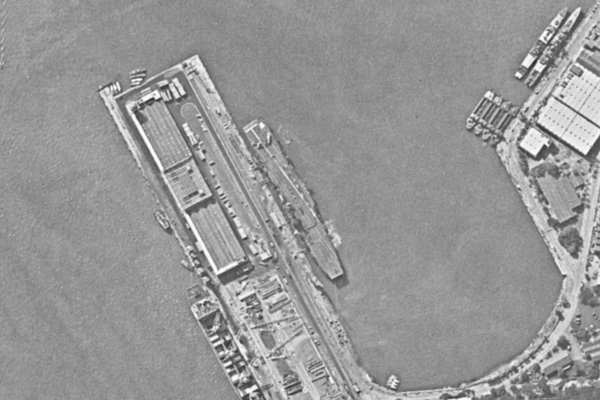 INS Vikrant was photographed by an American HEXAGON reconnaissance satellite in 1983. Some of her large helicopters are visible on the flight deck. (credit: Harry Stranger) |
Throughout her service, INS Vikrant monitored at sea by American signals intelligence posts as well as US Navy vessels. But she was also photographed in port numerous times by American reconnaissance satellites. Vikrant was photographed in port by a CORONA satellite in November 1967, and possibly several other times. HEXAGON satellites photographed her in 1975, 1977, and 1979 just before she entered drydock, and then again in 1983. Her whereabouts and status were certainly tracked by the US Navy.
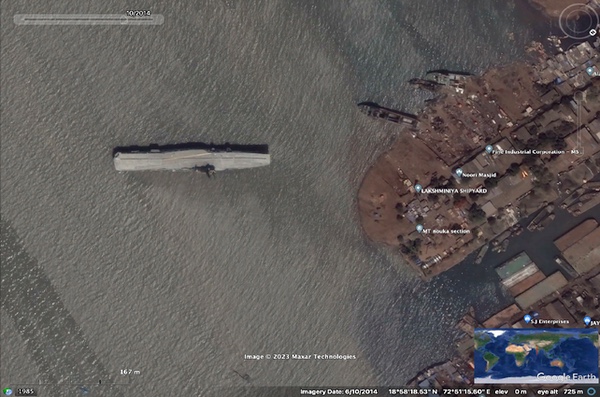 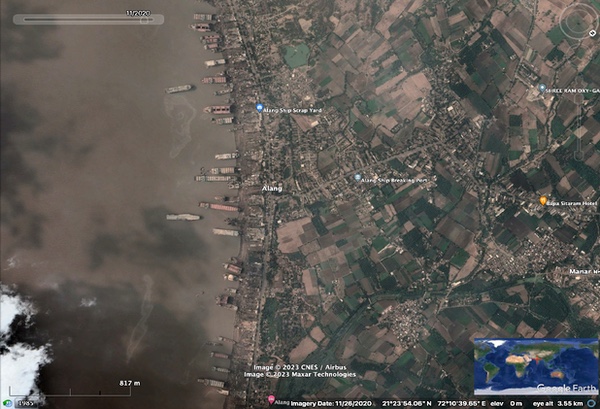 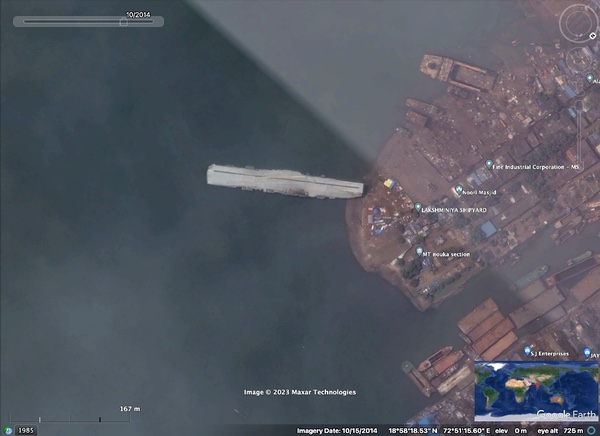 Retired INS Vikrant (R11) seen here anchored at Darukhana, India in 2014, awaiting scrapping. A modern INS Vikrant has replaced her. (credit: Maxar Technologies) |
After her retirement, India began work on an indigenously-built replacement also named Vikrant. Design work began in 1999 and the keel was laid in 2009. The ship was floated in December 2011 and launched in 2013. But building aircraft carriers in the modern age is not easy. They are complicated ships, and the new INS Vikrant did not begin sea trials until August 2021. In the meantime, India acquired an ex-Soviet aircraft carrier that was heavily modified after a long and expensive refit in Russia. That carrier, the INS Vikramaditya, entered service in 2013. INS Vikrant was commissioned in late 2022. She currently serves as the flagship of the Indian Navy.
Note: we are now moderating comments. There will be a delay in posting comments and no guarantee that all submitted comments will be posted.