A modest proposal for orbital debris modelingby Michael Puckett
|
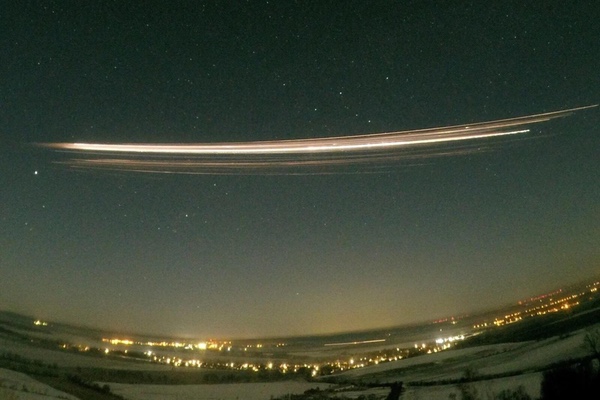
| Its principal product would be a better estimate of the number, size, velocity, and directional distribution of fragments produced by an upper-stage breakup. |
A secondary experiment using a spent Falcon 9 second stage and several inexpensive small satellites or cubesats could provide those observations. The stage would first deliver its working payload. It would then deploy the observer satellites into a very low orbit with a lifetime of no more than a few days. After the satellites assumed their assigned positions, the stage would undergo a controlled energetic breakup.
The experiment would measure the material generated by the breakup event. Its principal product would be a better estimate of the number, size, velocity, and directional distribution of fragments produced by an upper-stage breakup.
The modeling problem
NASA’s Standard Satellite Breakup Model estimates the fragment populations produced by spacecraft and upper-stage explosions and collisions. It provides distributions for fragment size, area-to-mass ratio, and separation velocity. These outputs support debris-environment forecasts, conjunction assessments, shielding design, and post-event analysis.[2]
The explosion portion of the model is derived substantially from observations of historical orbital breakups. NASA has compared its modeled distributions with cataloged fragments from several upper-stage explosions. Those observations are most complete for larger objects. Smaller fragments, particularly those between one millimeter and ten centimeters, are less completely measured.[2]
A breakup model must estimate the population below the detection threshold of normal tracking systems. Errors in that portion of the distribution affect estimates of collision risk because small debris is more numerous than cataloged debris and can still damage spacecraft.
An upper-stage experiment would provide direct measurements during the first seconds and minutes of debris-cloud formation. Multiple nearby cameras could record fragments before the cloud dispersed beyond useful optical resolution.
DebriSat
DebriSat is the principal modern laboratory experiment developed to improve satellite-breakup models. NASA’s Orbital Debris Program Office conducted the project with the Air Force Space and Missile Systems Center, The Aerospace Corporation, and the University of Florida.[3]
The project constructed a 56-kilogram spacecraft mock-up representative of a modern low-Earth-orbit satellite. It incorporated carbon-fiber composites, multilayer insulation, solar cells, wiring, batteries, circuit boards, and contemporary structural panels.
On April 15, 2014, researchers struck DebriSat with a 570-gram hollow aluminum projectile traveling approximately 6.8 kilometers per second. The impact catastrophically fragmented the spacecraft inside a ground-test chamber.[4]
Foam panels surrounding the target captured and decelerated the fragments. Researchers sought to recover approximately 90% of the original mass and characterize fragments with dimensions as small as two millimeters. Measurements included size, mass, shape, density, material, area-to-mass ratio, optical properties, and radar cross section.[5]
NASA's Standard Satellite Breakup Model had forecast approximately 85,000 fragments of two millimeters or larger from the impact. Researchers ultimately collected more than 130,000, with roughly 250,000 expected once characterization was complete—nearly three times the model’s forecast.[6] The test also showed that modern composite structures can produce large numbers of thin, flake-like, and needle-like pieces that are poorly represented by assumptions based on spherical particles.[7]
DebriSat provides detailed physical measurements that an orbital experiment cannot duplicate. Its fragments can be recovered, weighed, and examined individually. However, DebriSat tested a 56-kilogram satellite mock-up under laboratory conditions. It did not test a complete upper stage or observe the development of an uncontained debris cloud in orbit.
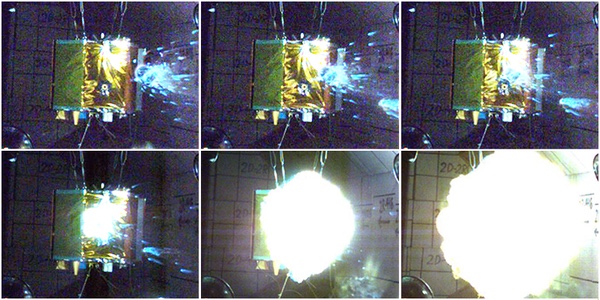 DebriSat during impact. High-speed frame of the laboratory breakup (credit: NASA) |
A Falcon 9 second stage has thin-walled propellant tanks, an engine, pressure vessels, plumbing, avionics, wiring, insulation, and structural interfaces. An orbital test would apply DebriSat’s empirical approach to a representative launch-vehicle stage.
Delta 180
Delta 180 provides the closest orbital precedent. The Strategic Defense Initiative Organization launched the experiment on September 5, 1986.
| The experiment should use a Falcon 9 launch already scheduled to deliver an operational payload. Payload delivery would remain the primary mission. |
The mission placed a Delta second stage and a maneuvering Payload Assist System into orbitts at approximately 220 kilometers. After separation, the vehicles conducted relative maneuvers and collected infrared, ultraviolet, visible-light, radar, and lidar observations.
Approximately 205 minutes after launch, the maneuvering vehicle struck the Delta second stage nearly head-on at about 2.9 kilometers per second. The collision produced two distinguishable debris clouds and at least 381 cataloged fragments ten centimeters or larger.[8]
Delta 180 demonstrated separation, relative navigation, close observation, and a deliberate destructive event during a single short mission. Its observing spacecraft was also the impactor. It therefore did not remain available to measure the debris cloud after impact.
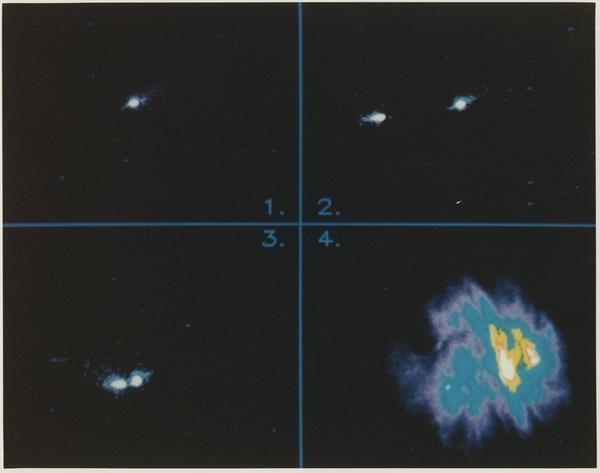 The two spacecraft smashing into each other over the Pacific Ocean. The United States observed the mission using multiple sensors, making it a highly complex operation. (credit: SDIO) |
A low-altitude intercept precedent
Operation Burnt Frost provides a relevant debris-residency record. On February 20, 2008, a US Navy Standard Missile-3 intercepted the failed USA 193 satellite at an altitude of approximately 247 kilometers. NASA later reported that all cataloged debris reentered in less than one year.[9]
The USA 193 record is included as an example and an extreme upper bound on debris residence, not as evidence of a several-day lifetime. It provides measured decay data for fragments created near the lower edge of low Earth orbit. Mission analysis should compare that record with breakup-model predictions and propagate the proposed fragment population across credible area-to-mass ratios and separation velocities. A days-long limit would require a substantially lower orbit and conservative treatment of the longest-lived fragments.
Breakup of USA 193 (credit: US Department of Defense) |
The experimental orbit will differ from the primary payload’s operational orbit and be conducted at the minimal necessary orbit. The second stage would require sufficient performance to deploy the payload as planned and then enter the lower orbit. Missions whose payload trajectories do not permit that sequence would not qualify.
A secondary Falcon 9 mission
The experiment should use a Falcon 9 launch already scheduled to deliver an operational payload. Payload delivery would remain the primary mission. The breakup experiment would begin only after the payload had separated and the second stage had completed all tasks associated with that delivery.
Falcon 9 is suitable because the second stage already carries payloads to orbit and is capable of deploying multiple spacecraft. SpaceX also operates a small-satellite rideshare program with established payload-integration and deployment procedures.[10]
The experiment could accompany a rideshare mission to maximize cost and operational efficiencies. Launch, payload integration, deployment support, and ground coordination would be shared with the primary mission. All customer payloads would be deployed before the second stage entered the experimental orbit.
The experiment would add:
- Several small satellites or cubesats
- Standard deployment hardware
- A command and timing package on the second stage
- An explosive charge mounted on a composite overwrapped pressure vessel (COPV)
- Ground software for formation verification and data collection
The mission should avoid a specialized carrier spacecraft. The Falcon 9 second stage would serve as the target, deployment platform, and central reference object until the event.
The charge would rupture a selected pressurized COPV and initiate the breakup from a known location and energy state. Charge size, vessel pressure, and mounting geometry would be fixed before launch and included in the predicted fragment distribution and safety analysis.
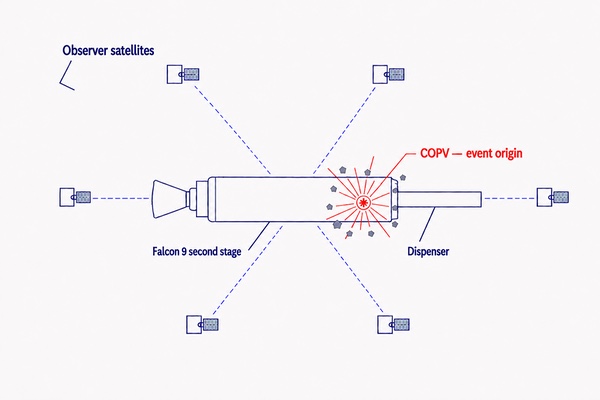 Proposed six-satellite observer formation around a spent Falcon 9 second stage with its payload dispenser. |
The observer satellites should use commercial buses, cameras, radios, navigation receivers, and attitude-control components. Their useful life would be measured in days. Long-duration systems would be unnecessary.
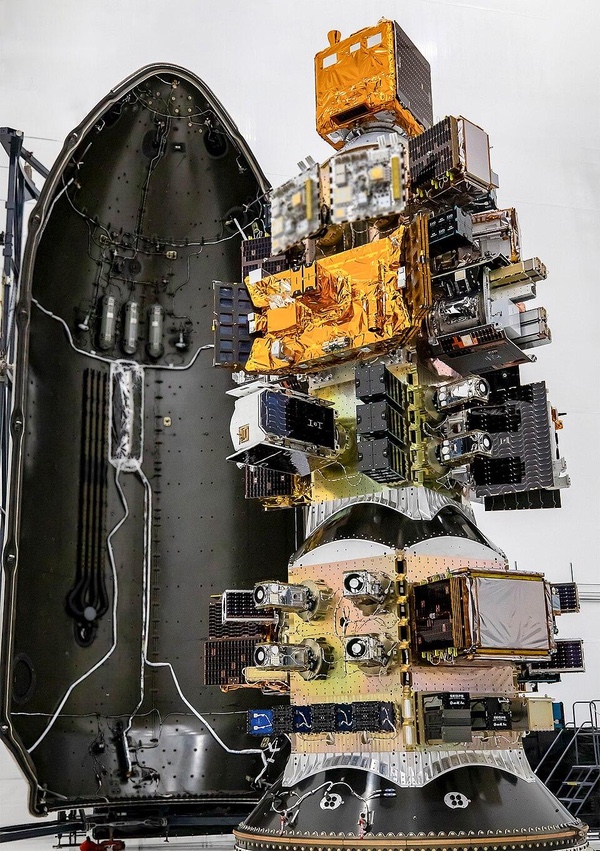 SpaceX rideshare payload dispenser (credit: SpaceX) |
Observer arrangement
Several viewpoints are necessary because the stage and larger fragments will conceal portions of the event from any single camera.
A basic formation could use four to six observer satellites:
- One ahead of the stage
- One behind it
- Two positioned to either side
- One above or below the orbital plane
- An optional more distant observer to record the full cloud
The positions would be determined by camera resolution, lighting, communications, and fragment-risk analysis. Separation distances should reduce collision risk while retaining sufficient resolution during initial expansion.
| The resulting measurements would provide an empirical upper-stage fragment distribution and show how much of that population remains undetected by ground-based systems. |
The formation trade would balance viewing geometry against orbital mechanics, cost, and vehicle complexity. Positions requiring substantial plane changes, stationkeeping, or propulsion should be avoided unless they materially improve the measurements.
The satellites would be released sequentially after payload deployment. Differential drag, spring deployment, and limited propulsion could establish the formation. Deployment directions should provide most of the required relative motion.
Each satellite would confirm its position, attitude, camera pointing, time synchronization, communications, and data storage before the event. Failure to establish the required geometry would cancel the breakup. The second stage would then follow its normal disposal procedure.
Instrumentation
The payload should be limited to instruments required to characterize the breakup. Each observer would carry:
- One or more high-frame-rate visible-light cameras
- A wide-field camera for cloud expansion
- Precise time synchronization
- Position and attitude sensors
- Onboard data storage
- A high-rate communications system
Different satellites could use different focal lengths. Wide-field cameras would record the overall event, while narrow-field cameras would resolve smaller fragments over limited portions of the cloud.
One or two satellites could carry commercial infrared cameras if cost and mass permitted. Small particle-impact sensors could be placed on the outermost observers or on one expendable unit to sample particles below the optical resolution limit.
Ground radar and optical systems would track the larger fragments after the event. The nearby satellites would cover the interval before the cloud expanded and before fragments could be cataloged individually.
The experiment would measure:
- Fragment count by observable size
- Initial fragment-size distribution
- Separation velocities
- Directional distribution
- Debris cloud expansion rate
- Large fragment shape and tumbling
- Apparent area-to-mass relationships derived from early motion
- Differences between onboard observations and ground-based detection
The data would be compared with the population predicted by NASA’s Standard Satellite Breakup Model for an explosion involving a stage of the same mass.
Orbit selection
The orbit must remain viable long enough to deploy the satellites, establish their positions, verify the formation, and conduct the experiment. It should decay within several days.
A fixed altitude cannot guarantee that lifetime. Atmospheric density at very low altitude varies with solar activity, geomagnetic conditions, vehicle attitude, and ballistic coefficient. Final orbit selection would require conservative atmospheric assumptions and current space-weather data.
The limiting factor is the lifetime of the longest-lived credible fragment. Some fragments will receive velocity changes that raise their apogees or perigees. The orbit must remain low enough that those fragments also reenter within the approved period.
The observer satellites would reenter with the stage debris. Their design would not depend on later recovery or disposal maneuvers.
Controls
The proposal conflicts with the normal requirement to prevent intentional creation of orbital debris. The US Government Orbital Debris Mitigation Standard Practices direct programs to limit debris released during normal operations and prevent accidental explosions.[11]
Approval should require:
- Independent review of the predicted fragment distribution
- Conservative analysis of the longest-lived fragments
- Conjunction screening before the event
- Exclusion of trajectories approaching crewed spacecraft
- Coordination with civil and military tracking organizations
- Multiple command inhibits
- Verified satellite positions before authorization
- Cancellation following any navigation, communications, or timing failure
- Selection of an orbit and event location that limit reentry risk
- Immediate release of tracking data to affected operators
The breakup would occur only after completion of the primary mission. A failed observer deployment would result in conventional disposal of the stage.
Cost and scope
The experiment is intended to use hardware already required for another mission. The principal existing asset would be the second stage after payload deployment. The observer satellites would use short-life commercial buses and modest sensor packages.
Costs would be concentrated in:
- Observer satellite procurement
- Payload integration
- Relative-navigation software
- Breakup hardware
- Mission analysis
- Regulatory review
- Ground data reception
- Post-event reconstruction and model comparison
This mission, being of limited scope, would only record the breakup and initial development of the debris cloud.
Conclusion
DebriSat demonstrated the value of destroying a representative spacecraft under controlled conditions and measuring the fragments. Its laboratory setting allowed detailed characterization down to two millimeters but did not reproduce the breakup of a complete upper stage in orbit.
Delta 180 demonstrated that a second stage and a separate spacecraft could maneuver relative to one another and complete a destructive orbital event during a short mission. It lacked surviving nearby observers dedicated to debris measurement.
A spent Falcon 9 second stage, several inexpensive small satellites or CubeSats, and existing deployment hardware could combine those two precedents. The resulting measurements would provide an empirical upper-stage fragment distribution and show how much of that population remains undetected by ground-based systems.
A future follow-on could characterize the effects of a collision between space objects and the development of the initial debris field. Broadly similar to Delta 180, a purpose-designed impactor would strike a spent upper stage at a selected relative velocity, impact point, and angle. The mission would use the observer architecture where practical but require a guided impactor and more demanding relative navigation.
Endnotes
- Passant Rabie, “Study Confirms: Reentering SpaceX Rockets Are Peppering the Upper Atmosphere With Metal Pollution,” Gizmodo, February 20, 2026.
- NASA Orbital Debris Program Office, Orbital Debris Quarterly News, October 2011, discussing fragment size, area-to-mass ratio, and velocity distributions in the NASA Standard Satellite Breakup Model, and comparing the modeled explosion distribution with cataloged fragments from seven upper-stage breakups.
- NASA Orbital Debris Program Office, “DebriSat.”
- J.-C. Liou et al., “Successful Hypervelocity Impacts of DebrisLV and DebriSat,” Orbital Debris Quarterly News, Volume 18, Issue 3 (July 2014), pp. 3–5.
- E. Ausay et al., “A Comparison of the SOCIT and DebriSat Experiments,” NASA, 2017.
- B. Shiotani et al., “Characterizing DebriSat Fragments: So Many Fragments, So Much Data, and So Little Time,” NASA, 2017.
- NASA Orbital Debris Program Office, Orbital Debris Quarterly News, November 2018.
- U.S. Congress, Office of Technology Assessment, SDI: Technology, Survivability, and Software, 1988; John Dassoulas and Michael D. Griffin, “The Creation of the Delta 180 Program and Its Follow-Ons,” Johns Hopkins APL Technical Digest, Volume 11, Numbers 1 and 2 (1990); Dwayne A. Day, “Smashing satellites as part of the Delta 180 Strategic Defense Initiative mission,” The Space Review, July 17, 2023.
- Eric Stansbery, “NASA Orbital Debris Program Office,” NASA, 2013, discussion of USA-193 reentry preparations and cataloged-debris decay.
- SpaceX, “Falcon 9” and “Smallsat Rideshare Program.”
- National Space Council, U.S. Government Orbital Debris Mitigation Standard Practices, November 2019 Update.
Note: we are now moderating comments. There will be a delay in posting comments and no guarantee that all submitted comments will be posted.