Rolling their ownby Jeff Foust
|
| With the supply of launches constrained and demand for launches only growing some satellite operators are taking matters into their own hands. |
The catch was immediately hailed as a major step in SpaceX’s efforts to make Starship rapidly reusable. “We caught a Starship, and now everything changes,” one SpaceX employee said on the webcast. That assessment might be a bit premature—SpaceX has yet to refly a ship, and the company once again failed to catch the Super Heavy booster on this launch—but it is a sign of progress.
The ship that flew the Flight 15 mission last week was designated Ship 42, or “S42” as was painted on the side of the vehicle. In a nod to Douglas Adams, below S42 were the words, “Don’t Panic.”
Tell that to the rest of the space industry. Since it became clear earlier this year that SpaceX was phasing out its workhorse Falcon 9, initially for rideshare missions but soon for all commercial missions, satellite operators have been racing to find alternatives. Those worries have been exacerbated by the growing belief that Starship will be primarily for used for SpaceX’s own missions.
The panic ratcheted up a level less then 24 hours after Ship 42’s return when a ULA Vulcan rocket lifted off from Cape Canaveral on its first mission in nine months. Within an hour, ULA reported that the mission failed because of an unspecified anomaly ten minutes into flight (although telemetry suggests the problem started earlier, during the first-stage burn.) Vulcan will be out of service again for the foreseeable future.
With the supply of launches constrained and demand for launches only growing some satellite operators are taking matters into their own hands. In the last few weeks, two companies—one deploying a constellation of satellites to communicate directly with mobile phones, and the other working on orbital data centers—said they would build their own launch vehicles. Both companies, though, may be underestimating the task in front of them.
Blacklift
AST SpaceMobile has been working for several years on satellites operating in low Earth orbit with very large phased-array antennas, allowing them to provide broadband services directly to mobile phones. The company has lined up partnerships with terrestrial mobile operators and has set up a satellite production line in a Midland, Texas, factory. The problem has been getting the satellites launched.
AST had been betting on Blue Origin’s New Glenn, which can place up to eight of AST’s BlueBird satellites into orbit. But New Glenn has been grounded since a pad explosion in May, with its return to flight now moved into early next year. Worse, on the previous New Glenn launch, an upper-stage problem stranded the single BlueBird satellite on board in an orbit too low for the satellite to recover from.
| “AST gets control of their own launch schedule. Firefly gets steady, non-dilutive funds to reinforce our launch services production,” Kim said. |
The company is currently relying on SpaceX’s Falcon 9, which can carry three BlueBirds per launch, but wants additional options. For a time this summer, it appeared AST was looking to acquire a launch company, raising more than $1 billion in debt for what it called “partnerships and/or acquisitions to further vertically integrate its business and mitigate risks associated with third-party launch providers.”
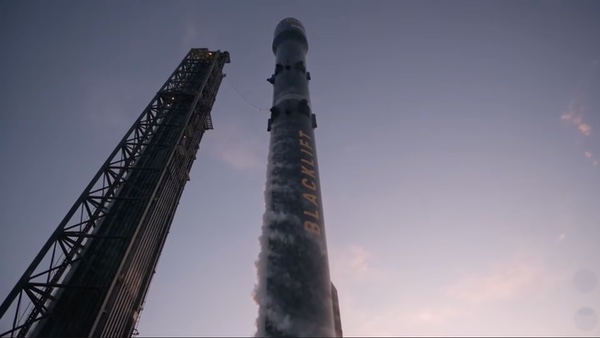
Instead, AST SpaceMobile announced November 6 it would develop its own launch vehicle—with some help. It announced a partnership with Firefly Aerospace to acquire engines that launch company produces as well as a license to allow AST to manufacture its own. Those engines would be used for a launch vehicle AST called Blacklift.
“The Blacklift rocket is the springboard to significantly expand our total addressable market, providing AST SpaceMobile with regular unconstrained access to orbit and providing for most favorable owners’ economics in the industry,” Abel Avellan, CEO of AST SpaceMobile, said in a statement.
The company said little about Blacklift itself in the announcement, other than it could place up to 20 tons into low Earth orbit, with room for five BlueBird satellites. The rocket, AST emphasized, would be used exclusively for launching its own satellites. It said at the time it would hold an “unveiling” for the rocket the following week in New York.
Between the announcement and that event, AST released its quarterly financial results and held an earnings call, giving Avellan a chance to provide more details. The rocket, he said, would have three stages, an unconventional approach for a vehicle designed for LEO missions where two stages are usually sufficient. It would also use carbon composite materials to save weight, using the experience the company has with those materials on those satellites.
He also indicated Blacklift would initially launch from an existing pad at Wallops Island, Virginia, originally built for Northrop Grumman’s Antares and being refitted to support Firefly’s Alpha and the joint Firefly/Northrop Eclipse. “Our first launches are going to be upgrades on existing launch, which Firefly already have prearranged for their Eclipse configuration,” he said. “Wallops will require an upgrade that we can fit in the timeframe that we have.”
Firefly held its earnings call around the same time. Jason Kim, CEO of the company, repeatedly called the $1.3 billion deal—$800 million for the engine license, $250 million for a set of Miranda and Vira engines for the first three Blacklift vehicles, and $250 million in engineering services—a “win-win” for both companies.
“AST gets control of their own launch schedule. Firefly gets steady, non-dilutive funds to reinforce our launch services production, strengthen our supply chain and infrastructure, grow our team and push the boundaries of what is possible in space,” he said.
The money, he said, would provide an injection of capital to help ramp up engine and vehicle production and testing. That will help Firefly develop Eclipse, a medium-class vehicle with a payload capacity only somewhat less than that of Blacklift.
He suggested that this was better for Firefly than selling Eclipse launches to AST. While Firefly loses a launch customer in the long term, it gains capital in the short term to help with developing the vehicle and serving other commercial and government customers, emphasizing that Blacklift is intended only for AST’s own spacecraft.
On Thursday of last week, AST held the unveiling event for Blacklift. There was no launch vehicle hardware to unveil, though, only animations of the rocket and videos of Firefly’s engines. Fareed Zakaria, a CNN commentator, served as master of ceremonies, introducing Avellan and later hosting a Q&A with him and AST president Scott Wisniewski.
Avellan took the stage wearing a leather jacket, cracking a joke about Nvidia CEO Jensen Huang. “I’m not resigning today,” he said a little more than an hour after Nvidia announced the resignation of Huang, known for his leather jackets.
Much of the presentation focused on the company’s satellite development work, and only well into the hour-long event did he turn to Blacklift. “We’re not doing this thing because we like rockets. We’re not doing this thing because we want to be in the launch business. We want this because we have so much demand for our satellites, and as you have seen it, we cannot get enough launches on time.”
The unveiling did not unveil a lot of additional details about the rocket, beyond reiterating its three-stage design and use of composites. He emphasized, though, perhaps the most ambitious part of Blacklift: that the company believes it can start launching the rocket in just two years.
Avellan argued that, by buying engines, the company was skipping most of the timeline of vehicle development. “A typical design cycle of a rocket could be over a decade. Eighty percent of that is on the engine,” he said. “We’re starting this program on third base.”
The event did not address many of the issues about Blacklift. The three-stage design, he said, was intended to support reusability for the booster. “When you have three stages, the first stage will go up not that much and will come back down very easily,” he said, even though other existing and planned reusable vehicles use a two-stage design.
| “A rocket, you can think about it—of course, rocket engineers are going to get mad with me—but you can simplify it as a big tank, feeding engines,” Avellan said. |
Avellan said that the company was already making carbon composite tanks for the rocket, with the first set of ten to be ready for testing in January at its Midland factory. However, large composite structures can be difficult to produce, as Rocket Lab has discovered with its Neutron rocket. That company suffered problems producing large first-stage tanks for Neutron this year, pushing back that vehicle’s first launch to some time in 2027.
There is also the issue of where Blacklift will launch from. The company used the unveiling event to reiterate previous statements that it would launch from the former Antares pad at Wallops. “Antares heritage pad at Wallops, already being upgraded for Miranda engines,” a slide from the company’s presentation stated.
However, a spokesperson for the Virginia Spaceport Authority, which operates the commercial launch pads at Wallops, said that while it has started preliminary discussions with AST, those talks specifically excluded the Antares pad, which the authority calls Pad 0-A. The company’s earlier comments about using the pad reportedly raised concerns with both Firefly and Northrop.
AST SpaceMobile, the authority said, could instead redevelop Pad 0-B, used infrequently for solid-fuel rockets like Minotaur, or develop a brand-new pad. Both options would require significantly more time and expense.
The company did not provide a detailed development schedule at the event or a cost estimate beyond the $1.3 billion already earmarked to Firefly for engines. But Avellan seemed to think that building a new rocket would not be that hard.
“A rocket, you can think about it—of course, rocket engineers are going to get mad with me—but you can simplify it as a big tank, feeding engines,” he said.
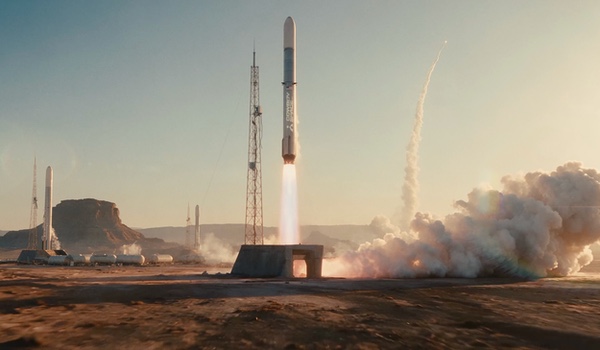 Cowboy Space says that its Big Iron rocket can begin launches as soon as 2028 because it uses engines it is developing internally. (credit: Cowboy Space) |
Big Iron
If AST’s plans sound audacious, they are positively mundane compared to what Cowboy Space announced late last month.
The company was founded several years ago as Aetherflux with a goal of pursuing another of the space industry’s holy grails: space-based solar power. Earlier this year, though, the company pivoted sharply, changing its name to Cowboy Space and its market to orbital data centers.
When it made that pivot, it said that it would not only develop large data-center spacecraft, it would also build the rocket needed to launch them. It said little about those launch plans, though, until an event in late October.
“We set out to build data centers in space and found there weren’t enough rockets to get them there, so we’re building our own,” said Baiju Bhatt, CEO of Cowboy Space, who founded the company after his time leading financial services company Robinhood.
| “A lot of things have to go right for that to happen,” Bhatt said of that 2028 schedule, “and it’s not a guarantee.” |
The vehicle, called Big Iron, can place 15,000 kilograms into Sun-synchronous orbit. A unique aspect of the vehicle is that the upper stage is also the payload. Once in orbit, the upper stage deploys giant solar arrays and radiators to support racks of Nvidia processors.
Cowboy Space has further increased the level of difficulty of its launch vehicle by choosing to develop its own engine, called Clydesdale. (The company is fully committed to the cowboy theme, down to the cowboy hat and bolo tie Bhatt wore on stage at the event.) The reusable first stage, made of stainless steel, would be powered by nine Clydesdale engines, each producing 300,000 pounds-force of thrust using liquid oxygen and methane.
At its own unveiling event, the company said it had just started testing of one element of the engine: the gas generator, itself a small engine that powers the turbopumps for the main engine. It said it expects tests of the full Clydesdale engine to begin next summer.
“We think that this is going to be one of the critical pieces of technology that’s going to let us get to orbit relatively quickly,” Bhatt said of the engine, outlining a schedule that called for an initial launch as soon as late 2028.
That, of course, is a remarkably fast timeline for a new vehicle powered by a new engine, one that is not backed up by experience. Neutron, for example, was set to make its first flight in 2024 when it was announced in 2021, and has yet to launch. Multi-year delays are not uncommon for new vehicles.
“A lot of things have to go right for that to happen,” Bhatt said of that schedule, “and it’s not a guarantee.”
Cowboy Space did not announce where Big Iron would initially launch from. The company instead announced a concept called Trailhead, which would combine production facilities with launch sites that he said would be scattered around the country and overseas, primarily in locations that can support Sun-synchronous launches. (The proposed data-center satellites would operate in dusk-dawn orbits to maximize solar power.) Each Trailhead would include five launch pads that company envisioned would launch salvos of Big Iron rockets.
The company did not disclose the projected cost of developing Big Iron. The company raised $275 million earlier this year, an impressive amount but only a small fraction of the likely cost for the vehicle, as illustrated by AST’s $1.3 billion deal for engines alone. It did not that each Trailhead site would cost $1 billion to develop.
Big Iron is a means to an end, that end being a constellation of orbital data center satellites called Stampede. The company has filed plans for up to 20,000 such satellites: deploying them, one at a time on Big Iron launches over five years, would require about 11 launches a day, every day.
Unlike AST and Blacklift, Cowboy Space said it will offer Big Iron to other customers as well. “Opening it to the rest of the industry makes every flight safer and more efficient, and gives the country another path to orbit,” Bhatt said. In an industry with limited paths to orbit, desperate times call for desperate measures. Or panic.
Note: we are now moderating comments. There will be a delay in posting comments and no guarantee that all submitted comments will be posted.