Musk’s Moon maniaby Jeff Foust
|
| “For those unaware, SpaceX has already shifted focus to building a self-growing city on the Moon, as we can potentially achieve that in less than 10 years, whereas Mars would take 20+ years,” Musk wrote. |
Perhaps it was NASA’s budget, with the White House proposing severe cuts to overall spending and even steeper cuts in areas like science and space technology, along with cancellations or early terminations of key elements of Artemis. But by the time the final fiscal year 2026 spending bill was enacted in January, NASA’s 2026 budget was close to its 2025 budget, with few cancellations.
Arguably the biggest surprise in the last year is the one that has developed just in the last several weeks: SpaceX’s sharp pivot to the Moon. A year ago, it seemed that Elon Musk, using his influence in the new Trump Administration, was shifting space policy from a return to the Moon towards human missions to Mars. That was evident in everything from Trump’s mention of “launching American astronauts to plant the Stars and Stripes on the planet Mars” in his inaugural address to a budget proposal that included funding for new Mars exploration technology initiatives.
Now, though, it’s SpaceX that’s changing course. The administration has made clear its near-term focus in human space exploration is the Moon, returning astronauts to the lunar surface before China can land its first taikonauts there. A White House executive order in December, which effectively serves as the national space policy, calls for a human landing on the Moon by 2028 and beginning work on a permanent outpost there by 2030. Mars is only mentioned in passing as a goal for the indefinite future.
SpaceX, already under pressure to accelerate work on the lunar lander version of Starship for NASA’s Human Landing System program (see “The (possibly) great lunar lander race”, The Space Review, November 3, 2025), seems to shifted even more towards the Moon in recent weeks, culminating in a social media post by Musk February 8, just as the Super Bowl was about to kick off.
“For those unaware, SpaceX has already shifted focus to building a self-growing city on the Moon, as we can potentially achieve that in less than 10 years, whereas Mars would take 20+ years,” he wrote.
Needless to say, most were unaware of that shift in focus. For most of SpaceX’s nearly quarter-century history, the company, and Musk, were deeply associated with a human presence on Mars, not the Moon. That was the subject of numerous presentations by Musk over the years, which have described making humanity “multiplanetary” by establishing human settlements, even large cities, on Mars in the next few decades.
That included, as an example, a talk he gave at Starbase in May around the time of a Starship test flight. “Progress is measured by the timeline to establishing a self-sustaining civilization on Mars,” he said then (see “Starship setbacks and strategies”, The Space Review, June 9, 2025).
| “Along the way we can do cool things, like have a Moon base, like Moonbase Alpha,” Musk said last May. |
He used that talk to outline plans for sending Starships to Mars, starting as soon as the next launch opportunity in 2026. That plan called for sending 500 landers to Mars in 2033, each capable of carrying 300 tons of payload. The goals for that launch campaign included establishing global mobility and communications at Mars as well as resource extraction and “increase independence from Earth.”
Musk made only a passing reference to the Moon in that talk. “Along the way we can do cool things, like have a Moon base, like Moonbase Alpha,” he said, referencing the classic sci-fi TV series “Space: 1999”. (“Moonbase Alpha” was also the name of a video game released in 2010 developed in cooperation with NASA, in which the player is an astronaut at a lunar base in the then-distant future of 2025.)
“We should have a Moonbase Alpha. The next step after the Apollo program would be to have a base on the Moon,” Musk said. That base, he suggested, would be a “gigantic science station.” But after that brief digression, Musk returned to talking about sending humans to Mars, the main thrust of the talk.
Musk has talked about establishing a lunar base off and on in the past, even using the same name for it. For example, at one conference in July 2017 he expressed his support for a lunar base. “If you want to get the public really fired up, you’ve got to have a base on the Moon,” he said then.
A few months later, talking about what was then called BFR at the International Astronautical Congress in Adelaide, Australia, he mentioned the ability of that predecessor of Starship to support a lunar base, which he also called Moonbase Alpha. “It’s 2017,” he said in that speech. “I mean, we should have a lunar base by now. What the hell’s going on?”
These concepts, though, seemed like side quests: nice things to do but not on the critical path to making humanity multiplanetary. The company’s interest in the Moon appeared largely limited to developing the HLS lander version of Starship, along the way gaining experience in technologies like in-space propellant transfer also needed for Mars.
So what changed? Musk, in his Super Bowl Sunday announcement, suggested it was a matter of speed. “It is only possible to travel to Mars when the planets align every 26 months (six month trip time), whereas we can launch to the Moon every 10 days (2 day trip time),” he wrote. “This means we can iterate much faster to complete a Moon city than a Mars city.”
That, however, has always been the case. In the past SpaceX was willing to overlook any advantages rapidly iterating at the Moon offered in favor of pressing ahead as fast as possible to Mars.
The shift from Mars to the Moon comes as part of some of the biggest changes at SpaceX in years. In December, SpaceX executives said that the company was preparing to go public after years of claiming it would remain private: “We can’t go public until we’re flying regularly to Mars,” SpaceX president Gwynne Shotwell said in 2018 (see “SpaceX, orbital data centers, and the journey to Mars,” The Space Review, December 15, 2025).
While the company’s CFO, Bret Johnsen, said that the proceeds for an IPO would allow SpaceX to “build Moonbase Alpha and send uncrewed and crewed missions to Mars,” the near-term factor in that decision was developing orbital data centers intended to serve what is, for now, an insatiable demand for computing power for AI applications.
Two weeks ago, Musk took another step in that direction when he announced that SpaceX would acquire xAI, his AI and social media company. The goal, he said, was to create a vertically integrated company that could both deploy and use the orbital data centers he insists is the future of AI.
“My estimate is that within 2 to 3 years, the lowest cost way to generate AI compute will be in space,” he wrote in a memo announcing the deal that was published on SpaceX’s website. “In the long term, space-based AI is obviously the only way to scale.”
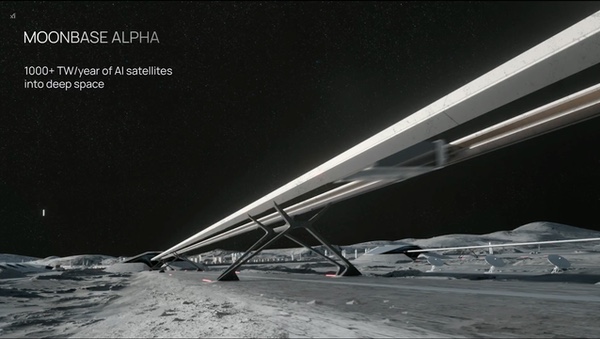
| “We’re going to make it real. We’re actually going to have a mass driver on the Moon,” he said. “I really want to see the mass driver on the Moon that is shooting AI satellites into deep space.” |
Just a few days earlier, SpaceX filed an application with the FCC for an orbital data center constellation of up to one million satellites. The satellites would operate in both sun-synchronous and mid-inclination orbits between 500 and 2,000 kilometers. The spacecraft in sun-synchronous orbits would be oriented to be in near-constant sunlight, providing continuous services, while those in mid-inclination orbits would handle peaks in demand.
The brief application had little in the way of technical details—nothing about the size and power of the satellites or specific orbital planes—but plenty of grandiose visions. “Launching a constellation of a million satellites that operate as orbital data centers is a first step toward becoming a Kardashev Type II civilization — one that can harness the sun’s full power — while supporting AI-driven applications for billions of people today and ensuring humanity’s multiplanetary future among the stars,” the company stated.
Musk used some of the same language in the memo discussion the xAI acquisition. “By directly harnessing near-constant solar power with little operating or maintenance costs, these satellites will transform our ability to scale compute. It’s always sunny in space!” he wrote. “Launching a constellation of a million satellites that operate as orbital data centers is a first step towards becoming a Kardashev II-level civilization, one that can harness the Sun’s full power, while supporting AI-driven applications for billions of people today and ensuring humanity’s multi-planetary future.”
Musk added that, eventually, the orbital data center satellites might be built and launched from the Moon, enabling terawatts of AI computing power. “Thanks to advancements like in-space propellant transfer, Starship will be capable of landing massive amounts of cargo on the Moon. Once there, it will be possible to establish a permanent presence for scientific and manufacturing pursuits,” he wrote.
“Factories on the Moon can take advantage of lunar resources to manufacture satellites and deploy them further into space. By using an electromagnetic mass driver and lunar manufacturing, it is possible to put 500 to 1000 TW/year of AI satellites into deep space, meaningfully ascend the Kardashev scale and harness a non-trivial percentage of the Sun’s power,” he said. No one could accuse Musk of not thinking big.
Last week, xAI posted a video of a company all-hands meeting hosted by Musk. Most of the 45-minute session involved updates from employees on various projects, but Musk closed the presentation with another vision of a lunar-enabled future for AI.
“Ultimately, you have to go out there and explore the universe to understand it, and that’s the motivation behind the combination of SpaceX and xAI,” he said. By launching spacecraft from Earth, he said the combined company could deploy 100 to 200 gigawatts of AI compute a year, with a path to one terawatt a year.
“But what if you want to go beyond a mere terawatt?” he asked. (AI data centers used about four gigawatts of power in the US in 2024, and are projected to grow to 123 gigawatts by 2035, according to a study by Deloitte last year.) “In order to do that, you have to go to the Moon.”
He described a factory that would build data center satellites on the Moon, launching them using a mass driver, which he described as a concept from science fiction. “We’re going to make it real. We’re actually going to have a mass driver on the Moon,” he said. “I really want to see the mass driver on the Moon that is shooting AI satellites into deep space.”
On screen, an illustration of such a mass driver appeared, looking not unlike concepts from half a century ago proposed by Gerard K. O’Neill and other advocates of space colonies, who proposed building those free-space settlements using lunar resources transported by mass drivers.
“I can’t imagine anything more epic than a mass driver on the Moon and a self-sustaining city on the Moon and going beyond the Moon to Mars,” he concluded, “going throughout our solar system and ultimately being out there among the stars.”
| “Musk is making a huge mistake,” Zubrin wrote. “Musk’s tweet is nonsense.” |
In none of the filings, memos, or presentations did Musk provide a schedule for his AI-enabled space ambitions, including a lunar satellite factory and self-sustaining city, beyond the comment in his post that a city on the Moon is potentially possible feasible within a decade. Most in the space industry, though, know such schedules are, as Musk himself has acknowledged, “aspirational.”
It does, though, suggest a new underlying thesis for Musk and SpaceX. He previously said that the company’s Starlink constellation would help fund human missions to Mars: “Starlink internet is what’s being used to help pay for humanity getting to Mars,” he said at Starbase last year, thanking Starlink customers “for helping secure the future of civilization and helping make life multiplanetary.”
Perhaps that business case no longer closes, either because of a better understanding of the revenues Starlink can generate or the costs of getting humans to Mars. Or the opportunity presented by AI and the demand for data centers is so compelling that it warrants going to the Moon first to enable that, even if satellite factories on the Moon are still decades away.
Whatever the reason, it has dismayed Mars advocates, the biggest of whom is Robert Zubrin. “Musk is making a huge mistake,” Zubrin wrote in an essay published last week, citing the lack of resources there for a “self-sustaining city” and propulsion constraints. “In short, Musk’s tweet is nonsense.”
Zubrin speculates Musk is motivated by the vast wealth AI data centers on the Moon could generate. “Or it might be where his winning streak ends,” he speculates. If lunar or orbital data centers can’t compete with terrestrial data centers—and Zubrin is skeptical they can—he worries “it could prove a financial disaster that collapses his credibility, and with it his entire corporate empire.”
Musk has said he is not giving up on Mars. “SpaceX will also strive to build a Mars city and begin doing so in about 5 to 7 years, but the overriding priority is securing the future of civilization and the Moon is faster,” he wrote in the post announcing the shift to the Moon. He has subsequently suggested this new approach could actually speed up that city on Mars.
And he has a need to speed things up: in June he will turn 55. If he still wants to achieve a goal he has long mentioned of dying on Mars—“just not on impact,” he would frequently add—a focus in the near term on the Moon needs to be an enabler if not accelerator of his Mars vision, not a diversion.
Perhaps in a year this will look like what happened with the NASA administrator confirmation process or the agency’s budget: a period of wild, unexpected swings that end up back to “normal,” in this case with Musk and SpaceX again monomaniacally focused on Mars. If not, this could turn out to be one of the biggest shifts in spaceflight so far this century.
Note: we are now moderating comments. There will be a delay in posting comments and no guarantee that all submitted comments will be posted.