The Isaacman honeymoonby Jeff Foust
|
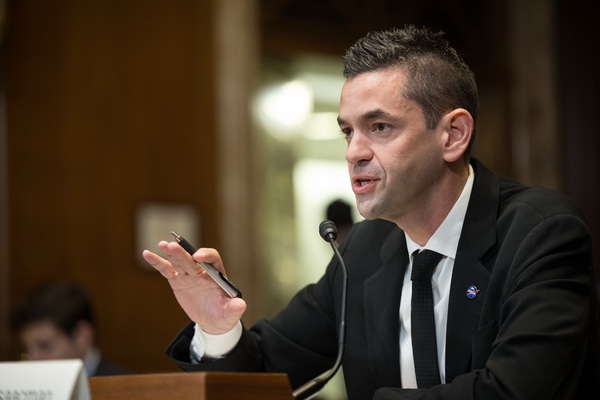
| “Mr. Administrator, this would be a very different hearing if I believed the budget request from the administration your best judgement,” Van Hollen told Isaacman. |
That budget proposal, released early this month, proposed a cut of 23% to the agency, about the same as what the administration proposed in 2026. The cut to NASA’s science programs, 47%, was identical to last year’s request. The proposal generated plenty of criticism from both members of Congress and advocacy groups.
Yet, most of the criticism was focused not on Isaacman, the leader of the agency, but on the White House and its Office of Management and Budget. “The 2027 request for NASA, I think, was largely locked down before you, Mr. Administrator, assumed your position,” said Rep. Zoe Lofgren (D-CA), ranking member of the House Science Committee, during an April 22 hearing by that committee on the budget. “But it should come as no surprise that we have concerns here at the science committee.”
That assessment is likely accurate. While the budget was released in early April (see “Artemis eclipses,” The Space Review, April 6, 2026), development of the budget started last year. By the time Isaacman was sworn in as administrator five months ago, many of the details about the budget were likely already set, with little room for changes. Notably, many of the new initiatives outlined in at the Ignition event in late March, such as a lunar base or the SR-1 Freedom nuclear propulsion demo (see “Igniting a new vision for NASA,” The Space Review, March 30, 2026), were not included in the budget proposal.
There were, though, plenty of questions at that science committee hearing, as well as hearings by both the House and Senate CJS appropriations subcommittees days later. There was criticism of the proposed science cuts, as well as the closure of NASA’s Office of STEM Engagement. Isaacman, as the representative of the administration, dutifully defended the proposal. But rarely did members criticize Isaacman personally, and many praised his leadership of the agency and the recent Artemis 2 mission even as they questioned the cuts in the proposal.
An example was an exchange with Rep. Suhas Subramanyam (D-VA). “You have a lot of support in Congress,” he told Isaacman after mentioning the Artemis 2 mission and his own childhood in Clear Lake, Texas, near the Johnson Space Center. He then, though, raised concerns about the cuts to NASA science.
Isaacman argued that science missions can take advantage of commercial capabilities to reduce costs, giving as one example future commercial successors to Landsat. “Do you think we can cut 50% across the board and still yield the same results or better?” asked Subramanyam.
“We can do far more with the resources available, even with a reduction in the budget,” Isaacman said.
Subramanyam ended the exchange unconvinced. “We’re going to have to agree to disagree.”
Isaacman has enjoyed a honeymoon on Capitol Hill despite the massive budget cuts proposed for NASA. Part of that is likely the result of the Artemis 2 mission: throughout the hearings, members praised NASA for the successful crewed flight around the Moon, even as they then launched into questions criticizing the proposed budget cuts. When the four-person crew visited Congress last week, members of both parties lined up for photo ops with the astronauts.
There is also support for some of the changes Isaacman is trying to implement at NASA, such as the revisions to Artemis outlined at the Ignition event and the efforts to accelerate the pace of Artemis missions. Members expressed concerns about a space race with China at the hearings, along with fears that China might land astronauts on the Moon before NASA astronauts return.
| “Our chore in this environment is oversight and budgetary, but we’re also your big cheerleader and we want you to succeed,” said Rogers. |
“I will tell you, up until a few months ago, the odds were in their favor,” Isaacman said of a Chinese crewed landing before a NASA return during a House CJS appropriations hearing April 27. “We have a far more achievable plan now.”
“Our chore in this environment is oversight and budgetary, but we’re also your big cheerleader and we want you to succeed,” responded the committee’s chairman, Rep. Hal Rogers (R-KY), not long after he and another octogenarian member of the committee, Rep. John Carter (R-TX), reminisced about Sputnik.
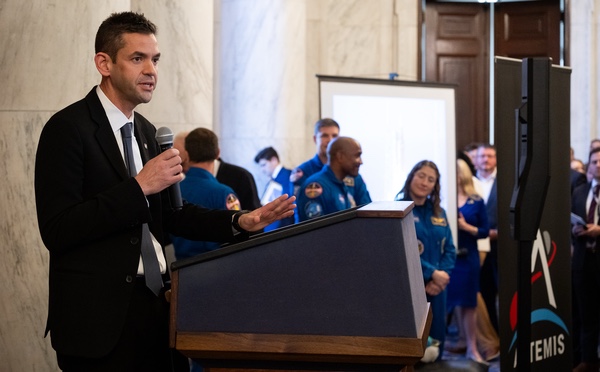 Jared Isaacman with the Artemis 2 crew on Capitol Hill last week. (credit: NASA/Joel Kowsky) |
Honeymoons, though, do not last forever. There are signs of perhaps not dissatisfaction but of concern about some of the plans Isaacman has announced in recent months and their implementation.
Key among them is NASA’s potential changes to its Commercial LEO Destinations (CLD) program the agency announced at Ignition, with NASA considering abandoning its current approach to backing companies working on stations to developing a “core module” to be added to the ISS that commercial modules could attach to. Companies and some members of Congress have opposed those plans, which for now remain just proposals (see “Commercial space station developers make their business case to NASA,” The Space Review, April 20, 2026.)
Others in industry have noted there have been few details about some of the plans rolled out by Isaacman and NASA since the beginning of the year. In some cases that is because NASA has been soliciting input from companies about those plans, but in other cases the lack of details—such as any roles for industry in SR-1 Freedom, the nuclear propulsion demonstration—has been frustrating.
Another case involved Artemis 3. Isaacman announced in February the agency was converting the mission to a low Earth orbit test of lunar landers by Blue Origin and/or SpaceX. Since then, though, the agency has provided few specifics about the mission. Only in the last week did NASA reveal it will not use an upper stage for the SLS on the flight, saving the final Interim Cryogenic Propulsion Stage for Artemis 4 in 2028.
Other details, though, remain unclear. NASA has yet to name a crew for the mission, although Isaacman has said in recent weeks the astronauts will be revealed soon. NASA also has only said the mission will last longer than Artemis 2, which spent a little more than nine days into space. In a statement last week, NASA said it is still determining if astronauts will enter the lunar landers their Orion spacecraft with dock with on Artemis 3.
There are also signs that the mission is slipping. NASA said when it announced the revised plans for Artemis 3 that it would fly in about a year, and other agency officials said weeks later they were working to a launch between March and June 2027. But at the House appropriations hearing, Isaacman appeared to offer a later date.
“I’ve received responses from both vendors, both SpaceX and Blue Origin, to meet our needs for a late 2027 rendezvous, docking, and test the interoperability out of both landers in advance of a landing attempt in 2028,” he said at the hearing.
| Isaacman said “I would not be surprised if you see some early wet dress testing at [Launch Complex] 39B before the end of this year.” |
Isaacman on social media pushed back about the reports that followed that suggested a delay. “We never officially moved the timing of Artemis III to ‘late’ 2027. A reporter wrote that after misinterpreting my quick response to a question during a budget hearing,” he said. (Several reporters wrote about a late 2027 mission, based on the quote above. He may have misspoke, but he was not misquoted.)
In the same post, he said that “I would not be surprised if you see some early wet dress testing at [Launch Complex] 39B before the end of this year.” Yet, the critical path for Artemis 3 is not SLS, Orion, and ground systems, but instead the status of Blue Moon Mark 2 and Starship, and neither NASA nor the companies have provided significant updates on their development or acceleration plans to ensure they would be ready for low Earth orbit tests in 2027 and landings in 2028.
Those concerns, beyond the criticism of potential changes to the CLD program, have been largely private for now. “Industry is excited about these changes and want Isaacman to succeed,” one industry official said on background. “But those ideas need to be backed up by execution. If NASA stumbles, you’ll start hearing criticism.”
The honeymoon, in any case, will likely be over by the time Isaacman returns to Capitol Hill next spring for hearings on the agency’s fiscal year 2028 budget request. That proposal will, presumably, reflect the administrator’s judgement, and thus could be a very different hearing.
Note: we are now moderating comments. There will be a delay in posting comments and no guarantee that all submitted comments will be posted.