Superstar in the Smithsonian: the FARRAH satelliteby Dwayne A. Day
|
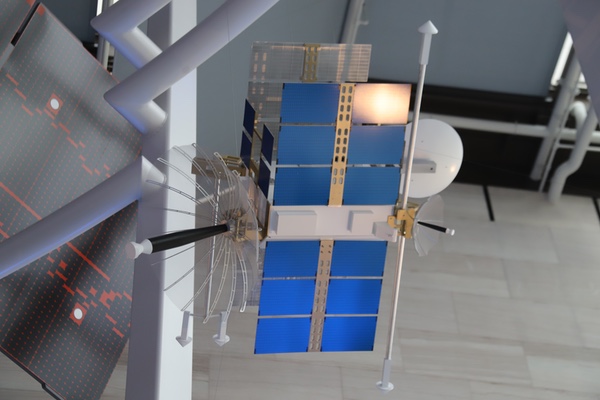
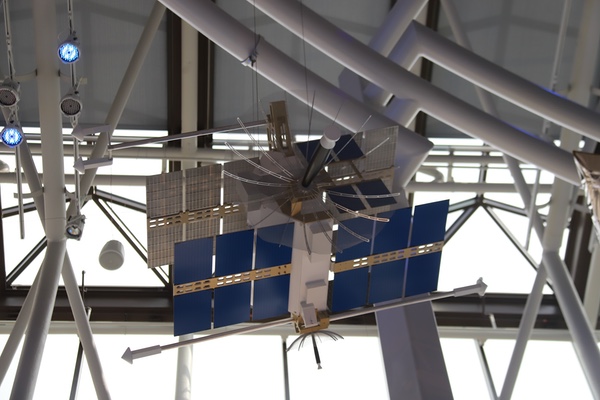 The FARRAH satellite spun at 60 rotations per minute. The direction of rotation was away from this viewpoint, so that the dish antennas swept the face of the Earth. (credit: D. Day) |
The number of P-989 satellites launched per year was never high, peaking at four in 1968 and another four in 1969. After that, the launches dropped significantly. There was one launched in 1971, two in 1972, one in 1973, two in 1974, and then one each in 1976, 1978, and 1979. The satellites had code names like MABELI, RAQUEL, and URSALA (see “Big bird, little bird: chasing Soviet anti-ballistic missile radars in the 1960s,” The Space Review, December 14, 2020.) When first developed, they stored their collected signals on tape recorders and played them back over American ground stations. The data was analyzed over weeks or even months to determine the characteristics of Soviet radars.
In the early 1970s, URSALA was modified to make it more useful to tactical forces, and the later satellites, such as FARRAH, incorporated a direct downlink capability so that they did not have to record their signals for later playback. They became intelligence assets that could provide near-real-time information to ground forces (see “Jupiter on the Space Shuttle and the Titan II: the FARRAH signals intelligence satellites,” The Space Review, March 16, 2026.)
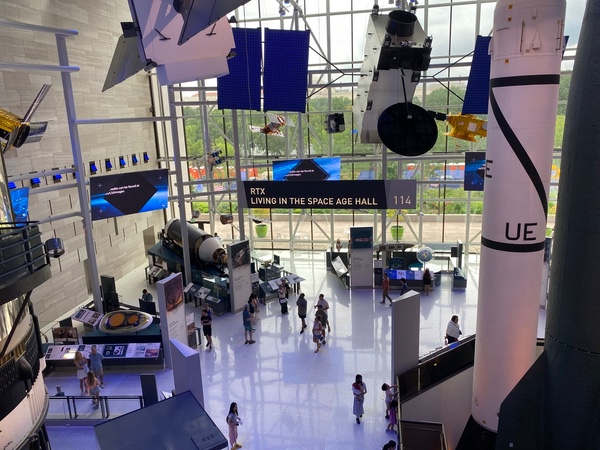 The Living In Space Hall at the National Air and Space Museum contains many rockets and spacecraft, including a GAMBIT reconnaissance satellite (center back left) and an engineering test article of the Hubble Space Telescope (not visible to the right). (credit: D. Day) |
Snooping on signals
FARRAH I was launched in 1982, deployed off the side of a massive HEXAGON photo-reconnaissance satellite and boosted into a higher orbit with a small rocket motor. It spun at greater than 50 revolutions per minute, sweeping its antennas across the face of the Earth. FARRAH II was deployed in 1984 off the side of the 19th HEXAGON satellite launched, the last HEXAGON to reach orbit (see “Little Wizards: Signals intelligence satellites during the Cold War,” The Space Review, August 2, 2021.)
By the late 1970s they were being used by the United States Army as part of a relatively new program known as TENCAP, for Tactical Exploitation of National CAPabilities. The specific Army program was known as the Tactical ELINT Processor/Tactical Unit Terminal system, or TEP/TUT, which had a unit logo featuring King Tutankhamun. TEP/TUT was a system mounted in vans and trailers that could be deployed with Army units in places such as West Germany and South Korea. FARRAH and other satellites could detect Soviet mobile air defense radar emitters. The mobile radars would guide vehicle-mounted missiles to shoot down American planes and helicopters. The satellite data would be processed by the ground system and distributed to Army commanders.
TENCAP was an increasingly expensive effort to bring “national level” intelligence collection systems that had previously served leaders such as the president, Pentagon and intelligence officials, to directly support troops in the field (see “From the sky to the mud: TENCAP and adapting national reconnaissance systems to tactical operations,” The Space Review, June 19, 2023.) FARRAH and similar satellites could fly over places such as Eastern Europe and nearly instantly provide useable intelligence to Army units in Germany.
RAQUEL, URSALA, and FARRAH were all named for actresses (although URSALA was apparently a misspelling.) Soon after Ronald Reagan became president, an official briefed him on American intelligence satellites. The person in charge of Program 989 was concerned that he would have to rename the satellites if Reagan objected—this would be expensive, because the names were included in computer programs. But when Reagan saw the names he laughed and said that he knew those actresses, the names were fine (see “Stars in the sky: the top secret URSALA, RAQUEL, and FARRAH satellites from the 1970s to the 21st century,” The Space Review, March 10, 2025.)
The model hangs in the museum’s RTX Living in the Space Age Hall above a GAMBIT reconnaissance satellite and near several other military satellite mockups. Look up and you’ll see it.
Note: we are now moderating comments. There will be a delay in posting comments and no guarantee that all submitted comments will be posted.