Getting to yes—or noby Jeff Foust
|
| Tyson was blunt in his assessment of Reflect Orbital’s plans during a National Academies meeting last month, calling those plans “even crazier” than broadband megaconstellations. |
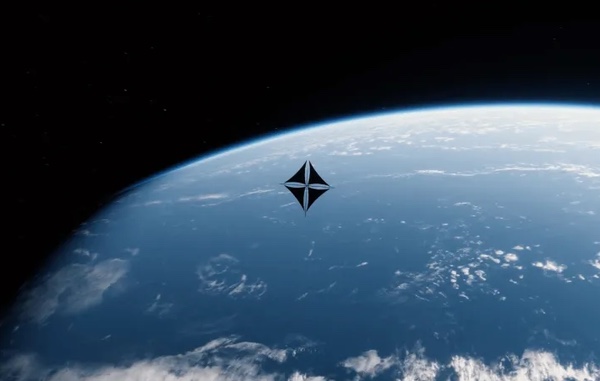
However, Eärendil-1 is not a typical communications or remote sensing satellite. The 142-kilogram spacecraft, expected to launch later this year into low Earth orbit, will deploy a thin-film reflector 18 meters on a side. Reflect Orbital will use the spacecraft to test how it can reflect sunlight to spots on the ground.
This spacecraft will be able to light up spots on the ground a few kilometers across for several minutes at a time, potentially as bright as the full moon. The company has plans for a constellation of as many as 50,000 satellites that could provide artificial sunlight to extend the operations of solar farms, aid agriculture and construction sites, and more.
However, many environmentalists and astronomers worry that such spacecraft would make groundbased optical astronomy virtually impossible and upset the diurnal cycles of plants and animals.
“This harm could include damage to sensitive research telescope equipment, potential flash-blinding of pilots and drivers, and—as Reflect Orbital stated in its own FCC filings—potential permanent eye damage to anyone looking through a mid-sized telescope,” the American Astronomical Society (AAS) said in a statement about the mission.
Tony Tyson, chief scientist of the Vera C. Rubin Observatory, was blunt in his assessment of Reflect Orbital’s plans during a meeting of National Academies committees last month, calling those plans “even crazier” than the megaconstellations that he and fellow astronomers have worried about for the last several years.
Those concerns prompted a flood of public comments regarding Reflect Orbital’s FCC application: nearly 1,900 comments by the time the agency issued its order, mostly opposing the mission. By comparison, SpaceX’s application for a constellation of up to one million orbital data center satellites had generated nearly 1,500 comments by the time of the FCC ruling, although that application came months after Reflect Orbital’s.
The FCC, in its order approving Eärendil-1, said those concerns were beyond its remit. “We find that concerns about Eärendil-1’s impacts on optical astronomy fall outside our review and authorization of the space station and are not a basis for denial of or additional conditions on Reflect Orbital’s operations,” it stated.
Later, when addressing environmental concerns, it stated that “we find that operation of a solar reflector attached to the satellite is too attenuated from the Commission’s action of approving use of spectrum and, thus, beyond the Commission’s authority.”
| “We are working on a framework that allows the government to say ‘yes’ to innovative space activities that don’t fit into traditional offices,” said Jordan. |
The FCC’s decision highlights a regulatory gap for commercial spaceflight in the United States. While licensing and approval processes exist for launches and reentries, by the FAA; for remote sensing, by the Commerce Department’s Office of Space Commerce; and for communications, by the FCC, who can, or should, regulate other activities remains unclear. Yet some degree of oversight by the federal government is required to meet US obligations under the Outer Space Treaty to provide “authorization and continuing supervision” of space activities by its nationals.
This has been a longstanding concern of the commercial space industry, which worried that this gap meant there was no agency empowered to approve missions that fall outside the well-worn paths of launch, remote sensing, and communications. That has led to years of efforts to develop a “mission authorization” system to provide such approvals and, thus, regulatory certainty for those companies.
But after a decade of effort, there is no mission authorization system in place. In the last administration, that debate led to a standoff between the White House, which proposed a system that split those responsibilities between the FAA and Office of Space Commerce, and the House Science Committee, which advanced a commercial space bill giving that authority solely to the Office of Space Commerce (see “An extended mission for authorization”, The Space Review, December 18, 2023.)
The latest effort for mission authorization came in March, when the Office of Space Commerce rolled out a proposal for a voluntary system. That proposal was in response to direction from an executive order on commercial space policy in August, directing the Commerce Department to develop a proposal for authorization what are widely called “novel space activities.”
“We are working on a framework that allows the government to say ‘yes’ to innovative space activities that don’t fit into traditional offices,” Taylor Jordan, the director of the Office of Space Commerce, said in a speech at the Satellite 2026 conference that announced the proposal.
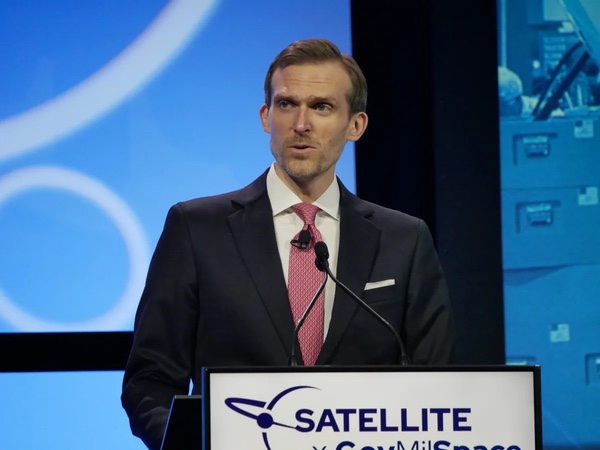 Taylor Jordan, the director of the Office of Space Commerce, discusses the new mission authorization proposal at a conference in March. (credit: J. Foust) |
That proposal would establish a voluntary system where companies could receive a “Space Commerce Certification” from the Office of Space Commerce. The companies would provide information about their missions to the office, which would then distribute them to other government agencies for review.
Those agencies would have 30 days to review those applications and raise any objections. The office would have 120 days from the time it received a completed application to rule on it, with a presumption of approval: if the office did nothing after 120 days, the application would be automatically approved.
The Office of Space Commerce has since collected input from industry on the proposal while awaiting a White House decision on it. “In developing this proposal, we worked hand-in-glove with the interagency to get their feedback to be able to say yes to how this works,” Jordan said last week at a hearing on the proposal by the House Science Committee’s space subcommittee. With the proposal now in the hands of the White House, “to me that means that we have the interagency in a good place to use our framework we have proposed.”
The certification is voluntary, he noted, because the office lacks the statutory authority right now to require companies to use. “We are leveraging existing authorities,” he said, including the ability “to seek the removal of legal, policy, and institutional impediments to the growth of the commercial space sector.”
So, what is the incentive for companies to go through a voluntary process? “The incentive that we’ve come up with is that we can provide a streamlining of the different regulations,” he said. “A company could put in one application to us and it could satisfy portions of the FAA’s or FCC’s obligations for their own work.”
He suggested that a Space Commerce Certification could be used to satisfy payload review requirements for an FAA license or orbital debris mitigation requirements for an FCC license.
If the White House approves the proposal, Jordan said his office would gradually implement it, starting a pilot program and tabletop exercises using more mature missions as initial cases.
“We intend to look at mature technologies and mature missions, and really focus on what is near operations in space,” he said. “From there, we will put our application into the interagency. We will work with them on how we get to yes through that process.”
| “I believe we ought to advance a commercial space industry that contributes to the public good and a strong economy,” said Lofgren. “Clarity about who regulates specific activities is needed.” |
During the 90-minute hearing, with Jordan as the only witness, members of the committee agreed on the need for some kind of mission authorization system. “We must provide the regulatory certainty that companies need,” said Rep. Mike Haridopolos (R-FL), chairman of the space subcommittee. “Failing to do so would slow investment, slowing innovation and undermining American leadership.”
“I believe we ought to advance a commercial space industry that contributes to the public good and a strong economy,” said Rep. Zoe Lofgren (D-CA), ranking member of the full committee. “Clarity about who regulates specific activities is needed.”
Members raised questions on both what legal authorities the office might need to turn the Space Commerce Certification into a binding, required system as well as concerns about the potential for overregulation.
Jordan vowed to provide a light-touch approach to the certification but suggested some new authorities in law would be helpful. “With congressional action, you all have the ability to make that non-voluntary,” he said.
The theme of his testimony, and of the questions from some members, was that the certification or some other kind of mission authorization scheme was needed for the commercial space industry to thrive as it moves into new activities.
“The current licensing regime is not designed to address them,” he said of novel space activities. “US regulations simply do not offer a clear path to ‘yes’ for novel activities. Instead, they risk trapping our industry in an endless maze.”
But a system that offers a clear path to “yes” can also produce a “no,” and the lack of a mission authorization system also makes it difficult to object to a novel space activity. Lofgren hinted at that when bringing up Reflect Orbital’s FCC approval in her opening remarks.
“In a rare admission, the FCC said that addressing any concerns related to the satellite’s purpose was outside their jurisdiction,” she said. “That admission illustrates, in part, why we’re here today. No federal agency has the statutory authority to oversee novel space missions.”
The AAS, in its statement, pressed the FCC to take action on Reflect Orbital’s application even after the commission said it had no authority to do so. “While the current license is for a single satellite, this logic implies that the Commission would also have no ability to consider the severe implications of a constellation of 50,000 solar reflectors like that envisioned by Reflect Orbital,” it stated.
“In the absence of another licensing agency that could take these considerations into account, we believe that it is critical for the FCC to consider all of the impacts of the satellite's use case,” the AAS added. (The House Science Committee has previously criticized the FCC for enforcing orbital debris mitigation requirements without the explicit authority to do so in federal law.)
| But a system that offers a clear path to “yes” can also produce a “no,” and the lack of a mission authorization system also makes it difficult to object to a novel space activity. |
The lack of a mission authorization system has, so far, not been an insurmountable obstacle for many companies pursuing novel space activities. Three companies have launched commercial lunar lander missions. SpaceLogistics, a subsidiary of Northrop Grumman, launched two missions to dock with and extend the lives of commercial GEO communications satellites, and has another launching this week. Others have flown tech demos for satellite servicing and related technologies.
A mission authorization system would provide more certainty for those companies. “The commercial space industry has told us for years that the lack of a clear regulatory pathway has discouraged investment and slowed the development of novel space activities,” said Rep. Brian Babin (R-TX), chairman of the House Science Committee, at last week’s hearing.
But creating a system that can say “yes” to novel space activities also means one that has the ability to say “no,” particularly if government policies and priorities change.
Note: we are now moderating comments. There will be a delay in posting comments and no guarantee that all submitted comments will be posted.