Review: New Space Capitalismby Jeff Foust
|
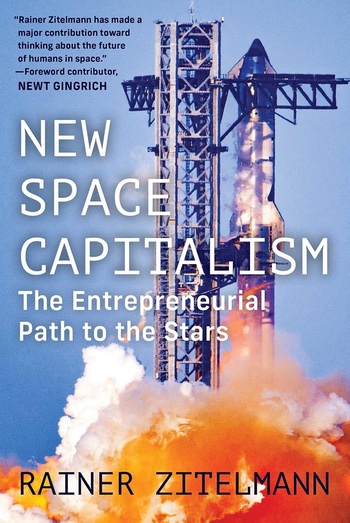
| The book makes clear his belief that government-funded space activities are inefficient and ineffective when compared to private efforts. “Hope for the future of space exploration lies solely in private spaceflight,” he writes. |
NASA administrator Jared Isaacman suggested at that briefing that there was an opportunity for new entrants, but without the financial support that NASA provided SpaceX and Boeing. “We currently do not have a plan to stand up a new commercial crew program right now,” he said. “There is, in this thriving commercial industry right now, lots of outside capital that seems to be eager to get involved. We’re giving you the demand signal.”
That likely suits Rainer Zitelmann just fine. The German author is a champion of capitalism in general—a publicity photo shows him wearing a t-shirt stating “I ❤️ Capitalism”—and its role in spaceflight more specifically, which he spells out in his book New Space Capitalism. Government, he argues, would do well to get out of the way in space and let the market take over.
The book extols the triumphs of private space activities, with a particular focus on SpaceX. Starship gets its own chapter with the title “A Ship for the Future of Humanity” with Zitelmann quoting one person who says the vehicle “will dominate space transport for the rest of the twenty-first century.” Other chapters explore topics ranging from Mars settlement to asteroid mining, as well as an examination of Chinese space activities.
The book makes clear his belief that government-funded space activities are inefficient and ineffective when compared to private efforts. “Hope for the future of space exploration lies solely in private spaceflight,” he writes, again praising Starship as the “most magnificent spacecraft in history.” Government’s role is largely as a customer as well as providing legal certainty for commercial space activities, like property rights to support asteroid mining.
That is, of course, not a novel idea. Zitelmann, in an extensively footnoted book, leans heavily on past works. The arguments he makes about the advantages of private space projects over government ones will be familiar for anyone who has followed the issue. There’s little in the way of novel policy prescriptions or recommendations here.
And those arguments, of course, have familiar flaws. “Few people realize how much our lives already depend on space-based infrastructure,” he writes, going on to describe the importance of space-based positioning, navigation, and timing services. Of course, those services are provided by government-run constellations like GPS, Galileo, and Beidou, with commercial newcomers to the field largely focused on augmenting, not replacing, government systems. Several pages later, he writes, “Weather forecasting is almost inconceivable without satellites,” which, again, are predominantly government systems, although assisted in some cases by commercial data.
The book was published before the current situation in space access as SpaceX withdraws the Falcon 9 from the commercial market and, with it, Crew Dragon, to focus on Starship. That’s led to some discussions about what the US government should do in response, including ways to pressure SpaceX to continue Falcon 9 and Dragon. Right now, such measures seem unlikely, given Isaacman’s response to a question about supporting new commercial crew entrants. But it suggests that capitalism alone can’t solve every issue in spaceflight.
Note: we are now moderating comments. There will be a delay in posting comments and no guarantee that all submitted comments will be posted.