RAMs and Blackjacks and shuttles: the Soviet Ramenskoye flight test center (part 2)by Dwayne A. Day and Harry Stranger
|
| If a new fighter or bomber—or even more exotic aircraft—was developed in the Soviet Union, it would most likely show up there first, and American satellites would photograph it, provided the skies were clear. |
American intelligence satellites were managed and operated by the National Reconnaissance Office (NRO). Throughout the 1960s and the first half of the 1970s the imagery satellites that photographed Ramenskoye and other targets used film, which was collected in reentry vehicles and returned to Earth. This meant that photos of Soviet activities were at least days to weeks old before they were seen by human eyes at the National Photographic Interpretation Center (NPIC, pronounced “enpick”). But in late 1976, the NRO began operating a new satellite, the KH-11 KENNEN. It sent its images back to Earth in near-real-time. Although its images were not as high-resolution as the film-return GAMBIT-3 satellite that remained in use until 1984, it increased the coverage of Soviet targets. This changed the nature of intelligence gathering. It made it easier to observe patterns of behavior at places like Ramenskoye.
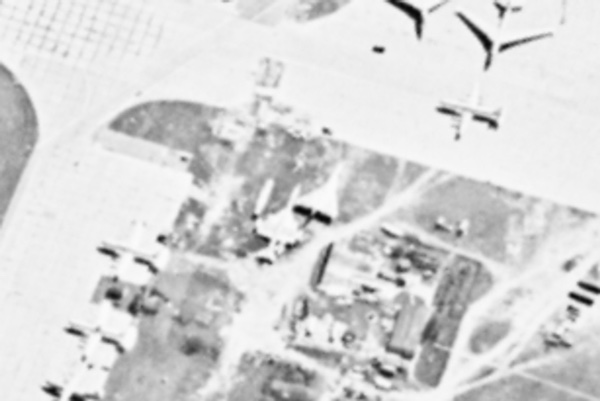 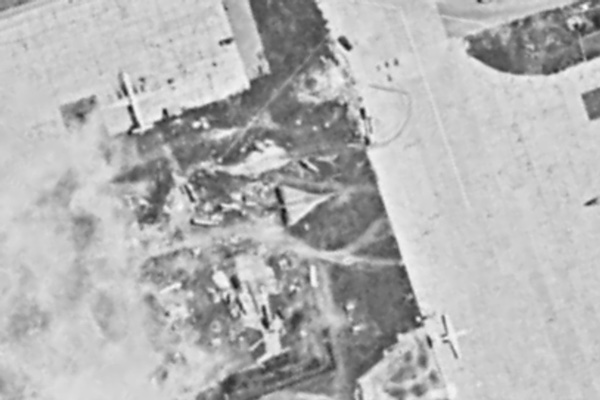 Only three Bounder bombers were produced, starting in the late 1950s. Only one flew. This aircraft, the M-52, was stored at Ramenskoye starting in the late 1960s. These two photos show the bomber in 1979, and then dismantled in pieces in 1980. (credit: Harry Stranger) |
Fighters and a bomber
Sometime in 1977—the exact date remains classified—American satellites spotted a new large twin-tail fighter aircraft at Ramenskoye. Intelligence analysts designated it the RAM K, using a designation system that had been developed in the 1960s. RAM for Ramenskoye and then a sequential letter, K for the 11th new aircraft spotted at the airfield. Soon a second, smaller twin-tail fighter aircraft was photographed at Ramenskoye. It was designated RAM L.
In September 1979, an American satellite overflying Ramenskoye spotted the wings and fuselage sections of two unidentified test scale models of a high-performance aircraft at what the CIA designated the Ramenskoye Central Aerohydrodynamic Institute (the Russian acronym was TsAGI). The scale models were similar in appearance and consisted of a fuselage section with new-type variable geometry wings. The models had previously been in open storage. “The two test scale models were probably undergoing tests in the institute’s high- and low-speed wind tunnels,” according to an intelligence report. The CIA referred to Ramenskoye Central Aerohydrodynamic Institute as “the principal Soviet installation for design-oriented applied research in aerodynamics… responsible for structural and aerodynamic testing of aircraft.”
What would gradually become apparent over the next several years was that these test models were for a new, large, swing-wing strategic bomber.
An extensive May 1981 NPIC report summarized activity observed at Ramenskoye. One of the aircraft it commented on had first been spotted in the late 1950s. It was believed to be a medium-range bomber with a new and unusual configuration, and the CIA had designated it Bounder. Only three aircraft were built and only one flown. The design was a failure. The first vehicle, designated the M-50 by the Soviets, had been sent to a Soviet aircraft museum in the late 1960s. The third vehicle, designated M-51, was unmanned and was scrapped in the late 1960s.
The second piloted vehicle, designated M-52 and differing from the M-50 in several ways, had sat at the Fili airport outside of Moscow during much of the 1960s, until it was disassembled later in the decade and taken to Ramenskoye and then reassembled in the area occupied by its design company. It sat there on static display—never flying once—throughout the 1970s. The 1981 report noted that “the [M-52] Bounder normally seen in the Myasishchev area has been disassembled. By March 1980 the engines had been removed, and by [deleted] disassembly was complete.” (See “Bounders and RAMs: satellites track a unique bomber at the Soviet Ramenskoye flight test center (part 1),” The Space Review, October 12, 2026.)
But there were much more interesting activities underway at Ramenskoye in May 1981 than the disassembly of a failed bomber. The large interceptor aircraft designated the RAM K was undergoing increased testing. The report stated that “a high level of RAM K activity has been observed during the past two years.” A fuselage was observed, another aircraft was spotted being towed toward Moscow Central Airfield. A probable two-seat version was observed on the runway. Two more aircraft were observed, and another one was moved to a testing area, presumably for static testing.
| The component first spotted in November 1980 was determined to be environmental protection for a large bullet-shaped object “very similar in appearance to the external fuel tank of the US space shuttle.” |
The other, smaller fighter aircraft that the CIA had designated as the RAM L was also visible in satellite photography. But it had always been concealed under a canvas covering. A satellite had caught the aircraft in tow within the east parking area.
In late 1981, an American satellite spotted a large swing-wing bomber aircraft at Ramenskoye. It looked similar to the North American Rockwell B-1 bomber, although significantly larger. This was a major discovery. In November, an airline passenger at Ramenskoye photographed the bomber on the tarmac, and it became publicly known. In December it took its first flight. The aircraft was designated RAM P by NPIC.
Although American reconnaissance satellites started flying over Moscow in the early 1960s, there had only been a single U-2 reconnaissance flight over the city in 1956. That mission had overflown the airfield and provided a crucial piece of information that had informed intelligence analysis for decades later. Dino Brugioni, who supported photo-interpretation efforts at NPIC in the 1950s and later and then became a prolific historian, wrote in his book Eye in the Sky, “We had wondered how the Soviets could get a Bison bomber out of the Fili plant because the runway was far too short for such a large plane to take off.” The U-2 mission solved that mystery. “We got our answer when the images showed a large barge on the Moscow River next to the plant. The Bisons were placed on the barge and ferried to the Ramenskoye test field.” Barges proved to be a key piece of a puzzle for a new aircraft that showed up there.
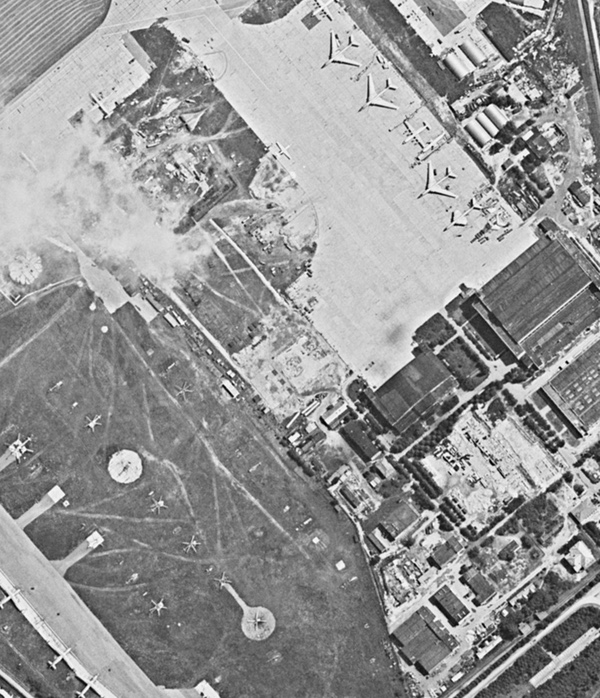 The area at the center of the photo in this satellite image of Ramenskoye taken in July 1980 was being cleared for new activity. (credit: Harry Stranger) |
The “aerospace components”
In 1981, intelligence analysts spotted a large structure consisting of two horizontal beams with a central connector at Ramenskoye. It was a lifting device, a crane capable of picking up a large object, and with a wide enough stance so that an aircraft could be moved underneath and the object attached on its top. This discovery would have reminded intelligence analysts of a similar device constructed by NASA to enable a Space Shuttle orbiter to be lifted onto the back of its 747 carrier aircraft. A nearly identical structure was also photographed under construction at Baikonur on the edge of a large runway that had been started in 1979. It is unknown who in the intelligence community first made the connection, but the conclusion was obvious: something being tested at Ramenskoye was going to be transported to Baikonur.
In November 1980, American satellites observed what NPIC photo-interpreters designated “aerospace components.” These components were eventually identified at Ramenskoye, at Kubyshev Aerospace Production Plant 1, and Tyuratam Airfield 3—the sprawling Soviet space launch site known as Baikonur. A similar gantry crane was being built at the production plant and another one at Tyuratam, and the runway at the production plant was also being lengthened.
By fall 1982, NPIC reported that “the exact function of these aerospace components is not known; however, they are probably components of a space launch vehicle.” The component first spotted in November 1980 was determined to be environmental protection for a large bullet-shaped object “very similar in appearance to the external fuel tank of the US space shuttle.”
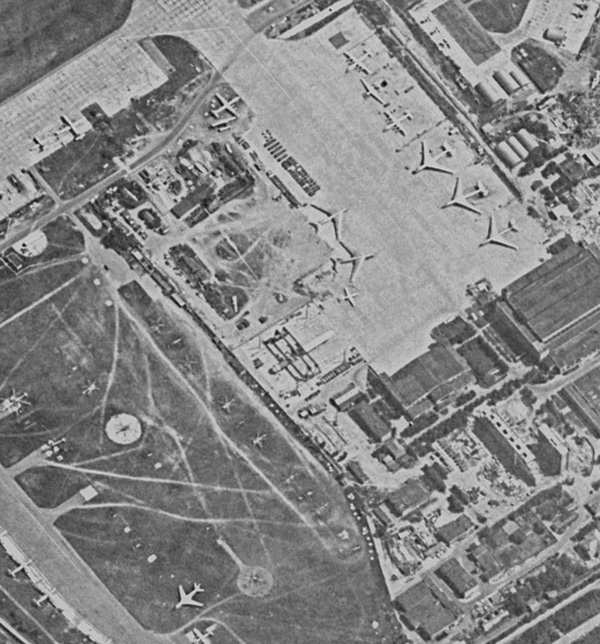 The center area of this photo taken in 1982 now reveals a large gantry crane and a bullet-shaped object underneath. This crane was used to lift components of a large fuel tank so that they could be placed atop a carrying aircraft. Similar cranes appeared at both the production plant and the Baikonur launch site, enabling American intelligence analysts to connect all three facilities. (credit: Harry Stranger) |
NPIC concluded that the structures were so large that they could only be delivered by air. Two Bison bombers were modified to carry them. The modified aircraft were loaded by moving under a gantry crane holding the component—an operation that was apparently photographed by a satellite. The pointed end of the component was facing aft to reduce vortex disturbance at the rear of the aircraft. At one point a satellite had photographed a V-shaped bracket mounted to the top of a Bison aircraft, but it was unclear if this was for mounting the large tank or something else, something yet unseen.
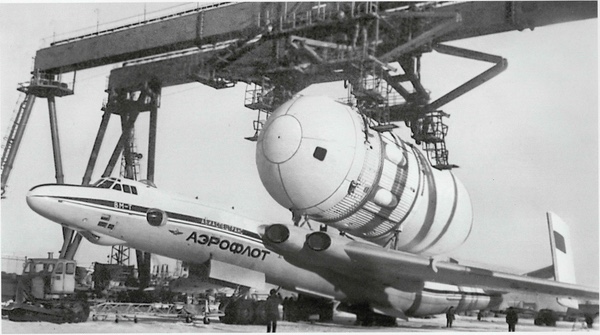 The gantry crane used to lift the tank components. (credit: "Myasishchev M-4 and 3M: The First Soviet Strategic Jet Bomber," Peter Gorin and Dmitriy Komissarov) |
The intelligence analysts speculated that the crane and operations at Ramenskoye were only for testing the aircraft’s flight characteristics with the large tank mounted on top, and eventually production equipment would be flown directly from the plant to Tyuratam, “where they will be removed and taken by transporter to their designated assembly areas.”
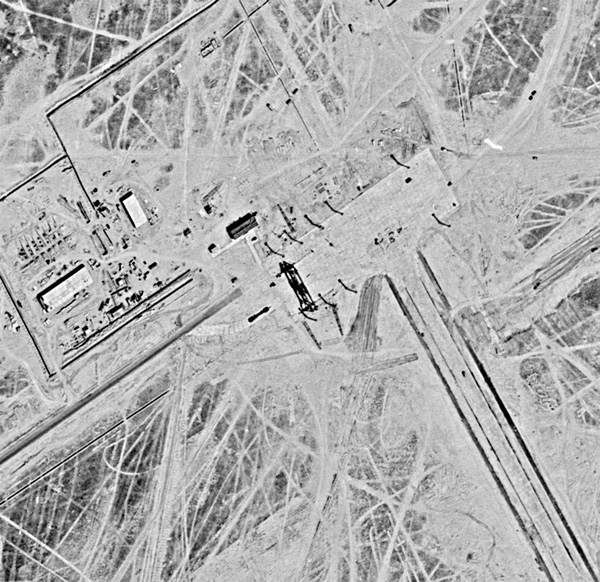 A large gantry crane was built at Baikonur so that the tanks could be removed from their carrying aircraft. They were then placed on ground vehicles to take to the processing facility. (credit: Harry Stranger) |
The first test flight of any major item at Ramenskoye’s flight test center that was associated with the new rocket program took place in January 1982, at a time when Moscow was almost certainly cloud covered. The first transport of any major item from Ramenskoye to Baikonur took place in December 1982. That involved the forward and aft covers of the rocket’s giant liquid hydrogen tank joined together, placed atop a Bison bomber. It is unknown if American satellites spotted this event, but the Soviet landmass was much more cloud-covered in winter, and opportunities for satellite photography are rare.
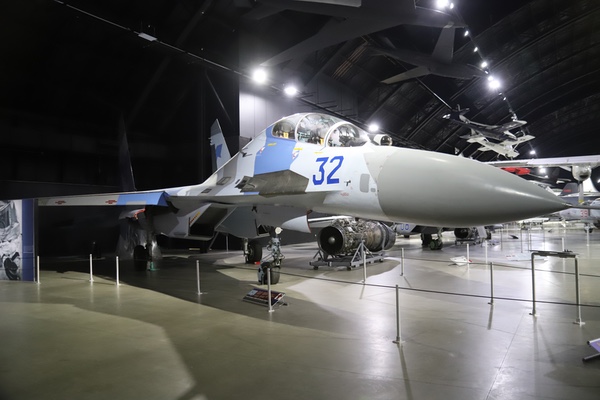 The Su-27 Flanker was first detected at Ramenskoye in the later 1970s. During the early 1980s, American satellites photographed multiple Flanker aircraft being tested at Ramenskoye. The Flanker was a front-line interceptor aircraft, roughly equivalent to the U.S. Air Force's F-15 Eagle. Multiple variants are still flying and in production today. (credit: Dwayne Day) |
Flanker and Fulcrum
By October 1983, NPIC produced another detailed report on activities at Ramenskoye. By this time the RAM K and RAM L fighters had been respectively designated the Flanker and Fulcrum. The Soviet designation for the Flanker was the Sukhoi Su-27. The designation for the Fulcrum was the MiG-29. Both would become important frontline aircraft for the Soviet air force by the late 1980s and later and would be exported around the world and spawn multitudes of variants. The MiG-29 was a highly maneuverable but very short-ranged fighter. The Su-27 was a much bigger interceptor. They were roughly analogous to the US Air Force’s F-16 Viper and F-15 Eagle in size and mission.
NPIC had identified what it designated the Flanker A, and the Flanker A MOD. The early Flankers—the Flanker As—had problems in flight and were redesigned, becoming what NPIC referred to as the MOD version. The Flanker A was not very active during this time, but the Flanker A MOD was undergoing extensive flight testing. Five fuselages had been identified in the Sukhoi area of the test center in late March 1983. The large number of fuselages indicated that the aircraft was probably in pre-series production, although it was unusual for them to be delivered partially assembled to Ramenskoye rather than flight tested at the production facility in Komsomolsk. The report authors speculated that the plant might not be fully equipped to perform flight tests.
The aircraft weapons test program was active at Akhtubinsk since at least early September 1982. This too was unusual, because normally aerodynamic testing at Ramenskoye would be completed before weapons testing began, but this might have been an effort to accelerate the program to operational status.
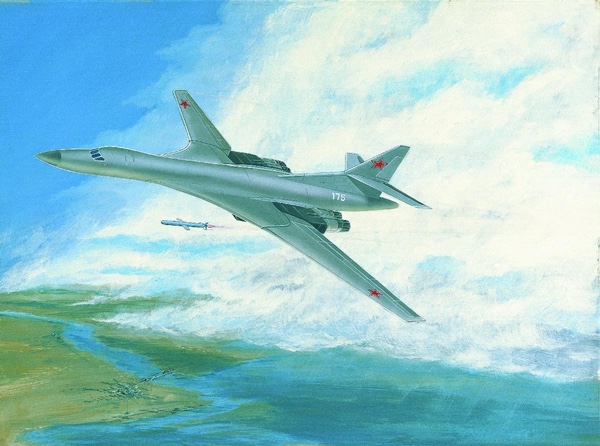 The Tu-160 Blackjack strategic bomber was first spotted at Ramenskoye in late 1981, although parts of a subscale wind-tunnel model were photographed by American satellites there in 1979. It was initially designated RAM P by the US intelligence community before being renamed as Blackjack. The bomber is still in operation today, although fewer than 20 are flying. This artwork was produced by the Department of Defense in the later 1980s. (credit: Department of Defense) |
In addition to the Flanker A MOD, the Fulcrum A aircraft were also occasionally observed at Ramenskoye “mainly in shelters in the East parking area.” But the focus of the test program had apparently shifted from Ramenskoye to the Lukhovitsy Airframe Plant, where six preproduction aircraft were photographed, and to Akhtubinsk, where nine were spotted by a satellite.
What the report indicated was that by the early 1980s, NPIC and the intelligence community had a good understanding of how and where the Soviets tested their aircraft, and how the stages of testing progressed. At least some of this was probably due to the much more prolific imagery provided by the KH-11 KENNEN.
The RAM P aircraft detected in 1981 had been designated the Blackjack by the CIA. In 1982, a satellite had photographed the aircraft on the ground surrounded by support trucks. The Blackjack was still undergoing testing at Ramenskoye in 1983. Satellites photographed the bomber and revealed that its configuration had changed. The horizontal stabilizer was modified probably during the summer of 1982. The stabilizer’s span was reduced, and the tip chord was increased—all visible to American satellites. The report noted that “observations of the Blackjack A have been infrequent and there is no evidence that two models of the Blackjack exist.” By early January 1983, the CIA predicted that the Soviets would have 50 to 75 of the aircraft flying by 1990. (The total number built, including test aircraft, was 41.)
The Soviet space shuttle appears at Ramenskoye
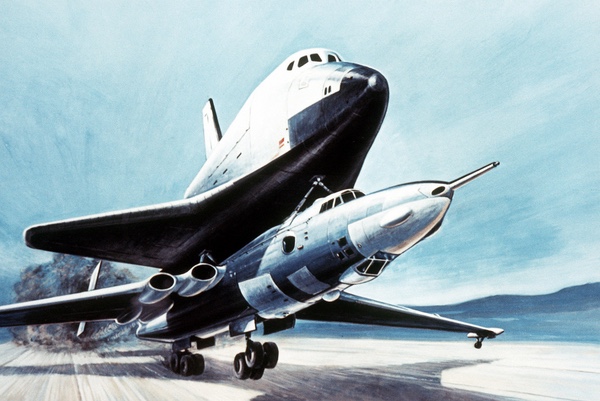
In early 1983, another major aircraft appeared at Ramenskoye and was photographed by a reconnaissance satellite: the Soviet Union’s space shuttle. A report stated that “a space shuttle orbiter for a Soviet reusable space transport system” was observed for the first time. It received the interim designation RAM R. It was photographed mounted atop a Bison B bomber in the Myasishchev area at Ramenskoye. A second modified Bison B with a 44-meter “aerospace component” was also present.
| When the Soviet space shuttle appeared in American satellite photos, it was simply the final piece of the puzzle, and the beginning piece of another. |
The report described it as “very similar to the U.S. Space Shuttle orbiter in size and general layout” and noted that “preliminary dimensions of the RAM R are very close to those of the U.S. Space Shuttle orbiter.” It added that “the type of thermal protection system, if present, cannot be determined.”
The report stated that the vehicle was “probably produced at Moskva Guided Missile Plant Tushino 82… and transported to Ramenskoye for assembly. Various unidentified components seen previously at Ramenskoye could have been part of the RAM R program.” Those were the large tank-like structures first spotted in 1980.
The CIA had likely suspected that the Soviet Union was building a space shuttle for some years by then. In 1978, Aviation Week & Space Technology reported that the Soviets were conducting wind tunnel tests of a large delta-wing lifting body space vehicle, speculating that the Soviets were starting a shuttle program. Ultimately, the Soviets chose a design much closer to the American shuttle.
In 1979–1980, American satellites photographed the enlargement of the runway at the sprawling Soviet launch site at Baikonur, which the CIA called Tyuratam. That was a likely indication of plans to land a space vehicle there.
American satellites had also photographed an object on the apron of the flight test area that “strongly resembles the forward fuselage section of an aircraft, primarily the flight deck area.” It apparently had windows. “It is possible that, because of the other space-related activity in the flight test area, the object is also space related. It is not comparable in size or configuration to any known Soviet aircraft.”
Although satellite photos taken by American KH-11 KENNEN and KH-8 GAMBIT-3 satellites remain classified, the declassified reports indicate that intelligence analysts had substantial photography and other information to work with piecing together what was increasingly looking like a Soviet space shuttle program. They had the reports of wind tunnel tests, the connection between Ramenskoye and the launch site at Baikonur, and the object that looked like a forward fuselage. When the Soviet space shuttle appeared in American satellite photos, it was simply the final piece of the puzzle, and the beginning piece of another.
The October 1983 NPIC report had much to say about the Soviet space shuttle that had been detected earlier in the year: “The RAM R has not been seen with a vertical stabilizer, which will have to be attached before the shuttle is flown with the Bison for free-flight testing. Possibly, the Bison is unstable in flight when carrying the shuttle with the vertical stabilizer attached or, more likely, the shuttle with the stabilizer attached cannot clear the bridges over the Moskva River. The shuttle is barged between Ramenskoye and Moskva Guided Missile Plant Tushino 82… where it was built. The vertical stabilizer will probably be attached after transport to Tyuratam.”
Another significant event had been spotted by US satellites earlier in the year: the shuttle and its Bison carrier aircraft were off the runway. “The Bison apparently veered off the runway and came to rest on the infield area between the long runway and the taxiway. Ruts caused by the Bison were visible, but no damage to the shuttle was observed. The Bison was in the mud with the port wing nearly on the ground and the nose close to the ground.”
| Another significant event had been spotted by US satellites earlier in the year: the shuttle and its Bison carrier aircraft were off the runway. |
Soon afterwards, operations to retrieve the aircraft commenced. “The Bison, either because it was mired so deeply or because the landing gear was so badly damaged, could not be moved with the shuttle attached. Two concrete block paths were laid from the runway to the Bison, and two cranes were present to remove the shuttle.” Shortly after this, another satellite photographed the area and both the shuttle and Bison were gone, probably inside hangars.
The shuttle was probably returned by barge to Tushino. A satellite photographed an empty barge at the pier at Ramenskoye, and later an empty barge was at the land-to-water transshipment facility at Tushino. “Either the shuttle could not be repaired at the flight test center or repairs to the Bison are expected to take a considerable amount of time and, therefore, the shuttle was returned back to Tushino.”
The October 1983 report also referred to the “aerospace components” and stated that “the program to develop the flight envelope and handling characteristics of the Bison/component combination is probably complete, and it is unlikely that either of the components will be returned to the flight test center.”
Integration of the various space components took several years, and it eventually became clear to American intelligence analysts that the Soviets were developing a powerful rocket that could carry either a space shuttle, or a separate cargo container. The first launch of the heavy-lift rocket, named Energia, took place from Baikonur in May 1987. The first and only launch of the Soviet Buran space shuttle, which was carried on the side of an Energia, occurred in November 1988. That flight did not include a crew, and soon the program was grounded and eventually canceled due to its expense. Those events were also monitored by the US intelligence community.
Note: we are now moderating comments. There will be a delay in posting comments and no guarantee that all submitted comments will be posted.