The commercial space station competition finally beginsby Jeff Foust
|
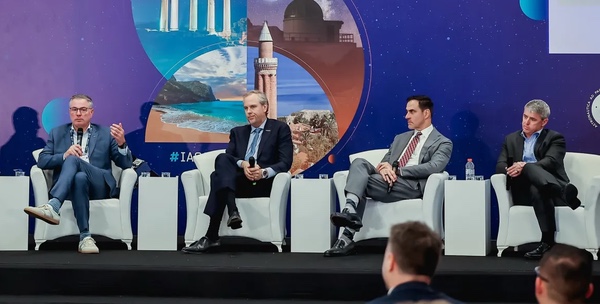
| “Whoever does that first will be in the best position,” Vast’s Haot said of developing commercial space stations. “It’s a race.” |
NASA’s excuse was that, well, it was really busy. “You can imagine we have a lot of things going on,” Dana Weigel, manager of NASA’s Low Earth Orbit program, said at a September 30 briefing previewing the upcoming launch of the Crew-13 mission to the ISS. That included both the Crew-13 launch as well as an announcement two days earlier about additional support NASA was giving Boeing to aid in the certification and future operations of its Starliner vehicle.
“We’re putting finishing touches on it,” she said of the final RFP. “So, we’re going to get that out as soon as we can.”
Some in industry feared another significant delay. NASA was working towards an RFP last summer when the agency said it would shift from a single contract for the next phase of the CLD program to multiple funded Space Act Agreements, delaying that planned procurement.
Then, in March, NASA said it was considering a radical overhaul of the program, proposing to add a “core module” to the ISS to which commercial modules could attach as a step towards commercial stations (see “Commercial space station developers make their business case to NASA,” The Space Review, April 20, 2026). Companies proposing commercial space stations opposed the move, and in June NASA backed off, promising something like the earlier approach.
Fortunately, the latest delay was only a minor slip. On October 9, NASA issued that final RFP, seeking proposals from industry by December 8. The agency said it would select at least two companies by next April for initial awards to continue work on their stations, with at least one later selected for full development. The race to succeed the ISS was finally, formally underway.
The four contenders
The next phase of the CLD program is open to any company, not just those that participated in the first phase. Most, though, have received support from earlier phases of the program.
Axiom Space, for example, was selected by NASA in 2020 to use a docking port on the ISS to attach commercial modules to. Axiom originally envisioned attaching several modules to that port, creating a commercial wing of the ISS that would later detach to become a standalone station. The company’s plans have evolved, though, to use that port for a single module, and only for a short time.
| “There’s a lot of people that go, ‘Oh, well, if it’s such a great market, why don’t you just go do it yourself?’” Smith said of commercial crew vehicles. “Well, we’ve got to remember that SpaceX, love them, but they didn’t do it themselves either.” |
Testing that first module at the ISS will “demonstrate that we can fly the vehicle, attach the vehicle, operate the vehicle, have humans check it out, do those kinds of things,” Jonathan Cirtain, CEO of Axiom Space, said during a panel discussion at the International Astronautical Congress (IAC) in Turkey on October 6. “That safety-first mentality really drives a lot of the considerations that we make.”
Blue Origin was one of three companies that received funded Space Act Agreements for the first phase of the CLD program in 2021 for a space station called Orbital Reef. The company has taken a relatively low profile recently, when compared to its competitors, but the company is still actively pursuing the concept.
“We are a launch and infrastructure company, and our power is in our scale,” said Randy Lillard, program manager for Orbital Reef at Blue Origin, on the panel. “We build big spacecraft, we build them fast, and we build them at scale.”
Starlab Space, a joint venture led by Voyager Technologies, also received a CLD award in 2021 and later partnered with the third awardee, Northrop Grumman. Starlab’s technical approach involves a large single-module station launched on SpaceX’s Starship, avoiding the need for in-space assembly.
Marhsall Smith, CEO of Starlab Space, emphasized on the panel the joint venture’s partners that include Airbus, Mitsubishi, and MDA Space. “All of us have this vast experience in building this hardware, and so instead of trying to reinvent the wheel, we’re trying to use existing facilities and systems,” he said.
Vast did not receive a CLD award in the first round and did not even start operations until after NASA made the awards. The company, though, has scaled up quickly and is pursuing a human-tended station, Haven-1, scheduled for launch next year that will be able to host four-person crews for short-duration stays.
“We are all aspiring commercial space station companies,” said Max Haot, CEO of Vast. “Our view is the most important thing any of us need to do, for competing for NASA business and so on, is to develop our product and put it in space and become an actual space station company.”
“Whoever does that first will be in the best position,” he added. “It’s a race, and that’s what we are doing with our first space station module, Haven-1, that will launch next year.”
Getting there and back again
Companies developing commercial space stations have an array of challenges to overcome, from the ongoing NASA competition to securing outside investment and non-NASA customers to the technical issues of building a commercial space station. One of the biggest, though, may be a problem that seemed solved not long ago: getting crews to and from their stations.
Several of the companies appeared likely to rely on SpaceX’s Crew Dragon spacecraft; Vast, for example, already had contracts for Crew Dragon missions to Haven-1. However, SpaceX has privately indicated to companies that Crew Dragon will likely not be available for their stations as SpaceX transitions to Starship.
| “We await an on-ramp opportunity with NASA and how that would work out,” Lillard said a Blue Origin commercial crew vehicle. “But we have no plans to fund this internally.” |
That has created a headache for those companies. “We built an astronaut program, a training program, that has dependencies on SpaceX and their vehicles,” said Cirtain. Axiom has flown four private astronaut missions to the ISS on Crew Dragon spacecraft with a fifth planned for next year. “I don’t have a pivot plan. There’s no thing for me to now train against other than SpaceX.”
Other executives, though, were less concerned, seeing this as a bigger problem that NASA will need to resolve. “If we don’t solve that problem, we’re not going to Mars, we’re not going to the Moon,” said Smith.
The topic was a concern for companies reviewing the draft RFP for the next CLD phase, since NASA had requested providers to give an “end-to-end” price option that included transportation. With Crew Dragon off the market, the only other option for the foreseeable future is Boeing’s Starliner, a vehicle that has suffered years of development delays and setbacks.
NASA is putting its resources behind Boeing, though, announcing on September 28 a $359 million contract modification to cover work to address thruster and valve issues seen on previous test flights. It would also support work to certify United Launch Alliance’s Vulcan rocket for future Starliner missions once the remaining six Atlas rockets are flown.
However, NASA’s interest in supporting Boeing does not extend to also funding new entrants. While agency officials, like administrator Jared Isaacman, emphasized the importance of competition, he said there were no plans to establish a new commercial crew program like the one that funded development of Starliner and Crew Dragon.
“There is, in this thriving commercial industry right now, lots of outside capital that seems to be eager to get involved. We’re giving you the demand signal,” he said, with NASA offering technical expertise but not funding for those vehicles.
Commercial space station developers are skeptical, though, that private funding will be available for new commercial crew vehicles. “There’s a lot of people that go, ‘Oh, well, if it’s such a great market, why don’t you just go do it yourself?’” Smith said. “Well, we’ve got to remember that SpaceX, love them, but they didn’t do it themselves either. They got a lot of help from NASA.”
Of the commercial space station developers, Blue Origin is uniquely positioned to solve the problem itself. The company was involved in early phases of the commercial crew program 15 years ago and has an unfunded Space Act Agreement to get technical support for a crewed spacecraft known simple as Space Vehicle.
But despite that experience and the company’s deep coffers, Lillard said Blue Origin would not go it alone on a commercial crew vehicle. “We await an on-ramp opportunity with NASA and how that would work out,” he said on the panel. “But we have no plans to fund this internally.”
One reason Blue Origin wanted to work with NASA was to ensure that its vehicle would meet NASA certification requirements. “The certification is way easier with NASA if you do it with them, not at the end,” he said.
The RFP solution
Some in industry wanted NASA to handle the transportation element of the agency’s use of commercial space stations, rather than have the companies try to make those arrangements. The final RFP appears to give what the companies want, at least in the near term.
Under the RFP, NASA will offer what it calls Government Furnished Transportation and Support Services (GFTSS), which includes both cargo and crew transportation, for the agency’s first four missions to commercial stations. That includes one crewed mission and two cargo missions for a six-month increment on a commercial station.
NASA added in the RFP that companies can request GFTSS for missions beyond the first four, “but the Contractor shall assume additional transportation vehicles will not be provided by NASA.”
| “What we have read in the RFP are things that we can live with. We can certainly deliver something that can meet the national objectives as outlined in the RFP,” said Cirtain. |
That decision aligned with the belief some executives said before the final RFP release that NASA would have to step up and solve this issue. “We can already see that NASA is taking it to heart and we believe it will take care of the problem,” Vast’s Haot said on the panel, referring to NASA’s new support for Starliner. “We are optimistic.”
Another issue the companies raised in the draft RFP was the number of requirements that NASA sought to impose on companies, which those companies argued made it more difficult and expensive to develop their stations.
“I think the way the draft RFP was constructed emulates the prescriptive nature of the spacesuit procurement that I’m currently living through,” said Cirtain, referring to Axiom’s separate contract to develop a lunar spacesuit for NASA’s Artemis program. The company had to deliver 30,000 documents for a critical design review and close out 4,000 issues before the review could be closed.
“If you do that on a space station, you’re never going to get through the finish line, so NASA is taking an overly prescriptive approach,” he concluded.
At a pre-proposal conference last week about the final RFP for prospective bidders, NASA said it made reductions to the number of requirements and related paperwork, but did not quantify that reduction in slides it later released.
Speaking at an event in Washington last week, Cirtain said he was satisfied with the changes he saw in the final RFP. “What we have read in the RFP are things that we can live with. We can certainly deliver something that can meet the national objectives as outlined in the RFP.”
However, he continued to push NASA to reduce requirements in general. “Agencies throughout the U.S. government need to get better at defining what the objective is and staying out of the details of the requirements, because often they don’t have enough technical expertise to define what the requirements would be for an industry leader that’s trying to innovate,” he said.
Axiom and others will be spending the next several weeks working on proposals that could define which companies go forward with commercial stations and which are forced to regroup or even pivot to other markets. For those companies, the final RFP came not a moment too soon.
“Let’s move forward because we’ve been in phase one for five years plus now,” said Starlab’s Smith on the IAC panel.
Note: we are now moderating comments. There will be a delay in posting comments and no guarantee that all submitted comments will be posted.