Can data centers close the case for space-based solar power?by Jeff Foust
|
| “When we started our project more than 10 years ago at Caltech, I thought this was the craziest idea in the world,” Atwater said of SBSP. |
Some have argued that the election results may accelerate work on orbital data centers. Such centers would get around much of the opposition to terrestrial data centers that manifested itself in the elections. But they also face technical and financial obstacles that suggest it will be years before a significant amount of compute moves from the ground to space.
Last week, for example, Google announced it was proceeding with Project Suncatcher, an effort to test orbital data center technologies, buying a New Glenn launch of an unspecified number of satellites that will each have the computing power of a rack of servers in a terrestrial data center. That launch, though, will not take place until early 2029, and Google has yet to file plans for its own orbital data center constellation.
Space, though, might be able to help address the concerns of terrestrial data centers. One of the biggest is the power demand of such centers, which can strain power grids and increase rates. Companies are under pressure to provide at least some of their own power for data centers, using approaches ranging from solar farms to gas generators, which pose their own challenges.
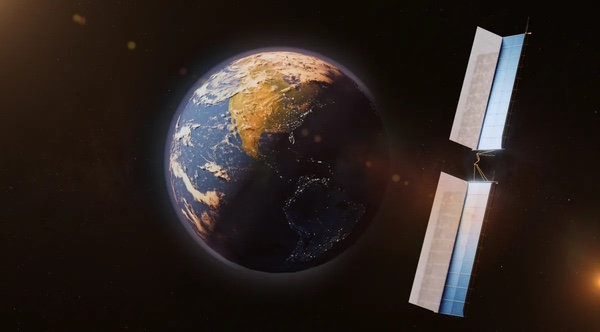
Some in the space community see an opening for a favorite concept, space-based solar power (SBSP). For more than half a century, advocates of SBSP have argued it can provide clean, limitless energy from space, but have struggled to get beyond small-scale experiments given the costs and complexity of such systems and limited demand for power they would provide that, at least initially, would be much more expensive than terrestrial sources.
Terrestrial data centers with growing power demands and less price sensitivity could be ideal customers for SBSP, some argue. “This projected 40% increase in demand that we may see over a decade for data centers is a natural first customer,” said Dan Kammen, a professor of energy at Johns Hopkins University and one of the leaders of the university’s Ralph O’Connor Sustainable Energy Institute, at a conference in Washington at the end of September.
Kammen described himself as an initial skeptic of SBSP. “I loved the idea, but this is never going to win because the learning curves for solar and batteries are doing so well,” he said, referring to terrestrial solar. High launch costs, he said, would keep SBSP from being an option.
Projected decreases in launch prices, though, as new reusable vehicles like SpaceX’s Starship enter service, changed his mind. “Much of our initial skepticism is likely wrong if we keep up the effort,” he said.
Kammen shared the stage with Harry Atwater, a Caltech professor who has worked for more than a decade on a privately-funded initiative to test key SBSP technologies (see “A small step forward for space-based solar power technology,” The Space Review, November 13, 2023).
“When we started our project more than 10 years ago at Caltech, I thought this was the craziest idea in the world,” he said. “I was charged to think about this as a technology and I immediately wrote it off.”
The idea, though, “gnawed at me,” he said, continuing to study it while thinking about how reduced mass to orbit could make it feasible. That led to modular concepts that could be produced in volume and assembled in orbit.
| “The question today isn’t whether space solar is possible. It’s whether it belongs on the planning horizon of the people who keep the lights on,” said Menezes. |
What was notable about the comments was not just their cautious endorsements of SBSP but also the forum. The conference where they spoke was not a space industry event but instead a half-day symposium held during Experience Power, an energy industry conference. While the symposium was organized by the Space Frontier Foundation, a group that has long championed SBSP, the intent was to bring in more than space industry people to the event.
“The question today isn’t whether space solar is possible. It’s whether it belongs on the planning horizon of the people who keep the lights on,” said Mark Menezes, president and chief executive of the United States Energy Association, an energy industry group, in remarks that opened the event.
He thought SBSP should be considered by the energy industry. “It's time to take this seriously enough to test it,” he said.
He said that interest was driven by growing demand for power from terrestrial data centers as well as new industrial demand and growth in electric cars. “For the first time in a generation, utilities are planning for serious load growth,” he said. “When your customers are asking for gigawatts in years and not decades, you owe it to them to look at every option.”
Some SBSP startups are seeing demand for their services from data centers. Overview Energy, a Virginia startup that has proposed beaming power from spacecraft in geostationary orbit as soon as 2030, announced in April a deal to provide up to one gigawatt of power for data centers operated by Meta. That deal is part of an effort by Meta to diversify power for its data centers that also includes agreements to use geothermal and nuclear power as well as battery storage.
“One cheat code that we have is that there are over $1 trillion assets already built that are sitting dormant at night,” said Darko Filipi, co CEO of Overview Energy, at the conference. Those assets are solar farms that Overview’s satellites can illuminate with infrared lasers, allowing them to generate power at night without needing any additional infrastructure on the ground.
“We can move power across data centers on demand,” he said, referencing the Meta agreement, by switching the beams from one solar farm to another as needed.
Overview has conducted airborne tests of its technology, demonstrating the ability to accurately point a beam to a receiver on the ground. A hosted payload will launch next year followed by a demonstration satellite in low Earth orbit in 2028 before moving to larger spacecraft in GEO.
At the conference, another SBSP startup, Virtus Solis, announced a deal with a data center startup, Brae Systems, which agreed to buy 100 megawatts of power for data centers it is developing.
Virtus Solis proposes to develop solar power satellites in highly elliptical Molniya orbits, visible to a ground receiver for up to 10 hours at a time. The satellites themselves would be modular, with the company planning to mass-produce modules that can receive solar energy and then transmit 1 kilowatt of power using microwaves.
“They’re made on the same assembly line that big-screen TVs are made on,” said John Bucknell, CEO of Virtus Solis, in an interview. “And we make a million of those per line per year.”
At the conference, he said data centers have become a key potential market for the company, although not the only one. “When we started in 2019, there was no data center demand,” he said, with his company instead focusing on utility companies. Besides data centers, the company has seen some “interesting use cases” such as making sustainable aviation fuels. “In all these cases they want power and they can’t get it.”
Even Atwater, the Caltech professor initially skeptical of SBSP, is pursuing it commercially through a new venture, AHP Systems. (“I framed myself as an academic, but I’m also a serial entrepreneur,” he explained.) That startup is working to commercialize technologies tested at Caltech to create systems that can produce 100 megawatts of power.
The startup plans to license the technology tested at Caltech and has a strategic partnership with JPL to use testing facilities. “We’ve already reduced a great deal of risk and can move into scalability,” he said.
The organizers of the event hoped that it would start discussions between two different industries. “We need translation. We need to be able to speak the same language. Get the space community and the power sector speaking in the same language: capacity factors, dispatchability, cost per megawatt-hour, interconnection fees,” Menezes said, rattling off terms commonly used in the power industry.
He also pushed to define milestones for developing SBSP. “Leave with a shared view of what a credible demonstration looks like, and what evidence utilities and investors need before 2030.”
| SBSP has struggled over the decades to find a niche compelling enough to advance development of systems. |
“One of the things that we’re doing is being able to understand the differences” between the industries, said Sean Mahoney of the Space Frontier Foundation. “What is the language, what are the motivators, what are drivers of these two different industries, so that we can make sure we’re unlocking this potential value.”
It was not immediately clear at the end of the half-day event if the organizers had succeeded. There were several dozen people in the room, but many were from the space industry. Those from the energy industry there did bring up issues related to the efficiency of SBSP systems and the capital expenditures they would need to receive space solar energy, according to small group discussions during the symposium.
SBSP has struggled over the decades to find a niche compelling enough to advance development of systems. The original interest in the 1970s was triggered by the energy crisis, but failed to gain traction given the high costs to build and launch systems then contemplated. Twenty years ago, advocates focused on military interest in SBSP as a way to provide power to remote installations despite high costs. But a report from a Pentagon office promoting that concept went nowhere, and that office itself soon went away.
Data centers represent the next ring for SBSP advocates and startups to reach for. On paper, the case is compelling, given the high demand for power from data centers. But space-based solar power will have to compete with alternative energy sources, along with the option of moving the data centers themselves to space.
It’s worth noting that one of the startups that was pursuing SBSP a few years ago, Aetherflux, pivoted earlier this year to orbital data centers, changing its name to Cowboy Space and announcing plans to develop its own launch vehicle for those data centers (see “Rolling their own”, The Space Review, November 16, 2026). In the process, it raised $275 million: a small fraction of the money it needs for its plans, but far more than what the current group of SBSP companies have raised.
“Space solar has long been dismissed as impractical, dangerous, too expensive. Some say the technology may work but doubt the economics do,” said Menezes. “Our industry has never had the luxury of ignoring an option that might work. Space belongs in this energy room because the Sun never sets up there and because the people in this room will decide whether that matters down here.”
Note: we are now moderating comments. There will be a delay in posting comments and no guarantee that all submitted comments will be posted.